
What does Jung mean by the Pleroma as fullness and nothingness? How does differentiation shape our becoming as human beings? In what way do sex and sexuality embody the creative tension of opposites? Can ridicule and humiliation serve as gateways to individuation? How does Jung’s insistence that only women can be pregnant sit alongside his claim that men must integrate the feminine?
 In The Red Book, Jung sets forth his vision of the Pleroma, a realm of paradox where all opposites cancel each other out. It is the ground of being that is simultaneously fullness and emptiness, light and dark, male and female. To live dissolved in the Pleroma is to forfeit individuality, for the Pleroma holds no distinctions. Human existence, however, depends on differentiation.
Creation occurs through separation: from undivided unity arise the pairs of opposites—hot and cold, up and down, masculine and feminine. The task of individuation is to enter into relationship with these opposites, not to dissolve them back into the undifferentiated void.
Inasmuch as you run after these thoughts, you fall again into the Pleroma, and attain distinctiveness and sameness at the same time. Not your thinking, but your essence, is differentiation. Therefore you must not strive for what you conceive as distinctiveness, but for your own essence. At bottom, therefore, there is only one striving, namely the striving for one’s own essence.
Jung stresses that differentiation is the condition of life and becoming. Without it, there is neither form nor consciousness. To live only in the Pleroma is to risk annihilation; to live only in one pole of opposition is to be one-sided and unwhole. The psychological journey, then, is to hold the tension of opposites within the self, allowing their interplay to generate a fuller experience of humanity. Individuation, as Jung formulates it, is precisely this: the discovery of wholeness through conscious engagement with polarity.
This framework bears directly on the question of sex and sexuality. Jung was clear that biology sets natural boundaries. “Only women can be pregnant,” he remarks, affirming that certain embodied realities are fixed and not interchangeable. Yet beyond biological givens, the psyche contains contrasexual potentials.
Every man carries within him an anima, a feminine dimension of soul; every woman carries an animus, the masculine principle. These psychic realities are not reducible to social roles or biological sex, but instead function symbolically as mediators between consciousness and the unconscious.
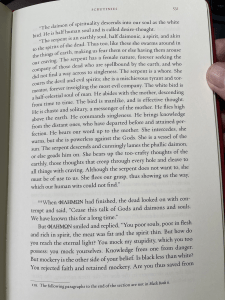
Jung goes so far as to suggest that a man might wear women’s clothes to confront his hidden femininity. He warns that such an act may provoke laughter and ridicule, but he insists that the humiliation is itself transformative. To “become a woman” symbolically allows a man to break free of enslavement to the feminine projected outward onto women.
The ridicule serves as a rite of passage: by accepting mockery, the man embraces what is most despised in himself, and in doing so calls forth the “white bird of the soul.” This inversion of gender performance is not a prescription for social behaviour but an inner drama of individuation, enacted outwardly as a test of limits1.
“Man shall differentiate himself both from spirituality and sexuality. He shall call spirituality mother, and set her between Heaven and earth. He shall call sexuality Phallos, and set him between himself and earth. For the mother and the Phallos are superhuman daimons that reveal the world of the Gods.
Jung insists that humanity is not simply man or woman, but both. To remain only within gendered roles is to confine oneself to artificial barriers. The psyche seeks balance, which can only be achieved when the individual “nurtures the opposite.” For the masculine man this means recognising and accepting the feminine within, even if it feels humiliating or alien.
For the feminine woman, it requires taking up her latent masculine. Without this integration, one remains bound to projections, enslaved to the other sex. Through differentiation, however, the contrasexual elements are internalised, making possible the emergence of the human beyond the merely gendered.
In this light, sex and sexuality are not only biological but archetypal. Sexual polarity mirrors the cosmic polarity of the Pleroma. Erotic attraction itself can be understood as the psyche’s attempt to reunite what has been separated. Yet individuation requires not a regression to unity, but a conscious integration of difference. To accept the contrasexual within is to deepen sexual identity, grounding it in wholeness rather than projection.
Spirituality and sexuality are not your qualities, not things you possess and encompass. Rather, they possess and encompass you, since they are powerful daimons, manifestations of the Gods, and hence reach beyond you, existing in themselves. No man has a spirituality unto himself, or a sexuality unto himself. Instead, he stands under the law of spirituality and of sexuality. Therefore no one escapes these daimons.
Thus Jung holds the paradox: men cannot bear children, women cannot inseminate, yet the soul of each contains the other. Differentiation ensures that life is always tension, never completion. Individuation does not erase sexual difference but situates it within a larger mystery, where biology, psyche, and spirit are woven together.
To become whole is to accept one’s limits while also embracing the otherness within. The Pleroma is the origin and end, but life itself is found in the dance of opposites, where laughter at the ridiculous is but one step on the way to the freedom of the soul.
Endnotes
1. Jung, C. (2009). The Red Book: Liber Novus (Reader’s Edition). New York: W. W. Norton, pp. 225–231.
Leave a Reply