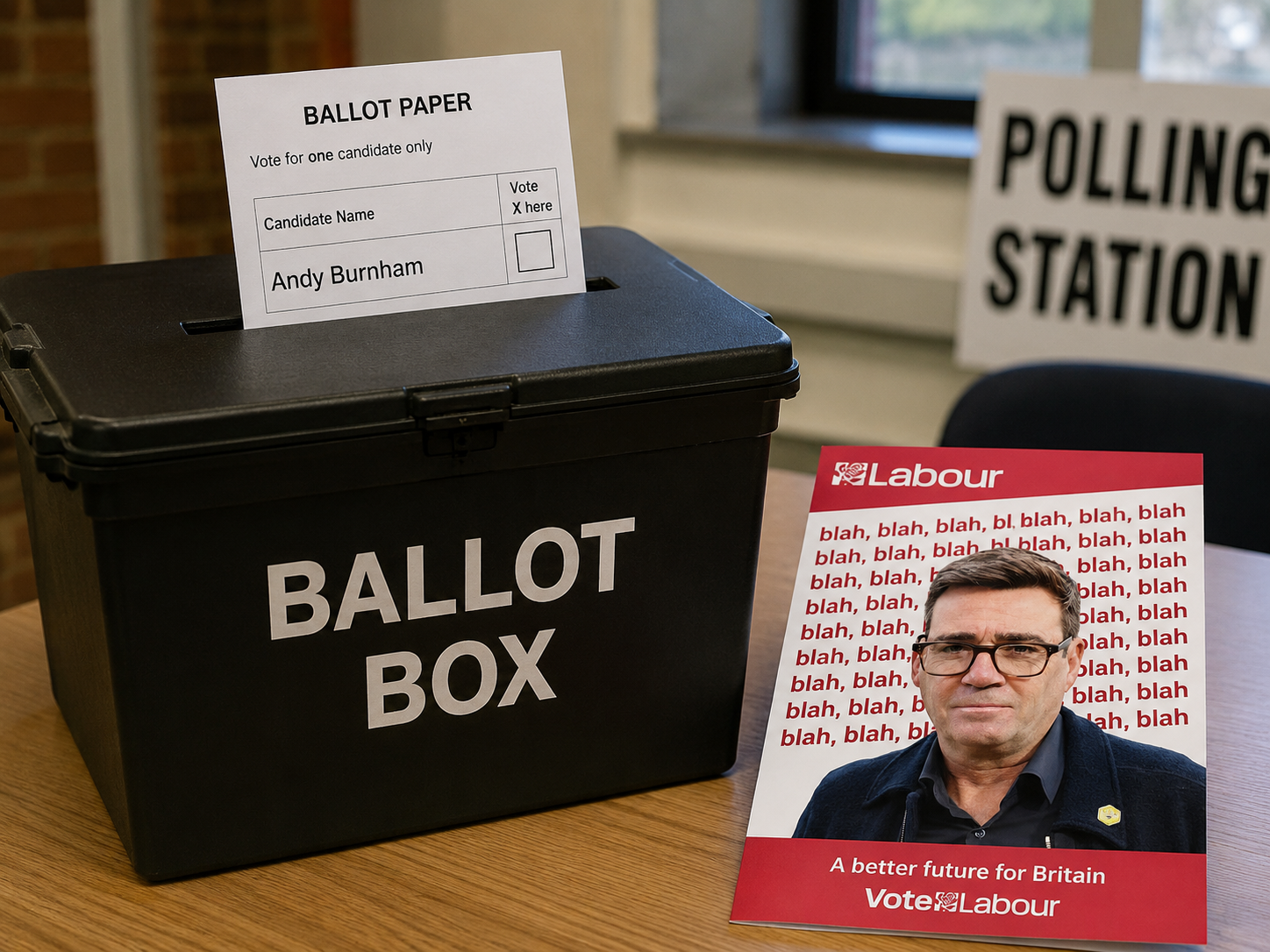
The prospect of Andy Burnham becoming Leader of the Labour Party should be welcomed as an opportunity for debate about the future direction of the country. Instead, it appears increasingly likely that his accession to the leadership will amount to little more than a coronation. That prospect leaves me uneasy.
This is not because I have any particular objection to Andy Burnham as an individual. He has demonstrated considerable political skill as Mayor of Greater Manchester and has become one of the country’s most recognisable advocates of English devolution. The difficulty is that leadership of the Labour Party is not simply another political office. It carries with it the expectation that the successful candidate will seek to become Prime Minister of the United Kingdom.
That raises an obvious question. On what programme?
Beyond broad themes of devolution, transport reform, public ownership and regional investment, it remains unclear what a Burnham-led government would seek to do across many of the issues that dominate public life. There has yet to be a comprehensive statement of policy covering taxation, public spending, immigration, constitutional reform, criminal justice, education, welfare, foreign affairs, defence and the many other questions that define a modern government.
Leadership should not be about personality alone. It should be about the consent of those who are expected to support a programme of government. Labour members deserve the opportunity to examine competing visions, challenge assumptions and understand the consequences of the policies they are being asked to endorse.
There is also a wider constitutional principle at stake.
When the Conservative Party changed leaders while in government, many Labour politicians and activists argued that a change of Prime Minister without a General Election lacked democratic legitimacy. The argument was straightforward: the public had voted for one political leader, not another, and therefore the electorate should be given the opportunity to express its view through a fresh election.
Whether or not one agreed with that position at the time, it established a principle. If that principle was considered important when the Conservatives replaced their leader, it ought to remain important should Labour replace theirs while in government.
To argue otherwise would invite accusations of inconsistency. Constitutional principles should not depend upon which party happens to benefit from them. Either changing the person who occupies Downing Street while commanding a parliamentary majority requires renewed public consent, or it does not. It cannot reasonably be one rule for one party and another rule for its opponent.
This is not an argument against Andy Burnham. Nor is it an argument against Labour. It is an argument for democratic accountability.
If Andy Burnham believes he has a compelling vision for Britain’s future, then he should be given every opportunity to present it. Labour members should have the opportunity to scrutinise it. More importantly, the electorate should have the opportunity to judge it.
The office of Prime Minister carries immense authority. That authority is strengthened when it rests upon a clear electoral mandate founded on transparent policies that have been openly debated. A change of leadership may be perfectly constitutional under our parliamentary system, but constitutions also depend upon conventions, public confidence and political integrity.
If Labour believed that a Conservative change of leader warranted returning to the country, then it would be difficult to justify a different approach were the circumstances reversed. Principles are tested not when they are convenient, but when they apply equally to ourselves.
Whatever happens in the coming weeks, I hope that Labour members are given sufficient information to make an informed judgement about the direction of their party. And if that direction ultimately produces a new Prime Minister without a mandate from the electorate, I hope Labour will apply the same democratic standards that it previously expected of others.
Leave a Reply