
Explore how myth shapes modern life through the insights of Carl Jung and Joseph Campbell, focusing on the interplay of logos, eros, and mythos. This article examines how Western culture compartmentalises thought, feeling, and symbolic meaning, leading to a loss of transformative narratives. It addresses current debates on gender identity—both affirming and critical—and their neglect of mythic, archetypal processes, contrasting these with popular culture examples like Priscilla, Queen of the Desert, which embodies themes of integration and becoming. Featuring Jung’s reflections on the body and Campbell’s call to re-mythologise, the post asks essential questions about identity, embodiment, and the forgotten role of myth in guiding personal and cultural evolution.
What role does myth play in shaping our lives today? For Joseph Campbell and Carl Jung, the answer is unequivocal: myth is not an archaic relic, but a living matrix through which human beings orient themselves to life’s fundamental realities. Yet, modern Western culture—despite its dazzling technological prowess—suffers a profound amnesia of this symbolic dimension. Our public discourses privilege logos—the language of rationality—and often sentimentalise eros—the realm of feeling—while leaving mythos, the archetypal patterns that weave meaning through both, to wither in obscurity.
Campbell once observed that the origin of myth lies in the body. Mythic forms and symbolic motifs, he argued, are not whimsical fantasies but crystallisations of organic life, arising from our physiological processes and existential conditions. In his words, myth “stems from the human body itself, from our own experiences… every mythological story or experience comes from our experiences as human beings in a physical body.” Myths are not escapist fabrications; they are interpretive frameworks that reconcile us to what he called “the mystery that emerges with every human being—namely, what are the possibilities of this particular human life?”
Carl Jung made the same point, though in his characteristically psychological idiom. In his Nietzsche Seminars, he underscores that consciousness cannot sever itself from its somatic roots without courting disaster:
“Because you have a body. If you were a spirit you could be anywhere, but the damnable fact is that you are rooted just here, and you cannot jump out of your skin; you have definite necessities. You cannot get away from the fact of your sex, for instance, or of the colour of your eyes, or the health or the sickness of your body, your physical endurance. Those are definite facts which make you an individual, a self that is just yourself and nobody else.” (Nietzsche Lectures, Vol. 1, p.63)
He continues, with a blunt realism often missing from today’s disembodied ideologies:
“Being in the body you are caught; therefore, the body is such an awkward thing: it is a definite nuisance. All people who claim to be spiritual try to get away from the fact of the body; they want to destroy it in order to be something imaginary, but they never will be that, because the body denies them… The Superman, the self, is the meaning of the earth; it consists of the fact that we are made of earth.” (Nietzsche Lectures, p.64)
For Jung, even our loftiest ideas require incarnation:
“The idea is like an autonomous being that wants a body so much that it even incarnates in the body; one begins to play, to perform the idea, and then people say one is completely mad. The idea has taken possession of one till it is as if one were out of one’s mind.” (Nietzsche Lectures, Vol. 1, p.197)
This is where logos and eros, stripped of mythos, become perilous. Rational discourses and emotive responses—especially in heated debates—lack the mediating depth of symbolic imagination. We see this vividly in current controversies around gender identity. Both affirming and gender-critical positions tend to eschew mythological understanding, reducing the conversation to categories of biology versus self-declared identity. In doing so, they overlook the archetypal drama of transformation, the narrative of the fool who dares, the initiate who suffers, and the hero who integrates.
Campbell warned that the real crisis is not the loss of rationality, but the erosion of symbolic frameworks. Our myths, he insisted, have not disappeared; they have gone unconscious. When myths lose their metaphorical resonance, they harden into dogma or dissolve into literalism. In either case, they fail to nourish the soul.
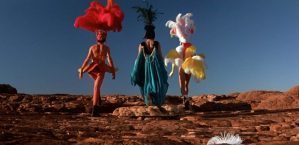 This is why popular culture—films, novels, music—remains a vital theatre for mythic expression. Consider Priscilla, Queen of the Desert. On the surface, it revels in flamboyance and camp excess, but beneath the sequins lies a deeper narrative. Its protagonist, initially caught in the archetype of the “sad transvestite,” does not resolve his journey through a total repudiation of masculinity. Instead, he accepts his role as a father while retaining his creative, feeling-oriented vitality through performance. The film, knowingly or not, enacts a pattern of integration rather than dismemberment: not a denial of the body, but a playful re-imagining of its possibilities.
Contrast this with the dominant discourse today, which often frames identity as a fixed endpoint rather than a process of becoming. The mythic dimension invites us to ask: where is the fool’s daring leap, the trials of initiation, the tension of opposites, and the ultimate synthesis into wholeness? Too much of our public rhetoric affirms identity but neglects transformation. In mythological terms, the quest is not about “being who you are” but about becoming who you are—not a static noun, but a verb of unfolding.
Questions for Re-Mythologising Our Moment
- What myths are animating today’s struggles over the body, identity, and belonging—even when we refuse to name them?
- How do stories of metamorphosis in film, literature, and music reflect or distort these archetypal processes?
- What happens when culture celebrates the mask but forgets the deeper initiation that gives the mask meaning?
- Can we imagine a myth for our time that honours the facticity of the body while allowing creative play with its symbolic possibilities?
- And most urgently: how do we speak of transformation in a language that neither collapses into ideology nor retreats into nostalgia?
Campbell once said, “Mythology is a compendium of metaphors.” If we are to navigate this age of fragmentation, we must recover the grammar of those metaphors—not to regress into old forms, but to craft new myths equal to the magnitude of our condition.
Leave a Reply