But protection and security are only valuable when not excessively cramping to our existence: and in the same way the superiority of consciousness is desirable only if it does not suppress and shut out too much life. As always, life is a voyage between Scylla and Charybdis (Jung, 1966, p. 294).
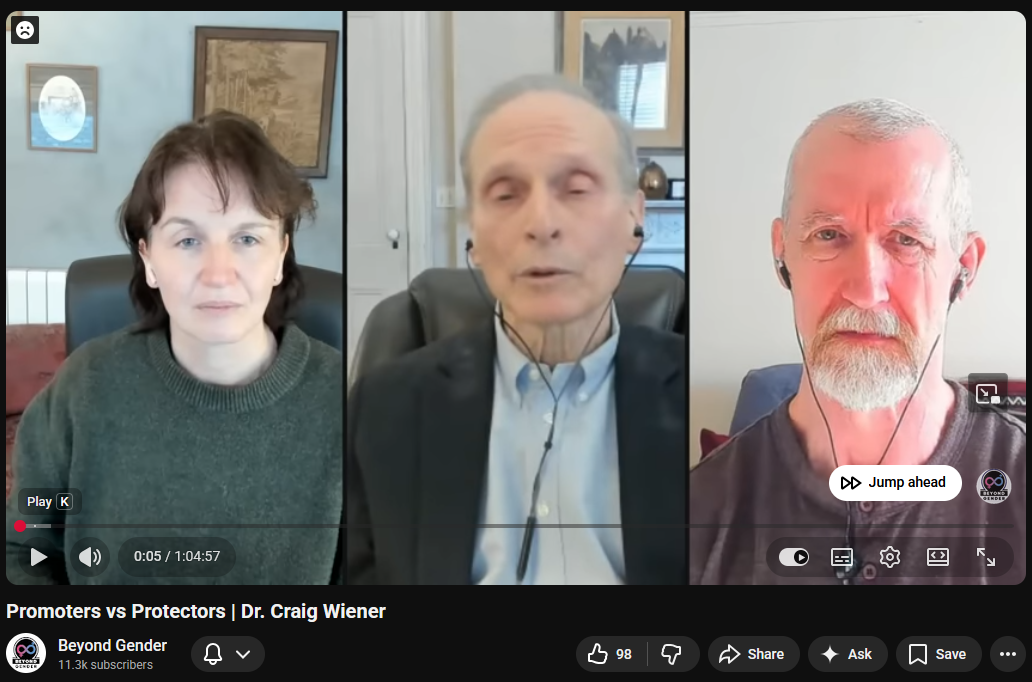
The Beyond Gender discussion with Dr Craig Wiener offers a useful distinction between two broad ways of helping people: protecting them and promoting them.
- Protection means rescue, shelter, comfort, defence, and the reduction of threat.
- Promotion means encouragement, development, challenge, adaptation, and the cultivation of agency.
Wiener’s concern is that modern culture has become too dominated by the protector impulse, especially where distress is quickly medicalised, diagnosis becomes identity, and discomfort is treated as harm. He argues that people need more than rescue. They need to develop the capacity to act, endure, adapt, and participate in the world. In the discussion, this is expressed through repeated contrasts between external explanations and personal agency, between safetyism and resilience, and between indulgent protection and what Wiener calls a “kind and firm” form of promotion.
This is a valuable argument, especially when public discussion is often trapped in blunt oppositions: left versus right, oppressed versus oppressor, victim versus villain, fragile person versus hard-hearted society. The protector and promoter distinction cuts across these categories. It asks a more practical question. Are we helping people by removing difficulty, or are we helping them by strengthening their capacity to meet difficulty? That question matters in parenting, therapy, education, welfare, policing, health, and politics.
Yet there is a limitation in the language of protectors and promoters. It can too easily become another binary. One side appears soft, passive, indulgent, maternal, bureaucratic, and risk-averse. The other appears active, robust, developmental, paternal, entrepreneurial, and freedom-oriented. Once framed in this way, the temptation is to choose sides.
- The protector becomes the anxious rescuer.
- The promoter becomes the courageous realist.
The discussion then risks reproducing the very simplification it seeks to escape.
This is where Carl Jung’s model of Psychological Types offers a more sustained way of thinking. Jung’s typology was not simply a system for sorting people into categories. It was a theory of psychic balance. He proposed that people differ in their dominant orientation to the world, but that each orientation is partial. Each has value. Each has danger. Each needs compensation from its opposite. Jung’s model therefore helps us understand why societies need both protectors and promoters, and why both become dangerous when they imagine themselves complete.
From Two Camps to a Living System
In Psychological Types, Jung described two broad attitudes, introversion and extraversion, and four main functions: thinking, feeling, sensation, and intuition. Later adaptations, including the Myers-Briggs Type Indicator, translated aspects of this model into the familiar four-letter type codes. The MBTI is not identical with Jung’s original theory, and it should not be treated as a clinical diagnosis or a complete map of the psyche.
The Myers-Briggs Company itself describes the MBTI as an assessment of preferences in four dimensions:
- extraversion or introversion,
- sensing or intuition,
- thinking or feeling,
- and judging or perceiving.
For present purposes, the value of MBTI language is illustrative. Popular MBTI-derived systems speak of groups such as Sentinels, who are associated with the Observant and Judging preferences, and Explorers, who are associated with the Observant and Prospecting preferences. Sentinels are described as practical, grounded, order-seeking, security-oriented, and reliable. Explorers are described as spontaneous, adaptable, tool-oriented, and comfortable responding to uncertain situations as they arise.
Older temperament language also uses terms such as Guardians for those who maintain continuity, duty, care, and structure. Popular typology language uses terms such as Adventurer and Prospecting to describe more flexible, experimental, open-ended orientations. These labels should not be read as fixed identities. They are better understood as symbolic shorthand for recurring social functions. Some people are naturally drawn to keeping things stable. Others are drawn to testing limits, improvising, making, exploring, disrupting, and discovering what has not yet been tried.
Every functioning society needs both. A society without nurses, teachers, carers, administrators, police officers, maintenance workers, safeguarding professionals, and reliable public servants would be anarchic. It would lack continuity, memory, routine, duty, and protection for the vulnerable. Children, older people, disabled people, isolated people, and those exposed to exploitation would be left too exposed to predatory actors, market fads, ideological enthusiasms, and institutional neglect. Protection is not a moral failure. It is one of the foundations of civilisation.
But a society without entrepreneurs, artists, engineers, inventors, critics, explorers, comedians, dissidents, experimenters, and disrupters would become sclerotic. It would repeat what it already knows. It would preserve institutions long after they had ceased to serve a living purpose. It would confuse order with life. It would regard every departure from routine as a threat, every new practice as irresponsibility, and every imaginative leap as delinquency. Promotion is not selfishness. It is the principle by which a society renews itself.
The Jungian Problem of One-Sidedness
Jung’s real contribution is not that he gives us better labels. It is that he warns against one-sidedness. Consciousness, for Jung, must choose a direction. To choose one way of seeing is to exclude other ways of seeing. This is necessary. No person and no institution can attend to everything at once. A nurse in an emergency ward, a teacher in a classroom, a police officer at a public event, and an artist making new work each have to privilege certain kinds of attention. The problem arises when that necessary selectivity hardens into a total worldview.
Jung argued that the excluded side does not disappear. It sinks into the unconscious and returns as compensation, disturbance, fantasy, projection, irritation, or symptom. In accessible summaries of Jung’s typology, one-sidedness is repeatedly presented as a central problem: an overdeveloped function or attitude can become unbalanced, while the underdeveloped function may return in shadow form.
Jung’s functions have a compensatory capacity, with the unconscious function helping to balance unhealthy one-sided conscious functioning. For Jung, psychological disturbance reflected imbalance, with neurosis overemphasising characteristic traits of the personality.
This has direct relevance to the protector and promoter debate. A one-sided protector culture becomes anxious, controlling, bureaucratic, censorious, and suspicious of ordinary difficulty. It begins with care but can end in suffocation. It may protect people from danger, but also from experience, error, consequence, and maturation. It may become so concerned with preventing harm that it cannot distinguish harm from disappointment, disagreement, frustration, shame, embarrassment, or the ordinary pain of learning.
A one-sided promoter culture has the opposite pathology. It becomes restless, impatient, hard, exploitative, and indifferent to dependency. It celebrates risk but forgets that risk is not distributed equally. It praises agency but ignores the fact that some people are genuinely constrained by illness, poverty, age, violence, disability, coercion, trauma, or lack of support. It tells people to adapt while leaving them exposed to those who manipulate, sell, hustle, recruit, or exploit. It may speak the language of freedom while quietly abandoning those who most need protection.
Jung’s model gives us a way to hold these opposites without collapsing into either. Protection and promotion are not enemies. They are compensatory functions. Each corrects the excess of the other. Protection without promotion becomes dependency. Promotion without protection becomes abandonment. Protection gives continuity, containment, and care. Promotion gives movement, challenge, and renewal. A healthy person needs both. A healthy family needs both. A healthy society needs both.
Roles, Archetypes, and Civic Imagination
Jung also helps because he understood that social roles are never merely technical. They carry symbolic force. A teacher is not only a person delivering a curriculum. A nurse is not only a person carrying out care protocols. A police officer is not only an agent of law. An entrepreneur is not only someone creating a business. An artist is not only someone producing cultural goods. Each role constellates images, expectations, fears, loyalties, and fantasies. In Jungian terms, where there is a role, there is an archetypal pattern.
This does not mean that every nurse is personally a Mother archetype, every police officer a Warrior, every entrepreneur a Trickster, or every artist a Visionary. That would be crude. It means that recurring social roles attract deep symbolic associations. People project hopes and resentments onto them. The teacher may become the guardian of civilisation or the agent of social control. The police officer may become the protector of order or the threatening face of authority. The entrepreneur may become the creative builder or the predatory opportunist. The artist may become the renewer of perception or the irresponsible narcissist.
Jungian thought asks us to notice these projections. When social groups become one-sided, they often demonise the role they need most. A highly protective culture may demonise the adventurer, the entrepreneur, the sexual dissident, the comic, the artist, the sceptic, the irreverent scientist, or the awkward questioner. A highly promotional culture may demonise the guardian, the rule-maker, the carer, the administrator, the safeguarding officer, the parent who says no, or the citizen who asks what happens to the vulnerable when everything is disrupted.
Here the MBTI-derived language of Sentinels and Explorers is useful as a public metaphor:
- The Sentinel asks: what must be preserved, protected, maintained, and made reliable?
- The Explorer asks: what must be tried, tested, loosened, improvised, or reimagined?
- The Guardian asks: who is at risk if we move too quickly?
- The Adventurer asks: what life is lost if we never move at all?
- The Prospector asks: what possibility is concealed in this uncertainty?
- The protector asks: what could go wrong?
- The promoter asks: what could become possible?
A mature culture needs to hear all of these questions. It should not allow any one of them to become sovereign.
Protection Is Not the Enemy
One weakness in some critiques of safetyism is that they can sound as though protection itself is the problem. It is not. Protection is one of the most basic moral functions of any decent society. The vulnerable are often vulnerable because they cannot protect themselves adequately. Children need adults. Patients need clinicians. Victims of crime need law. People with serious mental distress need containment and care. Workers need protection from dangerous workplaces. Citizens need protection from violence, fraud, abuse, and institutional negligence.
Protection becomes pathological when it expands beyond its proper range and begins to treat all discomfort as injury, all disagreement as violence, all risk as abuse, and all limits as oppression. That is the point Wiener is making in the podcast when he worries about the collapse of distinctions between hurt and harm, and when he argues that diagnosis can become a “thought stopper” rather than an invitation to deeper psychological inquiry.
But the answer to overprotection is not underprotection. That would merely reverse the one-sidedness.
A society that strips away protective institutions in the name of agency leaves people vulnerable to those who know how to exploit freedom better than others know how to use it. Markets, digital platforms, therapeutic fashions, political movements, ideological subcultures, and commercial wellness industries all contain forms of promise. Some are useful. Some are manipulative. Some offer real development. Others sell identity, certainty, belonging, or salvation to people in distress.
Without guardianship, people are not liberated into pure agency. They are often delivered into the hands of more agile actors. The task is not to choose between protection and promotion. The task is to ask what kind of protection makes agency possible, and what kind of promotion strengthens people without abandoning them.
Promotion Is Not Cruelty
The reverse also matters. Promotion is easily caricatured as harshness. In the transcript, Wiener repeatedly resists this. His preferred model is not cold discipline, but “kind and firm” socialisation. The point is to help people internalise limits and consequences without humiliating them, alienating them, or making development feel like rejection. He uses examples from parenting to show that a child can be helped to understand why limits exist, rather than simply experiencing them as anger or dislike.
This is a psychologically important distinction. Promotion is not the demand that people simply toughen up. It is the art of helping people become more capable. That requires encouragement, modelling, continuity, patience, and trust. It also requires enough firmness to prevent care from collapsing into indulgence. A child who is never frustrated cannot learn frustration tolerance. A student who is never corrected cannot learn discipline. A citizen who is never expected to consider the consequences of action cannot become fully responsible. A client who is never invited to examine the meaning of a symptom may become attached to the symptom as identity.
Here again Jung deepens the discussion. Individuation is not indulgence of the ego. It is not simply becoming whatever one currently feels oneself to be. Nor is it conformity to external rules. It is a long process of integration, in which the conscious personality gradually encounters what it has excluded. The over-adapted person has to recover imagination. The chaotic person has to develop structure. The sentimental person has to develop discrimination. The rationalist has to recover feeling. The intuitive has to become grounded. The dutiful person has to recover desire. The rebel has to learn responsibility.
This is why Jung’s typology is more durable than a simple protector-promoter divide. It does not ask which side is correct. It asks what has been overdeveloped, what has been neglected, and what compensation is now required.
The Social Need for Regeneration
Jung’s concern with balance was not merely private. His account of types has social implications. One frequently cited passage from Psychological Types states that it would be unjustifiable to regard one type as more valuable than another because the types are mutually complementary, and their differences generate the tension that both individuals and society need for the maintenance of life.
That sentence is central to the argument. Social life depends on tension. Not destructive conflict, but living polarity. A society needs people who remember and people who imagine. It needs people who care for the frail and people who build new institutions. It needs people who maintain standards and people who expose dead conventions. It needs people who can say “not so fast” and people who can say “not like this forever.”
When either side wins completely, society loses balance. If the guardians and sentinels dominate without challenge, culture becomes over-regulated, anxious, moralistic, and afraid of novelty. It protects the group by slowly draining it of vitality. If the adventurers and prospectors dominate without restraint, culture becomes unstable, restless, fashionable, and vulnerable to fraud. It celebrates renewal while dissolving the bonds that make renewal meaningful.
The healthiest communities are not those without conflict. They are those that can ritualise and civilise the conflict between continuity and change. They know when to protect the hearth and when to open the door. They know when to keep the flame steady and when to carry fire into new ground. They understand that the nurse and the artist, the teacher and the entrepreneur, the police officer and the dissident, the administrator and the inventor are not merely competing social types. They are parts of a wider ecology.
Against Moral Sorting
The most useful outcome of the protector-promoter discussion would be to move away from moral sorting. Protectors are not necessarily weak, sentimental, or controlling. Promoters are not necessarily brave, realistic, or liberating. Each orientation can be noble. Each can become corrupt. The protector can become the rescuer who needs dependency in order to feel virtuous. The promoter can become the liberator who refuses to notice the casualties of disruption. The guardian can become rigid. The adventurer can become reckless. The sentinel can become authoritarian. The prospector can become opportunistic.
Jung would ask us to look for the shadow. What does the protector refuse to know about protection? Perhaps that care can become domination. What does the promoter refuse to know about promotion? Perhaps that freedom can become exposure. What does the guardian refuse to know about order? Perhaps that too much order kills adaptation. What does the adventurer refuse to know about novelty? Perhaps that the new can be just as false, manipulative, and deadening as the old.
This is the level at which public discussion needs to operate. Not at the level of slogan, tribe, or diagnosis, but at the level of psychic and civic balance. The question is not whether we should protect or promote. The question is what kind of person, institution, or society we become when either function is allowed to rule alone.
A More Generous Frame
The Beyond Gender discussion raises important concerns about medicalisation, diagnosis, identity, parenting, safetyism, and agency. It is right to ask whether some forms of contemporary helping have made people less able to act. It is right to ask whether diagnostic labels sometimes close inquiry rather than opening it. It is right to ask whether a culture built around harm prevention can lose the ability to distinguish pain from damage.
But a Jungian reading asks us to go further. It asks us not to replace one one-sidedness with another. A society cannot live by protection alone. Nor can it live by promotion alone. It needs the conserving and the renewing functions. It needs those who defend the vulnerable and those who challenge stagnation. It needs institutions that protect people from exploitation, and it needs enough openness for people to test themselves against reality.
The deeper issue is not protection versus promotion. It is the maintenance of a living balance between care and courage, continuity and change, shelter and exposure, belonging and individuation. Jung’s Psychological Types model remains useful because it recognises that difference is not an error to be corrected. It is the source of psychic and social energy. The aim is not to eliminate the opposite, but to enter into a more conscious relationship with it.
That may be the more constructive lesson. Protectors need promoters to prevent care becoming control. Promoters need protectors to prevent freedom becoming abandonment. Guardians need adventurers to prevent order becoming sclerosis. Adventurers need guardians to prevent novelty becoming chaos. Sentinels need prospectors to see possibility. Prospectors need sentinels to give possibility form.
A mature society does not ask which type should win. It asks how the whole can remain alive.
Jung, C. G. (1966). The Practice of Psychotherapy (2nd ed.). Routledge.
Leave a Reply