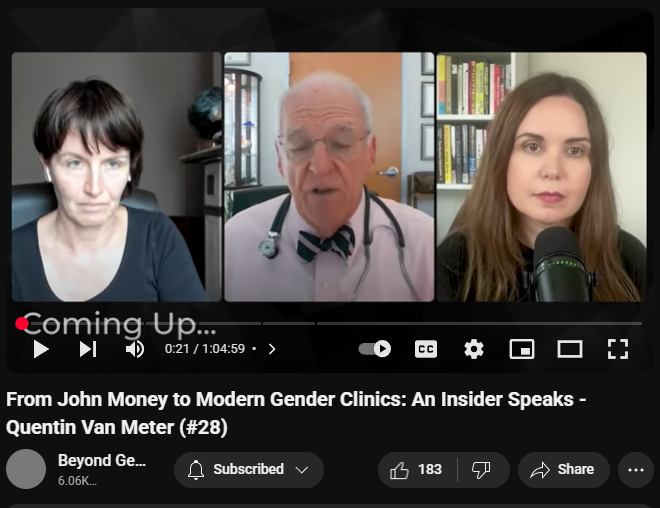
This post examines a high-profile discussion on gender medicine through Carl Jung’s framework of psychological types, exploring how introversion, extraversion, sensing, intuition, thinking, and feeling shape arguments and decision-making. It explains how Sensing, Thinking and Feeling approaches emphasise data, risk, and closure, while Intuition, Feeling and Prospecting perspectives prioritise narrative, ethics, and open possibilities. Using MBTI as a practical orientation guide, the piece highlights how different functional preferences influence clinical, therapeutic, and policy debates. By integrating Jung’s insights on balance and the acceptance of opposites, it calls for a more holistic, type-aware approach to public discourse and medical decision-making.
The discussion with paediatric endocrinologist Quentin Van Meter is more than a dispute about data and protocols. It is an encounter between psychological attitudes and functions. Read through Jung’s framework of introversion and extraversion, sensing and intuition, thinking and feeling, the exchange shows how typological preferences shape what counts as evidence, what feels ethical, and which interventions appear warranted. As a practical shorthand, the MBTI “Judging–Prospecting (Perceiving)” lens also helps to map conversational style: closure-seeking versus possibility-seeking. The point is not to type individuals, but to recognise functional emphases driving the debate. When a complex culture war crystallises into a quarrel over “standards of care,” typology clarifies why people talk past one another. “You achieve balance… only if you nurture your opposite,” Jung wrote; without that effort, positions harden, and the field polarises.
At one pole of the dialogue stands a pronounced ST (sensing–thinking) stance. Van Meter repeatedly privileges measurable physiology, adverse-event profiles, and operational definitions over self-report, insisting there is “no biologic basis” for an “incongruent gender identity,” that benefits are not sustained, and that cross-sex hormones and surgeries carry predictable harms such as sterility and sexual dysfunction. This is classic Sensing-Thinking language: concrete reference classes, risk accounting, and an allergy to ambiguous endpoints. In Jungian terms, it is sensation feeding thinking with somatic facts and clinical sequelae. Obviously, in clinical situations, there is good reason for this when avoiding harm and risk are the priority.
 Sensation–Thinking also shapes his critique of methods. He questions large online surveys and retrospective self-ratings, pressing instead for face-to-face examination, baseline mental-health evaluation, and clear outcome measures. This privileging of proximal observation over distal inference is a sensate corrective to intuitive overreach. “Self-reporting,” he argues, cannot replace operational diagnostics; a Sensing-Thinking ear hears “stories,” but a Sensing-Thinking eye asks for urological or gynaecological indices and cognitive endpoints.
Opposite him, the interviewers often occupy an Intuition-Feeling coloured ethical-narrative register. Their concern with social pressure, institutional capture, and harms that radiate through families and culture is intuitive–feeling in tone: pattern-spotting across systems, allied to value-laden language about truth-telling, protection, and the integrity of adolescence. When they challenge the “pause” metaphor for puberty blockers, they do so through developmental gestalt and lived-trajectory imagination: what happens to a body and a brain that never undergoes ordinary puberty and later receives cross-sex hormones. That is Introverted intuition and extroverted feeling reasoning, drawing a whole-life arc and asking what kind of adult such a pathway creates.
Introversion and extraversion surface in how authority is located. Van Meter’s line invokes an inward standard anchored in disciplinary canons and long memory of endocrine practice—introverted thinking supported by sensation. The hosts lean to extroverted feeling and intuition, testing claims against communal ethics, institutional climates, and public-square stakes. Both are needed.
Jung warned that a one-sided attitude “runs into the artificial barriers” of its own imagination and peers’ expectations; only balance keeps us from transgressing limits without noticing. Debate about medicine becomes ideological when either camp refuses its opposite.
Judging versus Prospecting (Perceiving) clarifies tempo. The Sensing-Thinking-Judging rhythm wants closure: clear thresholds, reproducible endpoints, and the right to suspend or cease interventions when those conditions fail. The Intuition-Feeling-Prospecting rhythm holds a wider horizon of possibilities and context, sceptical of technocratic finality yet alert to moral drift. Where the clinic demands decisions, Judging presses for binding criteria; where culture demands reflection, Prospecting resists premature foreclosure. The friction is visible when “standards of care” are criticised as ideologically driven guidelines. The Judging eye hears a failure of rigour; the Prospecting ear hears room for clinical discretion and person-centred nuance, yet it can drift into normless permissiveness if it will not specify limits.
The medical–therapeutic divide in the exchange is really a functional split. Medical intervention is framed in Sensing-Thinking-Judging: what blocks or induces which physiological cascades, what risks accumulate, what somatic functions are irreversibly altered. Thus, the objection that puberty suppression at the normal developmental window may impair bone accrual and neuro-cognitive maturation, and that a high proportion progress to cross-sex hormones—what starts as a “pause” functions as a track switch.
Therapeutic engagement, by contrast, is an Intuition-Feeling-Prospecting space: family systems, identity development, meanings and myths, the slow work of integration. In Jung’s language, therapy seeks the “transcendent function,” a third thing that arises from sustained tension of opposites. Policy that collapses the therapeutic into the medical, forecloses that function too soon.
Jung’s own counsel on sexed opposites belongs here, precisely because the public quarrel often oscillates between biological reductionism and disembodied idealism. In Liber Novus he observes that “humankind is masculine and feminine, not just man or woman,” and that psychological completeness requires accepting the contrasexual principle within. In individuation terms, the cultural argument about sex and gender is a displaced struggle with anima/animus and shadow. When this inner dialectic is refused, the outer field becomes the stage for absolutised claims. The work, Jung says, is to “nurture your opposite,” not to annihilate it.
An ethics of clinical restraint follows naturally from typological integration. Sensation must inform intuition; intuition must be tested against sensation. Thinking must cost itself against feeling; feeling must be educated by thinking. Otherwise, Sensing-Thinking-Judging can become punitive literalism, and Intuition-Feeling-Prospecting can become boundless romanticism.
“Man lives in two worlds… the inner is as infinite as the outer,” Jung reminds us; policy that honours only one produces one-sided harm. A culture that keeps both worlds in view is less likely to medicalise what requires meaning, and less likely to psychologise where the body sets real limits.
MBTI as a rubric helps non-specialists orient. If you notice your own Judging impulse tightening into premature closure, borrow a Prospecting question before deciding. If your Prospecting tolerance for ambiguity drifts into indecision while bodies are at stake, borrow a Judging boundary. If your Sensing focus on immediate, measurable effects makes you dismiss narratives, borrow an Intuitive scan of the larger developmental arc.
If your Intuitive love of pattern blinds you to base-rates and lab values, borrow a Sensing check. If your Thinking analysis cools empathy, borrow a Feeling appraisal of lived cost. If your Feeling concern for harm quiets your scrutiny of causal claims, borrow a Thinking audit. In short: let functions collaborate rather than compete because in contested areas “the soul demands your folly, not your wisdom”—your willingness to stand in the tension long enough for a better third to appear.
Jung once put the therapist’s task as making the unconscious conscious. That line has become a cliché, but it points to a civic method for our debate. Before we escalate protocols, bring shadow material to awareness: institutional incentives, professional prestige, social contagion, despair and dysphoria, parental fear, and the hope of relief. Then test proposals against both worlds—the inner meanings we owe attention to and the outer constraints bodies insist on. “Until you make the unconscious conscious, it will direct your life, and you will call it fate.” Public policy that neglects either pole ends by calling its own one-sidedness destiny.
If we can hold a centre where types and functions meet—think of Hestia’s hearth more than Prometheus’s torch—we can lower the emotional temperature while raising the standard of care. The point of such a hearth is not to choose for others, but to host the difficult conversation where sensation can speak to intuition, thinking can speak to feeling, and judging can confer with prospecting until a genuinely integrative path emerges.
Leave a Reply