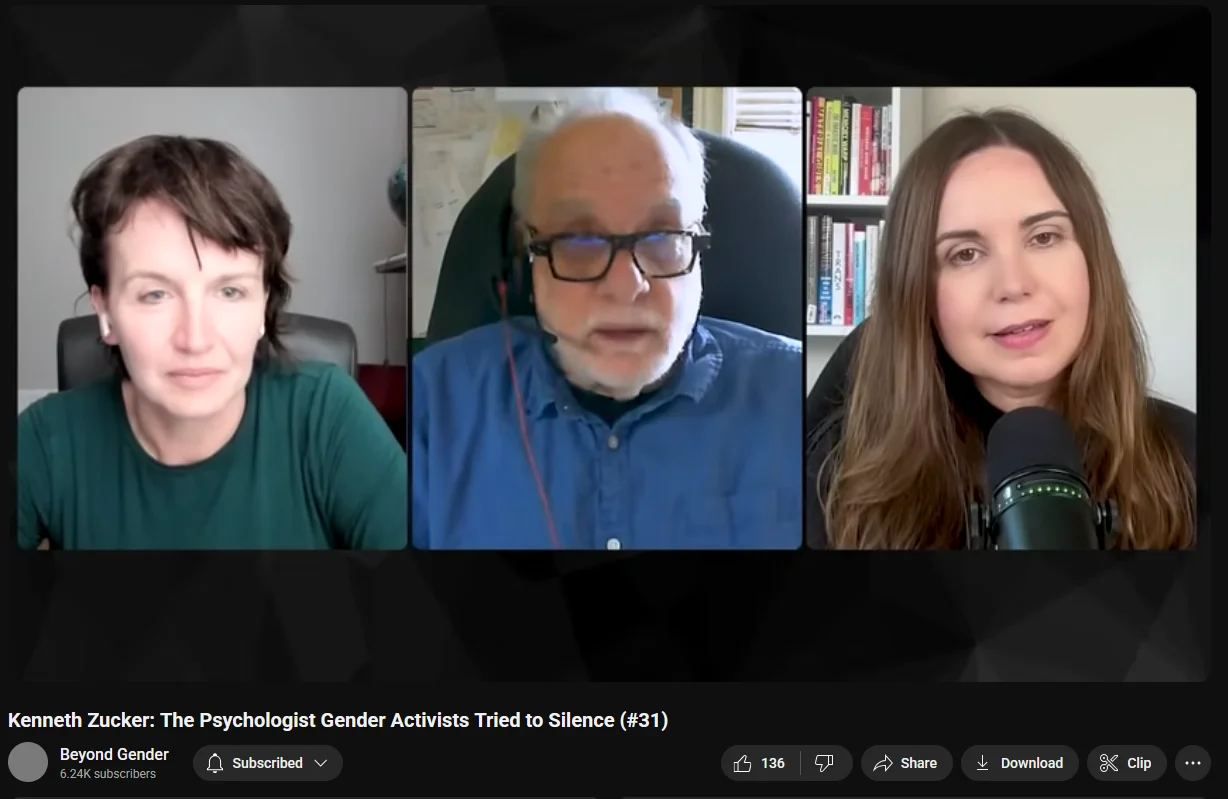
This review of the Beyond Gender episode with Kenneth Zucker explores the tension between phenomenological and hermeneutical approaches to gender identity. It shows how phenomenology underpins the affirming model, treating lived experience as final truth, while Jung’s hermeneutical depth psychology situates gender within the body and symbolic archetypes. The summary highlights Kenneth Zucker’s contested clinical role, Jung’s insistence that psyche and body are inseparable, and the consequences of treating gender identity as a destination rather than a symbolic bridge toward integration.
The Beyond Gender episode foregrounds the clash between phenomenological and hermeneutical approaches to psychology, particularly in the controversies surrounding Kenneth Zucker’s clinical work.
The phenomenological model, as the episode makes clear, underpins the affirming approach to gender identity. Identity is treated as a self-evident truth of consciousness. As the disucssion summarises: “The therapeutic frame of the affirming model is essentially phenomenological, where the lived experience of the client is treated as primary and authoritative”1. This means the therapist brackets interpretation and validates the declaration as final. Applied in clinical settings, this becomes the justification for rapid affirmation, with little exploration of unconscious or symbolic material.
By contrast, the hermeneutical and depth psychological model—with which Zucker’s detractors accused him of aligning—treats declarations not as endpoints but as entry points. Identity statements are read as symptoms, symbols, or archetypal expressions of deeper psychic conflict. Integration, rather than affirmation, becomes the task.
Carl Jung’s writings sharpen this contrast. In The Red Book he insists that the psyche is never separate from the body. He confronts the paradox of gender symbolism, noting that men who wear women’s clothes risk ridicule: “He who wants to be pregnant in the body is ridiculous… for only a woman can be pregnant”2. For Jung, this is not a judgement of worth, but a recognition that biological sex grounds psychic symbolism. The archetypes of anima and animus are not literal inner genders but symbolic figures, bridges across opposites, that lead the psyche toward integration. They are thresholds of transformation, not destinations for identity.
In his Nietzsche’s Zarathustra lectures, Jung further clarifies this grounding. He observes that consciousness is narrow, “restricted by the body” which anchors awareness in time and space. He warned against living only in abstractions: “The more the psyche leaves the body to itself, the more the body goes wrong.” Most decisively, he declared: “The body is the guarantee of consciousness, and consciousness is the instrument by which meaning is created. Since there is no consciousness without body, there can be no meaning without the body”3. This culminates in his counsel: “Go back to the body, go into the body, and then everything will be right, for there the greatest intelligence is hidden. Out of that living body everything originally has come”4.
The consequence of the phenomenological model, as the Beyond Gender discussion noted, is a flattening of identity into surface declarations. By treating experience as self-sufficient, it risks neglecting both the biological grounding of sex and the symbolic archetypal mediation of gender. In such a framework, gender identity becomes a static endpoint, rather than part of an evolving process of individuation.
The hermeneutical alternative does not negate experience but situates it within the symbolic depth of psyche and the materiality of the body. Where phenomenology stresses immediacy, hermeneutics stresses integration; where affirmation validates, depth psychology interprets. Jung’s insights from The Red Book and his Nietzsche lectures converge: identity is not a self-declared destination but a bridge, grounded in the body and illuminated by symbol, leading toward greater individuation.
Endnotes
1. Beyond Gender: Kenneth Zucker – The Psychologist Gender Activists Tried to Silence.
2. Jung, C. G. (2009). The Red Book: Liber Novus. “He who wants to be pregnant in the body is ridiculous… for only a woman can be pregnant.”
3. Jung, C. G. (1989). Nietzsche’s Zarathustra: Notes of the Seminar Given in 1934–1939, Part 1, p. 349–350.
4. Ibid., p. 370.
Leave a Reply