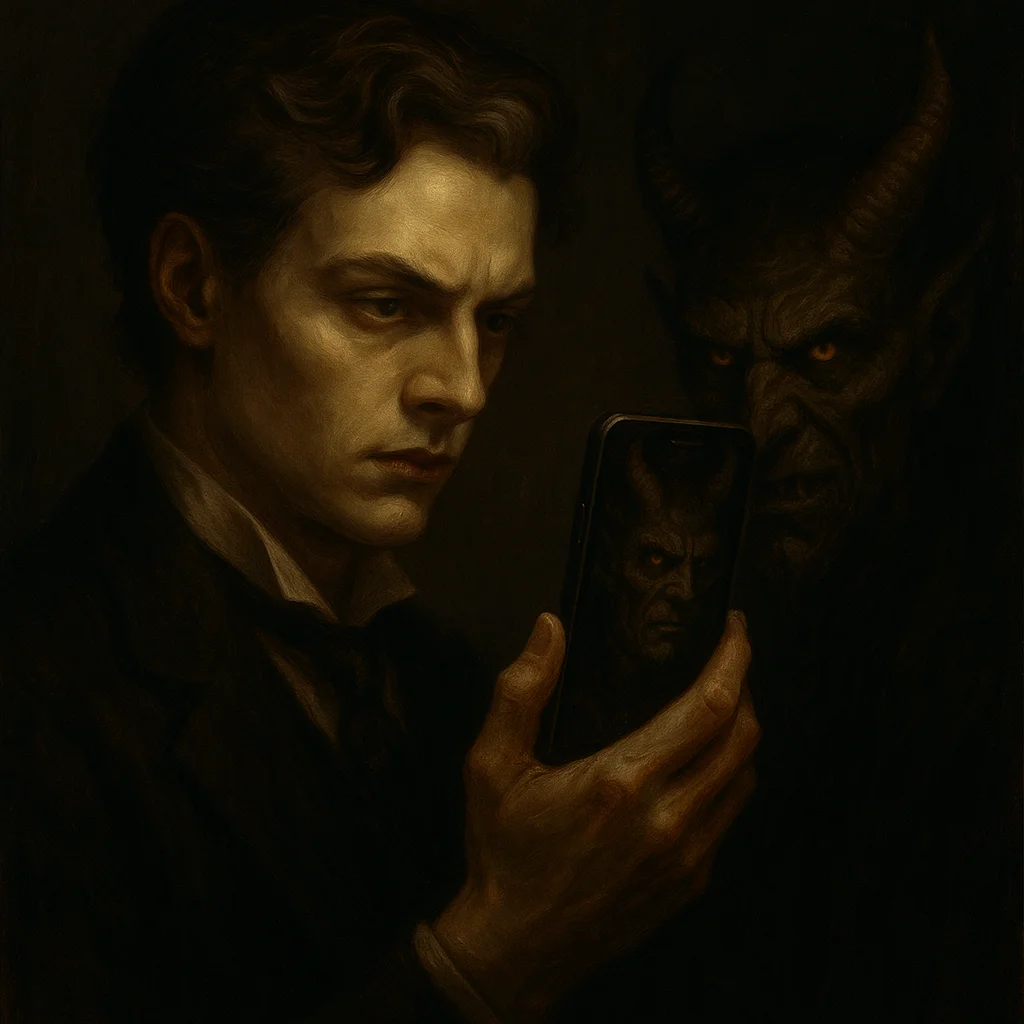
The blog explores the symbolic role of mirrors in myths and fairy tales, linking them to the modern “black mirror” of smartphones. Drawing on Jung and Marie-Louise von Franz, it examines how screens trap us in illusions of persona, shadow, and fantasy.
In the old stories, mirrors are never neutral. They are enchanted, dangerous, and transformative. From the Snow Queen’s shard of glass that distorts reality, to Narcissus gazing into the pool, to countless tales of mirrors that trap souls or reveal spirits, the mirror appears as a threshold between ordinary life and a shadowed, symbolic world. They warn us that reflection is never simple. It can illuminate truth, but it can also deceive and destroy.
Today, those tales have returned with new force. The smartphone is a black mirror, glowing in every hand. It is both tool and talisman, but also a portal possessed by the demons of image. The psychological impact of this has not yet been fully explored. Most people are extraverted by temperament, oriented outward to the social world. Yet smartphones demand introverted capacities: reflection, discrimination, symbolic thinking, and a capacity to distinguish image from essence. Those unprepared are swept into the dreamworld of curated perfection, endless scrolling, and illusory identities. It is no surprise that so many fall prey to the demons of the mirror.
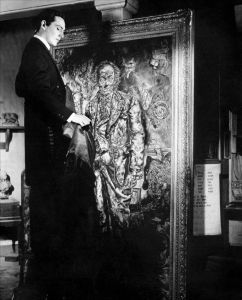
As Jung observed – and which has become an often cited meme – “Who looks outside, dreams; who looks inside, awakes” (Collected Works, Vol. 11). The problem of the black mirror is that it makes outward images masquerade as inner truths. We are surrounded by reflections that present themselves as reality, but which are, in fact, masks—forms of the persona mistaken for the self.
Jung warned: “The persona is a complicated system of relations between individual consciousness and society… a kind of mask, designed on the one hand to make a definite impression upon others, and on the other to conceal the true nature of the individual” (Two Essays on Analytical Psychology, CW 7). When the mask is confused with the soul, the mirror becomes a trap.
Marie-Louise von Franz emphasised that mirrors in fairytales symbolise confrontation with the unconscious. In her analysis of Snow White, she noted that the queen’s magic mirror is “an image of the shadow—of the truth the ego does not want to admit” (Shadow and Evil in Fairy Tales, 1995). The mirror exposes what is denied, and the ego reacts with envy, rage, or despair. Today, social media feeds perform the same function: they mirror back not only idealised perfection but also our envy, insecurity, and longing. The Kardashians, as a cultural phenomenon, embody the archetype of glamour, beauty, and excess. They appear as modern mirror queens—personae so polished that they compel endless projection of admiration and resentment. To mistake these images for reality is to fall into the queen’s fate: possession by vanity and rivalry.
The archetypes also appear in the worlds of anime and gaming. Jung described the anima and animus as contrasexual figures—projections of the inner feminine in men, and the inner masculine in women. These figures often emerge in dreams or fantasies as uncanny, alluring, or dangerous companions. Anime characters and gaming avatars function as collective anima/animus projections: hyper-stylised, otherworldly, embodying traits of beauty, power, or innocence that pull viewers into fantasy.
Von Franz observed that when the anima is not recognised as an inner figure but is mistaken for an outer reality, it can lead to “enchantment, addiction, and projection” (Anima and Animus, 1980). The endless scroll of anime icons or gaming skins can thus act as mirror-traps: dream figures mistaken for reality, archetypes consumed as entertainment rather than integrated as inner symbols.

Superhero movies play a similar role. Jung wrote that “the shadow is that hidden, repressed, for the most part inferior and guilt-laden personality whose ultimate ramifications reach back into the realm of our animal ancestors” (Aion, CW 9ii). Modern heroes like those from DC and Marvel embody both shadow and persona: perfected, idealised bodies and powers, but haunted by hidden traumas or destructive doubles.
Batman’s Joker, Spider-Man’s Venom, or Iron Man’s destructive hubris all show the shadow breaking through the mask of perfection. Audiences project their own disowned impulses into these figures, but the medium of film and social media recycles them endlessly as spectacle. The work of integration—the difficult confrontation with one’s own shadow—is avoided, replaced by consumption of shadow-images in the mirror-world of the screen.
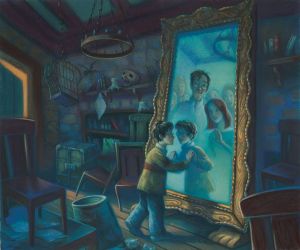
Von Franz reminded us that fairy tales are “the purest and simplest expression of collective unconscious processes” (Introduction to the Interpretation of Fairy Tales, 1970). When mirrors appear in those tales, they demand that the hero distinguish truth from illusion. Today, the same challenge is collective.
The smartphone reflects back endless masks, shadows, and anima/animus figures. For the extraverted majority, unused to navigating symbolic reality, this becomes a psychic trial. Without preparation, they are overwhelmed, mistaking fantasy for selfhood, persona for soul.
In the Red Book, Jung warned that images are autonomous powers: “The images of the unconscious place a great responsibility upon a man. Failure to understand them, or to come to terms with them, deprives him of his wholeness and imposes a painful fragmentariness on his life” (CW 9i). This is precisely the danger of the black mirror. To treat its images literally is to fragment the soul. To see them symbolically, however, is to begin the work of individuation—integrating shadow, anima/animus, and persona into a deeper wholeness.
The old tales remind us that reflection is powerful and perilous. Snow White’s mirror reveals envy. Narcissus’s pool reveals vanity. The Snow Queen’s glass reveals cynicism and distortion. Today’s black mirror shows us perfection, fantasy, and dream-images—but also our longing, shadow, and denial. The task is not to smash the mirror, but to learn to look through it. Only then can we resist the demons of the black mirror and reclaim the living soul beneath the surface of endless images.
Leave a Reply