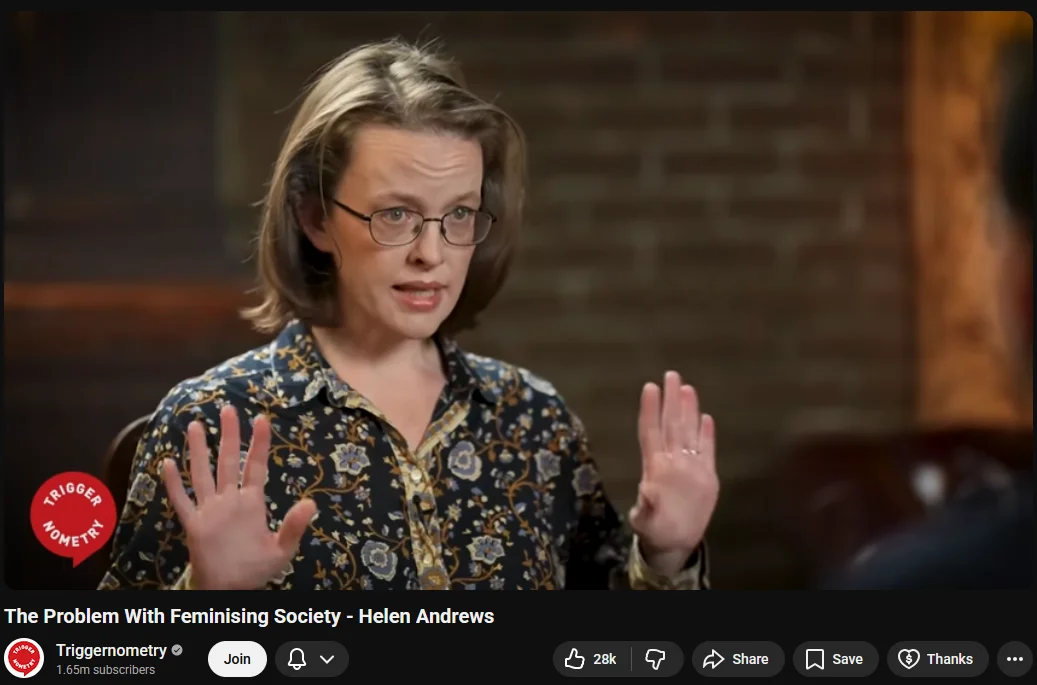
The recent Triggernometry conversation with Helen Andrews centres on a provocative but important claim: that many of the cultural pathologies now gathered under the label “wokeness” may be less an ideology, and more a predictable shift in group dynamics as institutions become demographically and temperamentally feminised. Andrews’ argument is not that “women cause all problems,” but that certain modes of consensus-making, conflict-avoidance, and moral judgement can become institutionally decisive once a critical mass is reached, particularly in environments that historically relied upon adversarial contest, eccentricity, and the toleration of disagreement as part of their operating logic.
The hosts press Andrews on where this thesis helps and where it becomes reductive, especially when the contemporary “bro-cast” media ecology is plainly male-heavy yet not obviously truth-oriented. The discussion stays, at its best, in the register of institutional purpose: what kinds of human dispositions help a university, a court, a newsroom, or a public body perform its function well, and what kinds inadvertently deform it?
Several concerns recur:
- First is the claim that the feminisation of universities and professional pipelines may be changing the moral style of organisations, producing stronger pressures toward conformity, reputational discipline, and “safety” rationales that can displace curiosity and disputation.
- Second is the worry that procedural norms, especially those associated with due process and adversarial testing of claims, can be weakened when moral urgency becomes the organising principle, with Title IX-era “campus courts” serving as a prominent example in the discussion.
- Third is a broader anxiety about second-order effects: the longer-term consequences of policies and incentives that encouraged mass female workforce participation, including family formation pressures and declining birth rates, and the uncertainty about what would happen if contemporary DEI and affirmative-action mechanisms were withdrawn.
- Fourth is a meta-concern about media itself: whether new media, shaped by attention incentives, can sustain truth-seeking regardless of whether it is feminised or masculinised.
In that sense, the episode is not merely about gender. It is about how societies metabolise conflict, status, care, risk, and authority when their symbolic and moral grammars are in flux.
From a Jungian and depth-psychological standpoint, the episode opens a space that is often foreclosed by the contemporary “culture war” habit of treating gender only as a battleground for policy positions. Jung would likely have insisted on a longer historical lens: “feminisation” is not a new event that suddenly arrived with HR departments and contemporary managerial cultures. It is also a psychic and religious process in the West, unfolding over centuries, in which the feminine principle has repeatedly sought recognition within a predominantly masculine theological and institutional order.
One of Jung’s most cited public reactions to this long arc appears in his response to the Catholic Church’s 1950 definition of the Assumption of Mary. Jung regarded this Marian development as an event of major religious-psychological significance, interpreting it as a compensatory movement in the Western psyche toward the inclusion of the feminine in the image of the divine.
In his framework, when a civilisation’s official theology excludes a living psychic factor, that factor does not disappear. It returns indirectly, often through mass movements, moral contagions, ideological intensifications, or symbolic eruptions that feel, to contemporaries, like sudden “madness.” Jung’s interpretation of Marian dogma does not require one to accept Catholic doctrine as metaphysical fact. It treats dogma as a cultural vessel in which the psyche speaks historically, especially at points where the inherited spiritual structure can no longer contain the tensions it has generated.
This matters for the present debate because it relocates the question. The discussion between Andrews, Kisin and Foster tends to frame feminisation as an institutional-demographic phenomenon: who is in the room, what social styles dominate, what managerial norms follow.
Depth psychology adds another layer: feminisation can also be the psyche’s demand that a one-sided civilisation re-balance its governing images of value, authority, care, embodiment, and relatedness?
If that demand is not consciously integrated, it will often appear in distorted forms. What looks like moral sensitivity can become moralism. What looks like care can become coercive protection. What looks like relational attunement can become reputational punishment. What looks like inclusion can become a brittle unanimity. In Jung’s language, these are not “mere political problems.” They are symptoms of a psychic compensation that has not found a mature symbolic form.
Marie-Louise von Franz, working in Jung’s wake, consistently emphasised that the psyche is not simply “male” or “female” in a literal, bodily sense. It is structured by polarities, and it seeks wholeness through the integration of opposites. The feminine and masculine principles, in this symbolic register, describe orientations and dispositions: differing ways of relating, valuing, judging, imagining, and binding oneself to meaning. This is precisely why Jung’s anima and animus remain useful when treated carefully. They are not a licence to stereotype men and women. They are a way of describing inner otherness: the contrasexual or counter-attitudinal factor that unsettles the ego’s preferred self-image and expands the range of what one can consciously bear.
In contemporary terms, one might say: while humans cannot change biological sex, there is wider variability in psychic orientation than modern public discourse easily admits. People do not merely “have traits.” They can be seized by them. Jung used the language of projection and possession to describe states in which an archetypal pattern is not being related to as symbolic, but is instead being lived as identity, certainty, or fate.
Anima and animus are especially prone to this, precisely because they mediate relationship, desire, judgement, and ideals. When the anima is projected, the world fills with enchanted figures who seem to carry one’s missing soul. When the animus is projected, the world fills with authoritative voices that seem to carry final truth. In both cases, the person is not primarily reasoning about reality. They are in a mythic economy, often without knowing it.
This is one point where a depth-psychological view can gently challenge certain habits in modern Gender Critical circles. The Gender Critical emphasis, at its strongest, is functional, legal, and materially weighted: it insists that sex is a biological category with real-world implications, and that policy should not pretend otherwise.
Depth psychology does not need to dispute that to add value. But it can note a limitation: if gender is treated only as an external social imposition or a legislative battleground, the symbolic role of gender in the psyche is easily missed. The result is that debates about identity become strangely literal. People argue as if the only options are compliance with social roles or escape from them. The symbolic third position, where roles are understood as expressions of archetypal patterns that can be related to, differentiated, and integrated, often disappears from view.
That disappearance has consequences. When traditional religion supplied a mythogenetic framework, people could seek transformation without needing to literalise it as personal identity. One could “put on the new man,” die and be reborn, be claimed by a vocation, submit to a rule, take vows, undergo initiation, make pilgrimage, enter the desert, confess, atone, receive grace. These were not merely moral commands. They were symbolic technologies for moving beyond socially ascribed identities and roles while remaining anchored in a shared image-world. As that world weakens, the longing does not vanish. It migrates into politics, lifestyle, and identity claims. The hunger for transfiguration persists, but the language of transfiguration is lost.
In that context, the mythopoetic motivation behind contemporary quests “beyond identity” becomes easier to see. Many people are trying, in good faith, to exit a deadening regime of social scripts, consumer roles, and managerial selves. They want to become more real. They want an interior authority. They want meaning that is not merely assigned by institutions, algorithms, or peer consensus.
But without a symbolic frame, the search easily collapses into idealism: the chase for a perfected state in which contradiction, limitation, and ambivalence are abolished. Depth psychology would describe this as a temptation toward inflation: the ego identifies with an archetype and mistakes a symbolic horizon for a literal destination. The result can be a pursuit of “unicorns”: imagined conditions of wholeness that promise deliverance from tragedy, finitude, and conflict, but which cannot be lived without violence to reality.
From this angle, one can welcome the Triggernometry conversation and Andrews’ contribution without needing to accept every inference of the feminisation thesis. The value of the episode is that it re-opens reflection on how institutions embody psychological dispositions, and how those dispositions shape what a society can think, say, and tolerate.
It also invites a deeper question that Jung would likely press: if the feminine has been returning to Western consciousness for a very long time, including through religious developments such as the heightened prominence of Mary in Catholic imagination, then what would a mature integration look like today? Not a swing from one one-sidedness to another, but a symbolic settlement in which care does not become coercion, inclusion does not become unanimity, and relatedness does not abolish truth-testing.
The practical implication is not a policy prescription disguised as psychology. It is a diagnostic invitation. Before arguing about whether an institution is “too masculine” or “too feminine,” one might ask what psychic functions it is currently over-identifying with, and what it is repressing. Is it repressing conflict in the name of safety, and thereby driving conflict into reputational warfare? Is it repressing care in the name of toughness, and thereby producing brutality and isolation? Is it repressing symbolic thinking in the name of material clarity, and thereby leaving people defenceless against mythic possession? These questions do not settle the culture war. They reopen the inner war that the culture war so often externalises.
And that, finally, is the best reason to welcome discussions like this. They create a pause in which the psyche can be heard again: not as a set of political talking points, but as a field of tensions seeking integration. Jung’s wager was that civilisation cannot be healed only by better arguments, because the conflict is not merely rational. It is archetypal, and one does not fuck with the archetypes!
If this is correct, then the work ahead is not to abolish the feminine or enthrone it, but to recover a symbolic and mythogenetic framework adequate to the complexity of modern life, so that the longing for transformation does not have to masquerade as literal identity, and so that institutions can serve their purposes without becoming vehicles for collective projection.
Endnotes
1. Triggernometry episode page on YouTube: “The Problem With Feminising Society – Helen Andrews”.
2. Episode listing (Podtail): “The Problem With Feminising Society – Helen Andrews”.
3. Pope Pius XII (1950), Munificentissimus Deus, defining the dogma of the Assumption.
6. Jung, C. G., Answer to Job (Collected Works Vol. 11; Google Books listing).
7. von Franz, M.-L., Animus and Anima in Fairy Tales (Inner City Books).
8. von Franz, M.-L., The Feminine in Fairy Tales (publisher listing).
Leave a Reply