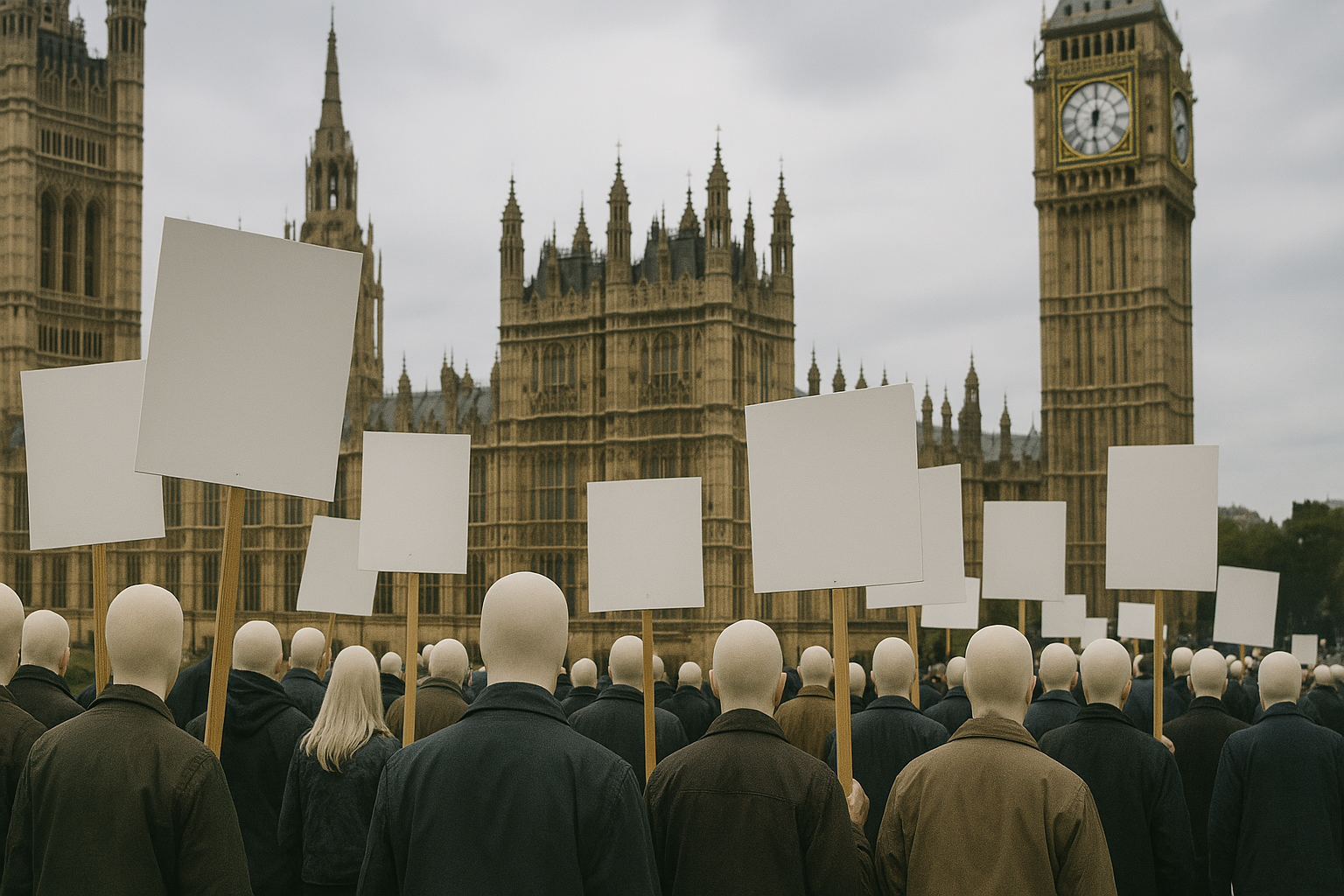
Carl Jung approached ideology not as a political analyst but as a depth psychologist. His concern was never merely with the content of belief systems but with what compels individuals to adopt them in the first place. He saw ideology as a symptom of a deeper psychological process—one that reflects a disconnection from the Self and the inner symbolic life of the psyche. Ideology, in this view, is less a neutral system of ideas and more a psychic structure formed when individuals seek certainty, belonging, and meaning outside themselves, often in response to inner fragmentation.
From a Jungian standpoint, to look at the world ideologically is to engage in a kind of psychic displacement. It is to take a belief, a vision, or a principle, and inflate it into something that appears to stand above and beyond the individual, endowed with autonomous authority. In doing so, the person fails to see that what is taken to be universal or metaphysical is often no more than a projection—an outward manifestation of inner needs, complexes, and unresolved psychic material. People do not merely adopt ideologies; they are possessed by them, precisely because ideologies often carry archetypal energy. They resemble myths and religious symbols, but stripped of their capacity for transformation and self-reflection.
What often goes unexamined is the interior landscape that drives the ideological commitment. Jung would ask not “What is your position on this issue?” but “What psychic need compels you to believe this, and what might be lurking in the shadow of this conviction?” The ideological stance becomes problematic not because it is right or wrong in content, but because it frequently evades the central task of becoming conscious. It allows the person to align with a collective ideal while avoiding the painful and necessary work of inner differentiation.
Jung’s critique of ideology is rooted in his understanding of the psyche as a living, symbolic system. The individual is not a blank slate upon which ideas are inscribed, but a deeply complex being driven by the interplay of unconscious forces—archetypes, instincts, dreams, and symbols that demand attention and interpretation. When these forces are not recognised or integrated, they are projected outward, often onto political, religious, or cultural ideologies. What appears to be a moral crusade may in fact be a disguised psychic struggle.
The metaphysical status often attributed to ideologies gives them the illusion of being detached, independent, and objective. They are treated as if they exist outside the people who hold them. But from a depth psychological perspective, this illusion serves to obscure the emotional and psychic investments that underlie such beliefs. The ideological worldview becomes a refuge, offering an externalised structure of meaning that alleviates the anxiety of facing the unknown within. It replaces the symbolic quest of the individual with the certainties of collective belonging and doctrinal clarity. In this way, ideology becomes not only a displacement of inner work but a substitute for it.
Jung recognised that human beings seek meaning, and in the absence of an inner symbolic orientation, they will turn to ideology to fill the void. This is especially true in modern and postmodern cultures where traditional religious narratives have lost their symbolic vitality. Ideology, in such contexts, often emerges as a surrogate metaphysics. It provides the promise of direction and purpose, but without requiring the individuation process that true inner meaning demands. In its more extreme forms, ideology takes on the qualities of a psychic possession, erasing nuance, silencing ambivalence, and demanding loyalty in place of reflection.
To take a Jungian view of the world, therefore, is not to deny the existence of collective structures or historical forces, but to question the inner motivations that compel people to identify with them so completely. It is to ask: what fear, what longing, what fragmentation lies behind this commitment? What unlived part of the self is being externalised and pursued under the banner of a cause? This psychological perspective does not discount social, cultural, or political realities, but insists that these must be understood in relation to the symbolic and psychic life of individuals. The forces that move history are also the forces that move within dreams, complexes, and archetypes.
Metamodernism offers a further frame for this reflection. In its oscillation between sincerity and irony, hope and doubt, metamodernism creates space for an engagement with meaning that is neither naïvely idealistic nor dismissively cynical. It acknowledges the desire for depth and coherence while remaining aware of the constructedness of all systems. When joined with depth psychology, this creates the possibility of a renewed symbolic life—one that does not collapse into ideology but remains attuned to paradox, to inwardness, and to the ambiguity of human motivation.
The individuation process, which lies at the heart of Jung’s vision, resists the seductions of ideological certainty. It requires the courage to encounter inner contradiction, to integrate shadow, and to bear the tension of opposites without fleeing into collective identifications. It is not a call to apolitical disengagement, but to a different kind of engagement—one rooted in psychological integrity rather than group conformity.
In this light, ideology becomes not a pathway to truth but a barrier to deeper understanding. It often prevents individuals from asking the questions that matter most: Who am I beneath the roles I play? What is the source of this anger, this zeal, this longing? What dream or image might offer a different path forward—one that honours both my uniqueness and my place in the collective field?
Jung once observed that the world hangs by a thin thread, and that thread is the psyche of man. To attend to that thread is to turn away from grand abstractions and attend instead to the dream, the symptom, the story, the silence. This is not a withdrawal from the world, but a reorientation toward it—a way of seeing that recognises each belief, each movement, each cause as rooted not only in history but in the mysterious depths of the human soul.
If the world is to change meaningfully, it will not be through ideologies alone, but through individuals who have faced themselves fully. The ideological spirit may stir crowds, but only the symbolic imagination can guide the psyche toward wholeness.
Leave a Reply