
Public arguments about sex and gender are generally presented as disputes over rights, definitions, medical evidence, institutional policy and personal identity. These matters are important, but they do not exhaust what is taking place.
Political controversies also generate images, rituals, costumes, slogans and symbolic performances. They organise people emotionally before they persuade them intellectually. A demonstration is therefore not simply a collection of articulated policy demands. It is a temporary symbolic world: banners define enemies, colours establish affiliation, costumes suspend ordinary identities, chants create collective rhythm, and placards condense complicated emotional positions into images that can be displayed, photographed and circulated.
From a Jungian perspective, the question is not only what such images consciously claim to mean. It is also why particular forms recur.
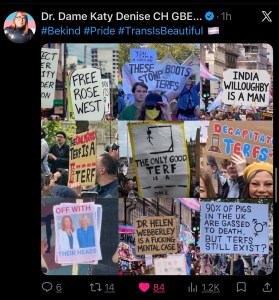
Recent transgender-rights demonstrations have included placards referring to opponents as people who should be punched, stomped, hanged, decapitated or subjected to forms of death associated with slaughter. The language is often defended as hyperbole, black humour, carnival or the exaggerated rhetoric of protest. It would be unjustified to treat isolated placards as representative of all transgender people or everyone attending a march. Violent political imagery is not unique to any identity group.
Yet recurrence matters. When the same symbolic pattern appears repeatedly, it becomes reasonable to ask what psychological work it is performing. Why does the head appear so often? Why is the political opponent imagined not merely as defeated, persuaded or excluded, but as separated from the body?Why do campaigns publicly organised around recognition, kindness, safety and personal authenticity sometimes produce images of execution?
These questions do not require us to diagnose the people holding the placards. Nor do they permit us to infer anything about transgender people as a psychological class. Jungian analysis is most useful when it examines the symbolic field created by a conflict, including the imagery produced by every side. It becomes least reliable when used to label an adversary from a distance.
The point is not to decide which political identity is psychologically healthy. It is to consider what the images disclose about a culture struggling to reconcile embodiment, consciousness, identity, authority and transformation.
The Cis/Trans Boundary as Symbolic Structure
The terms cis and trans originated as relational descriptions.
- Cis* means “on this side”.
- Trans* means “across”, “through” or “on the other side”.
They describe a relationship to a boundary. In Roman geography, the Alps served as a point of reference between Cisalpine and Transalpine Gaul. In chemistry, cis and trans describe molecular arrangements relative to a plane or structural axis. In genetics, cis-acting elements operate on the same DNA molecule, while trans-acting factors may act elsewhere. Neither word originally referred to a complete kind of person. The prefixes located something relative to something else.
Their application to gender retains this relational structure. A cisgender person, according to the people who use this term, is generally defined as someone whose gender identity corresponds to the sex ‘recorded’ or ‘assigned at birth’. A transgender person is someone whose identity, so it is claimed, does not correspond in the expected way. The terminology therefore places everyone in relation to a boundary joining—or separating—bodily sex, social classification and subjective identity.
This offers apparent symmetry. The previously unnamed majority is given a category, rather than being treated simply as normal while the minority is marked as exceptional. Yet the symmetry also introduces a theory: everyone is presumed to possess a gender identity, and this identity either corresponds or fails to correspond with the classification made at birth.
That theory may be useful. It may also be disputed. Some people readily describe themselves as cisgender. Others do not experience themselves as possessing an internal gender identity separate from being male or female. They may regard “cis” not as a neutral description but as the imposition of a conceptual scheme they do not share.
The argument therefore concerns more than vocabulary. It concerns which boundary is treated as fundamental and who possesses the authority to define it:
- Is the determining reality the body?
- Is it subjective identity?
- Is it social recognition?
- Is it an interaction among all three?
The cis/trans distinction attempts to stabilise this uncertainty through language. But because the underlying relationship remains contested, the terms carry more symbolic energy than an ordinary technical classification.
The boundary does not merely classify. It appears to decide where the person truly belongs.
Jung and the Difference Between Sign and Symbol
Jung distinguished a sign from a symbol. A sign points towards something already known. A traffic sign has an agreed referent. Its value lies in reducing ambiguity. A living symbol, by contrast, represents something that cannot yet be completely formulated. It gathers contradictory meanings and carries an excess that cannot be exhausted by a single definition. Symbols emerge where consciousness has not yet reconciled the forces involved.
Modern political discourse generally treats its language as a system of signs. It seeks definitions that are explicit, enforceable and administratively usable. A person is placed within a category, and institutions are expected to respond accordingly. Depth psychology asks whether apparently settled signs may also be functioning as symbols.
“Transition”, for example, can operate as a practical description of medical, legal or social change. But it also belongs to a much older symbolic family: initiation, metamorphosis, death and rebirth, crossing the threshold, changing the name, leaving an old body, acquiring a new social face, and moving from one world into another.
The trans prefix consequently carries symbolic associations beyond its formal contemporary definition, even where those associations are not consciously intended. It evokes crossing, departure, passage, inversion and movement beyond an established limit. Similarly, cis appears to indicate remaining on this side of a boundary. In political rhetoric it can acquire associations with settledness, continuity, conformity or attachment to an inherited order.
These are not dictionary definitions. They are possible symbolic resonances. The danger begins when either category becomes morally saturated—when crossing the boundary is treated as inherently enlightened, or remaining on one side as inherently authentic and natural. A Jungian analysis would resist both simplifications. Every threshold raises questions about what is being left behind, what is being sought, what is being sacrificed and whether transformation has been integrated.
The Placard as Projected Demand
 A political placard appears to face outward. It tells another person, institution or society what must change: they ask for recognition, protections, affirmation/belief. Alternatively, they seek to remove those who don’t agree, to punish them for their disbelief, and to silence those who may speak out.
The placard is therefore an instrument of projection in the everyday sense: it projects a message into public space. But it may also express projection in Jung’s technical sense.
Psychological projection occurs when qualities, conflicts or psychic contents that are not recognised within oneself are experienced primarily in another person. The other becomes the carrier of what the ego or group cannot acknowledge as its own. This does not mean that the other person has done nothing objectionable. Projection commonly fastens itself onto a real characteristic. Its distinguishing feature is not complete invention but emotional excess. The opponent ceases to be a complicated person and becomes the embodiment of everything threatening, cruel, irrational or corrupt.
In a politically polarised environment, the placard can become a portable screen for projection. It presents the enemy in condensed form and tells the crowd how that enemy should be emotionally experienced. The “TERF”, the “transphobe”, the “gender ideologue”, the “groomer”, the “bigot” or the “fascist” may refer to identifiable political positions. But the terms can also become containers into which fear, shame, aggression and contradiction are deposited.
The same process occurs in the other direction. Transgender people may be turned into symbolic carriers of social collapse, technological domination, sexual danger or the disappearance of established reality. Gender-critical women may be represented as the final defenders of nature and embodied truth. Each side risks becoming mythologised by the other.
At that point, the argument is no longer conducted between ordinary people. It is staged as a conflict between archetypal figures: innocence and corruption, nature and artifice, victim and persecutor, mother and devourer, child and predator, order and chaos. The symbolic intensity explains why factual correction alone so often fails. Facts cannot easily dissolve an image that is carrying an unconscious emotional burden.
When the Opponent Must Lose a Head
The recurrence of decapitation and hanging imagery deserves specific attention because the head is one of the most concentrated symbols in human culture. The head contains the face. It carries the eyes, mouth and name by which a person is socially recognised. It is conventionally associated with consciousness, speech, judgement, thought and authority. Crowns are placed upon it. Portraits identify people by it. To bow the head is to submit; to raise it is to reclaim dignity.
To remove the head is therefore not simply to injure the body. It destroys the visible centre of identity and governing consciousness. Historically and mythologically, decapitation can symbolise conquest, sacrifice, liberation, silencing, transfer of power or the overthrow of an old ruling principle. The severed head may become a trophy, an oracle, a relic or a warning. It can represent the defeat of tyranny, but it can also express the wish to abolish thought itself.
In controversies about sex and gender, the symbolic meaning becomes especially charged because the dispute repeatedly concerns the authority to name and distinguish:
- The head discriminates: this is one thing, and that is another.
- It classifies: male, female, body, identity, fact, belief.
- It speaks: I agree, I refuse, I recognise, I deny.
A fantasy of separating the head from the body may therefore symbolise more than hostility towards a political opponent. It may express a wish to end the painful activity of distinction.
The opponent’s consciousness is experienced as the obstacle. Their speech names differences that the movement regards as oppressive or intolerable. The imagined solution is not to answer the distinction, but to abolish the speaking head that makes it. This is psychologically different from integration.
Jung’s individuation process does not dissolve opposites by declaring one side unreal. It requires differentiation before reconciliation. Body and consciousness, masculine and feminine, individual and collective, instinct and culture must first be recognised in their tension. A premature unity is not wholeness. It is fusion.
The Head and Body as a Cultural Split
The recurring image of decapitation may also reveal a more profound problem in contemporary Western identity: the separation of mind from body.
Much gender discourse is organised around a possible conflict between embodied sex and conscious identity. One account gives priority to subjective self-knowledge: the individual knows who they are, and the body or social classification must be brought into alignment with this knowledge. Another gives priority to sexed embodiment: consciousness may interpret the body in many ways, but cannot redefine its underlying reality. Both positions can become one-sided.
- A purely voluntarist account risks treating the body as raw material governed by conscious declaration. The self becomes equivalent to the will, while the body is imagined as an object that ought to comply.
- A rigidly biological account can make the opposite error. It may reduce psychic life to anatomy and treat symbolic, relational and subjective experience as irrelevant or false.
Jung would be suspicious of both reductions. The psyche is embodied, but the body is never experienced without psychic meaning. Conscious identity matters, but consciousness is not sovereign over the whole personality.
The decapitated body offers an image of what happens when these realities are pulled apart. There is a head without embodiment, or a body deprived of its governing and speaking centre. Seen in this way, execution imagery may unintentionally enact the very split at the heart of the controversy. The culture cannot find an adequate relationship between body and identity, so it repeatedly imagines their violent separation.
The head claims autonomy from the body. The body appears as an obstacle to consciousness. Or, in reverse, the head is removed so that the disputed body can no longer speak for itself. The image is therefore not necessarily a hidden statement about one political programme. It may be a collective symptom of a civilisation that no longer possesses a convincing symbolic account of embodiment.
Persona, Recognition and the Public Face
Jung’s concept of the persona is also relevant. The persona is the social face through which a person enters collective life. It includes name, role, appearance, speech, clothing and recognised identity. The persona is essential. Human beings cannot participate in society without some socially legible form. The problem arises when the ego identifies completely with the persona and treats recognition of the public identity as confirmation of the whole person.
Gender identity has an unavoidable relationship with persona because it concerns how a person is named, addressed, seen and situated. Changes in clothing, pronouns, official documents and social role modify the public face. This does not make gender identity superficial or false. Jung did not believe the persona was merely deception. It is a necessary interface between individual and society.
 Screenshot
But no persona, however carefully established, can contain the whole psyche. The unconscious continues to produce contradictions, fantasies, dreams and bodily reactions that do not necessarily conform to the public account. When collective recognition becomes the primary guarantee of identity, disagreement can feel existential. The person who refuses the preferred term is not merely expressing another view. They appear to be attacking the social face through which the self has become recognisable.
This helps explain the intensity of the demand.
A placard may ask for legal change, but beneath the demand may lie a more fundamental appeal: confirm that I exist in the form through which I have become able to live. The opposing placard may contain an equally foundational demand: confirm that words still refer to realities independent of individual will.
Each experiences the other as removing the ground on which personhood stands. Under those conditions, political disagreement readily becomes symbolic annihilation.
Kindness, Purity and the Shadow
The juxtaposition of “be kind” with fantasies of punching, stomping, hanging or decapitating opponents is not only hypocrisy in the ordinary sense. It illustrates what Jung called the shadow. The shadow contains qualities that the conscious personality does not include within its preferred self-image. A person or movement strongly identified with compassion may find it especially difficult to acknowledge aggression.
A movement identified with reason may be unable to recognise its emotional investments. A group identifying itself with courage may repress vulnerability and fear.
The rejected quality does not disappear. It becomes unconscious and returns in distorted form.
Jung adopted the Heraclitean concept of enantiodromia to describe the tendency of an extreme one-sided position to generate its opposite. Excessive moral purity can produce cruelty. Absolute rationalism can become irrationally possessed. A movement organised around liberation can become coercive because coercion is not recognised within its image of itself.
The paradoxical message becomes:
- We are kind, and therefore those who oppose kindness deserve punishment.
- We protect vulnerable people, and therefore our opponents can be dehumanised.
- We oppose hatred, and therefore hatred directed towards the hateful is legitimate.
The shadow is enacted precisely because it remains unnamed. This applies equally to gender-critical or conservative movements when they identify themselves exclusively with truth, nature, women’s protection or common sense. Aggression, contempt and fantasies of humiliation can then appear as mere realism or moral courage.
Jungian analysis offers no monopoly on virtue. It asks each group to identify what its preferred public face excludes.
Joseph Campbell and the Religious Form of the Argument
Joseph Campbell developed his comparative mythology under significant Jungian influence, although his theory of myth was distinctively his own. He understood living mythology as performing several functions:
- opening consciousness towards the mystery of existence,
- presenting an image of the cosmos,
- supporting a social order, and carrying individuals through the stages and crises of life.
Campbell account for these as mystical or metaphysical, cosmological, sociological and pedagogical functions.
Campbell is sometimes associated with descriptions of “pseudomorphic” religious practice, but that wording should be used cautiously. A pseudomorph, in its original mineralogical sense, is something that retains the external form of one substance while its internal composition has been replaced by another. Applied culturally, it suggests an inherited form occupied by a new content.
That idea is useful for considering identity politics, provided it is presented as an interpretative extension rather than a direct Campbell application.
Modern political movements can assume religious forms without professing a conventional theology. They may establish:
- sacred identities;
- narratives of suffering and redemption;
- ritual declarations;
- purity tests;
- heresies;
- confessions;
- martyrs;
- symbols of rebirth;
- calendars of commemoration;
- promises of transformed existence;
- and images of a corrupt old world that must be overcome.
The outward form resembles religion, but its content is political, therapeutic or identitarian. It is in this sense pseudomorphic: older religious patterns continue to organise experience after explicit belief in their theological framework has weakened.
Campbell’s broader work distinguishes mythologies closely oriented towards animal life, fertility, seasonal recurrence and the seeded earth from traditions that direct consciousness towards metaphysical transcendence. His developmental account ranged from the “way of the animal powers” and the “way of the seeded earth” to celestial and later consciously metaphorical systems.
This should not be reduced to a simple opposition between primitive nature religion and superior metaphysical religion. Campbell’s point was that mythology changes in relation to forms of life and social organisation.
Nevertheless, the distinction helps illuminate two competing religious tendencies within contemporary gender discourse. One seeks legitimacy through nature. The other seeks transformation through identification with a reality beyond the inherited body.
The Religion of Nature
The gender-critical position frequently invokes nature, sex, reproduction, motherhood, materiality and the body’s evolved organisation. Its symbolic ground is chthonic and biological. The body precedes the declaration. Sexual difference is not created by language. Identity must remain accountable to nature. In Campbell’s terms, this resembles mythic systems in which meaning is embedded in animal life, fertility, birth, death and recurring natural processes. The body participates in an order larger than the individual. It cannot simply be reconstructed by an act of will.
The strength of this position is its resistance to abstraction. It recalls that human beings are organisms rather than disembodied consciousnesses. Its danger is that nature may be treated as completely self-interpreting. Biological fact does not automatically determine social meaning, personal vocation or symbolic identity. Human beings always mediate nature through culture, language and imagination.
Nature can also be idealised. The natural world is not only harmonious, maternal and ordered. It includes mutation, ambiguity, parasitism, violence, variation and death. A symbolic appeal to nature may therefore become its own pseudomorphic religion. “Nature” takes the place once occupied by divine authority. It becomes a final source of moral legitimacy rather than a reality requiring interpretation.
The Religion of Transformation
Gender-identity discourse often draws upon another mythic pattern: the true self concealed within an inadequate inherited form. The person crosses a boundary, receives a new name, adopts a new social form and seeks recognition from the community. The old identity may be treated as dead, false or imposed. The new identity represents authenticity and release.
This resembles initiation and rebirth. It also resembles traditions in which the empirical body is not the final measure of the person. The visible self is provisional. A deeper identity must be discovered, affirmed or brought into manifestation. Campbell described the mystical or metaphysical function of myth as awakening awareness of participation in a reality exceeding ordinary categories. Mythic images are not final objects, but openings towards a mystery beyond themselves.
In religious traditions, identification with the godhead does not ordinarily mean that the ego’s preferences become divine commands. It often entails the reverse: surrender of ego, death of the old personality and participation in a larger order. This distinction is crucial. Transcendence is not the same as personal self-assertion.
The mystical identification of Atman with Brahman, union with God or participation in divine life is not normally an affirmation that individual consciousness possesses absolute authority. It involves the relativisation or transformation of the ego. A modern identity movement can retain the form of transcendence while changing its content. The hidden inner identity becomes the final sacred authority. Social recognition functions as confirmation. Transition becomes a passage into the true form.
Again, this does not mean that the personal experience is unreal. It means that it carries a mythic structure that ought to be examined rather than merely literalised. The danger is inflation: the ego identifies with a transpersonal authority and becomes unable to distinguish between profound inner experience and unquestionable public truth.
Mythic Inflation and the Godhead
Jung used the idea of inflation to describe a condition in which the ego identifies with an archetypal or collective power. The individual feels enlarged, morally certain or historically appointed because an impersonal psychic force has been confused with the personal self. Religious identification with the godhead is particularly dangerous when stripped of disciplines of humility, sacrifice and symbolic interpretation.
The individual may cease to say: “I have encountered an experience larger than my previous understanding.” Instead, the claim becomes: “My conscious account is the final reality, and others must affirm it.” This is a shift from transformation to sovereignty.
The same inflation can occur among opponents who imagine themselves as guardians of civilisation, nature or truth. Archetypal identification is politically attractive because it converts uncertainty into mission. The person is no longer merely arguing about policy. They are defending reality itself. Once both sides identify with sacred principles, the opponent becomes not mistaken but profane. Execution imagery follows readily from this structure. The heretic does not merely disagree. The heretic contaminates the symbolic order.
Sacrifice or Scapegoat?
Mythological transformation frequently involves sacrifice. Something old must die so that another form of life can emerge. But sacrifice has two very different psychological forms. In mature transformation, the person relinquishes something of their own: certainty, status, attachment, innocence, self-image or control. In scapegoating, the sacrifice is transferred to another person. The community imagines that conflict can be resolved if the designated contaminating figure is expelled or destroyed.
The violent placard reveals this substitution. The movement does not say: what must we surrender to achieve a more adequate relationship among body, identity and society? It says: the opponent must be removed. The severed head becomes the externalised sacrifice.
From a Jungian perspective, this indicates failed symbolic transformation. The necessary psychic death has been projected outward. Instead of allowing an inadequate conscious position to die, the group imagines the death of those who challenge it. The opponent is required because they carry the contradiction the movement cannot contain internally.
Nietzsche’s Serpent and the Difference Between Transformation and Elimination
Nietzsche’s Thus Spoke Zarathustra contains a disturbing image of a shepherd choking after a black serpent crawls into his throat. Zarathustra calls upon him to bite off the serpent’s head. The shepherd does so and rises transformed, laughing with a radiance Zarathustra has never witnessed. The image concerns existential self-overcoming, not merely the killing of an opponent. The serpent is already within the shepherd. The crisis cannot be solved at a safe distance.
Jung’s long seminar on Zarathustra examined Nietzsche’s work as an eruption of archetypal material and as a warning about identification with the prophetic figure. Campbell likewise regarded effective mythic images as capable of precipitating affect and reconnecting consciousness with dimensions rationalism had excluded. The contrast with political execution imagery is stark:
- Nietzsche’s shepherd must confront what is lodged in his own throat.
- The political placard locates the serpent entirely in another person.
- The former represents dangerous inner transformation.
- The latter promises relief through external elimination.
The symbolic challenge is therefore to recover the inward movement: what is choking the movement itself? What contradiction has entered its speech? What cannot it say without destabilising its identity?
Holding Head and Body Together
The task is not to choose a metaphysics of the head against the body or the body against the head. A culture of pure embodiment becomes incapable of recognising imagination, psychic suffering and transformation. A culture of pure identity becomes incapable of recognising inheritance, limitation and the autonomy of the body.
Jung’s transcendent function offers another model. It does not refer to escaping the conflict into a higher declaration. It describes the emergence of a new symbolic attitude through sustained engagement with opposed psychic realities. The tension must be borne rather than prematurely resolved.
In the gender debate, this would mean maintaining several truths in conscious relation:
- The body is real.
- Psychic experience is real.
- Social recognition matters.
- Language does not possess unlimited power.
- Biology does not exhaust meaning.
- Identity cannot simply command agreement.
- Disagreement does not justify dehumanisation.
- Compassion does not abolish the need for distinctions.
The resulting position may not satisfy activists who require an immediate binary alignment. But individuation rarely conforms to collective slogans.
Recovering the Symbol from the Threat
It is possible to say that a violent placard is unacceptable without claiming that it reveals the essence of a whole movement. It is also possible to interpret its symbolic structure without excusing its literal social effect. A sign calling for opponents to be hanged or decapitated can reasonably be experienced as intimidation. Public figures and activists should not be expected to treat execution imagery as harmless merely because it is framed as carnival.
But censorship alone will not explain why the image keeps returning. The head must be understood as a symbol of speech, authority, distinction and conscious identity. The body must be understood as the ground of incarnation, limitation, instinct and material existence. Their separation portrays a collective failure to relate consciousness to embodiment.
The placard performs that failure. It makes visible a psychic division that political language usually conceals.
Towards a More Responsible Symbolic Politics
A mature political culture would become more conscious of the images it produces. Organisers would reject fantasies of killing opponents not only because they are reputationally damaging, but because they corrupt the symbolic life of a movement. They train participants to experience elimination as virtue and prevent the shadow from being recognised.
Opponents would resist using individual signs to define every transgender person or participant. That generalisation would repeat the same projective process under examination. Commentators would distinguish criticism of an ideology, institution or protest culture from hostility towards people grouped by a protected characteristic. Most importantly, each side would ask what it has made psychologically impossible to acknowledge.
Can a transgender movement speak openly about embodiment, limit, regret, ambivalence and unresolved conflict without treating these as betrayal? Can a gender-critical movement acknowledge symbolic transformation, psychic complexity and the insufficiency of anatomy as a total description of personhood without surrendering the material reality of sex?
- Can compassion survive disagreement?
- Can distinctions be made without humiliation?
- Can identity be recognised without being made metaphysically absolute?
These are not administrative questions. They are questions about the kind of symbolic order in which people can continue to live together.
The Unsevered Person
The enduring image required by this conflict may not be the severed head but the unsevered person. The unsevered person does not solve psychological tension by declaring consciousness sovereign over the body. Nor do they reduce consciousness to bodily classification. They remain embodied and reflective. They possess an identity but are not exhausted by it. They recognise symbolic life without mistaking every symbol for a literal instruction. They can encounter an opposing view without requiring the disappearance of the person who expresses it.
Campbell believed that a viable mythology should connect individual life, social order, the cosmos and the mystery beyond ordinary categories. When those functions fail, political movements attempt to provide substitute mythologies. They offer identity, belonging, villains, redemption and ritualised transformation. But their symbols may become destructive when they are treated as literal warrants for power.
Jung’s warning is complementary. What is not recognised inwardly returns outwardly as fate. A movement that cannot recognise its aggression will repeatedly encounter aggression in the form of enemies. A culture that cannot hold mind and body together will continue producing images of their separation.
The recurrence of decapitation imagery should therefore concern us at more than one level:
- It is threatening rhetoric.
- It is evidence of political dehumanisation.
- It is a projection of unacknowledged aggression.
- And it is a symbol of a larger cultural split between consciousness and embodiment.
The task is not to identify which group possesses the shadow. The shadow is present wherever people become certain that violence belongs only to the other side. The question is whether the conflict can be transformed before its symbolic executions become accepted features of ordinary political expression.
A living symbolic culture would not demand the death of distinction or the abolition of embodiment. It would seek a form capable of holding head and body, identity and nature, transformation and limit, compassion and judgement within the same human figure. That is a considerably more difficult undertaking than displaying a placard. It is also the only form of transformation that does not require somebody else to lose their head.
Leave a Reply