This blog explores the idea of the Golden Thread in Jungian depth psychology and applies it to the contemporary notion of the “transgender child.” Rather than treating gender distress as a purely ideological issue, the piece argues for a symbolic and mythological understanding grounded in Jung, von Franz and Hillman. It examines how archetypal images, projections and developmental conflicts may shape a child’s sense of identity, and raises safeguarding concerns where adults, including Dr Helen Webberley, frame medical intervention as “life-saving.” The article cautions against premature affirmation, suggesting that such dynamics can resemble conversion or grooming, and highlights the need for reflective, depth-informed guidance that protects children’s psychological development.
The image of a golden thread appears again and again in depth psychology. Jung used it to describe a third kind of relationship, “the only lasting one,” as if an invisible telegraph wire ran between two people. He called this subtle, enduring connection “the Golden Thread” [1]. It is a way of speaking about the living bond between the ego and the deeper Self, and about the relationships that help that bond to grow.
When children today say “I am trans” or “I was born in the wrong body,” this is often treated as a literal statement about identity. The public argument tends to move quickly to ideology, policy and treatment pathways. From a Jungian and depth-psychological viewpoint, though, such declarations are also symbolic texts. They are dreamlike utterances that may point towards archetypal dramas in the child’s psyche: the Child, the Androgyne, the Hero, the Anima or Animus [2].
Jung insisted that archetypes first appear in imaginal form, as stories, fantasies and symptoms. They are not yet instructions for concrete action. The “transgender child” can therefore be approached as a contemporary image in which the psyche is wrestling with sexed embodiment, cultural expectations and unconscious patterns of masculinity and femininity [3].To treat this image only as a factual label is to miss its symbolic density. To deny the distress is cruel. But to read the distress only through an ideological lens, whether affirming or rejecting, is equally one-sided.
James Hillman’s “acorn theory” is helpful here. Hillman suggests that each person is born with a unique “acorn,” a daimonic pattern that quietly insists on a particular way of being in the world [4]. Childhood experiences, including gendered conflict, may be ways in which this pattern first makes itself known. For Hillman, the task of adults is not to normalise the child into an average template, nor to rush to literalise the child’s early self-descriptions, but to protect and interpret the acorn. The question is always: what is the soul trying to say here?
Marie-Louise von Franz, writing about individuation, stressed that it is not the same as ego self-realisation. It is the unfolding of “one’s own predestined development,” which does not always please the conscious personality [5]. Much of her work on the puer aeternus warned of staying stuck in provisional identities and fantasies that avoid the difficult work of embodied life [6]. Taken together, this suggests that a young person’s wish to escape a sexed body, or to occupy an idealised identity, may express a real archetypal pressure. Yet depth psychology would ask us to stay with the image, not to confirm it prematurely through irreversible medical intervention.
Jung’s Golden Thread is an image of a relationship that allows such tensions to be held. It is not sentimental attachment. It is a bond in which projections are gradually withdrawn, and both people are transformed [7]. Applied to gender-uncertain children, the task of parents, therapists and doctors would be to provide this kind of enduring, symbol-sensitive connection. The adult holds the field so that many possibilities may be imagined, spoken and tested against reality. The child is not abandoned to the crowd, nor coerced into conformity, nor fast-tracked into one fixed narrative of salvation.
This is where safeguarding comes sharply into focus. Contemporary services now stress that children presenting with gender incongruence often have complex co-existing difficulties, and that care should be holistic, exploratory and cautious [8]. The Cass Review in England, for example, highlighted the limited quality of evidence for puberty blockers and cross-sex hormones, and the need to protect children from treatments whose long-term impacts are uncertain [9]. A safeguarding lens asks first how adults are using their influence, and whether a child is being enabled to think, feel and question freely.
From this perspective, it matters how clinicians and advocates describe their work. Dr Helen Webberley, founder of GenderGP, presents gender-affirming treatment as “life-saving” care and has defended puberty blockers as “safe and life-saving” for distressed youth [10]. Testimonials on her site speak of GenderGP as “life savers,” and her advocacy emphasises urgency, barriers and the need to challenge “outdated medical gatekeeping”[11]. At the same time, NHS and professional bodies have raised serious concerns about unregulated providers prescribing hormones to minors, specifically warning GPs against shared care in such arrangements and citing legal judgments that found aspects of GenderGP’s practice a “very significant concern” for patient safety[12].
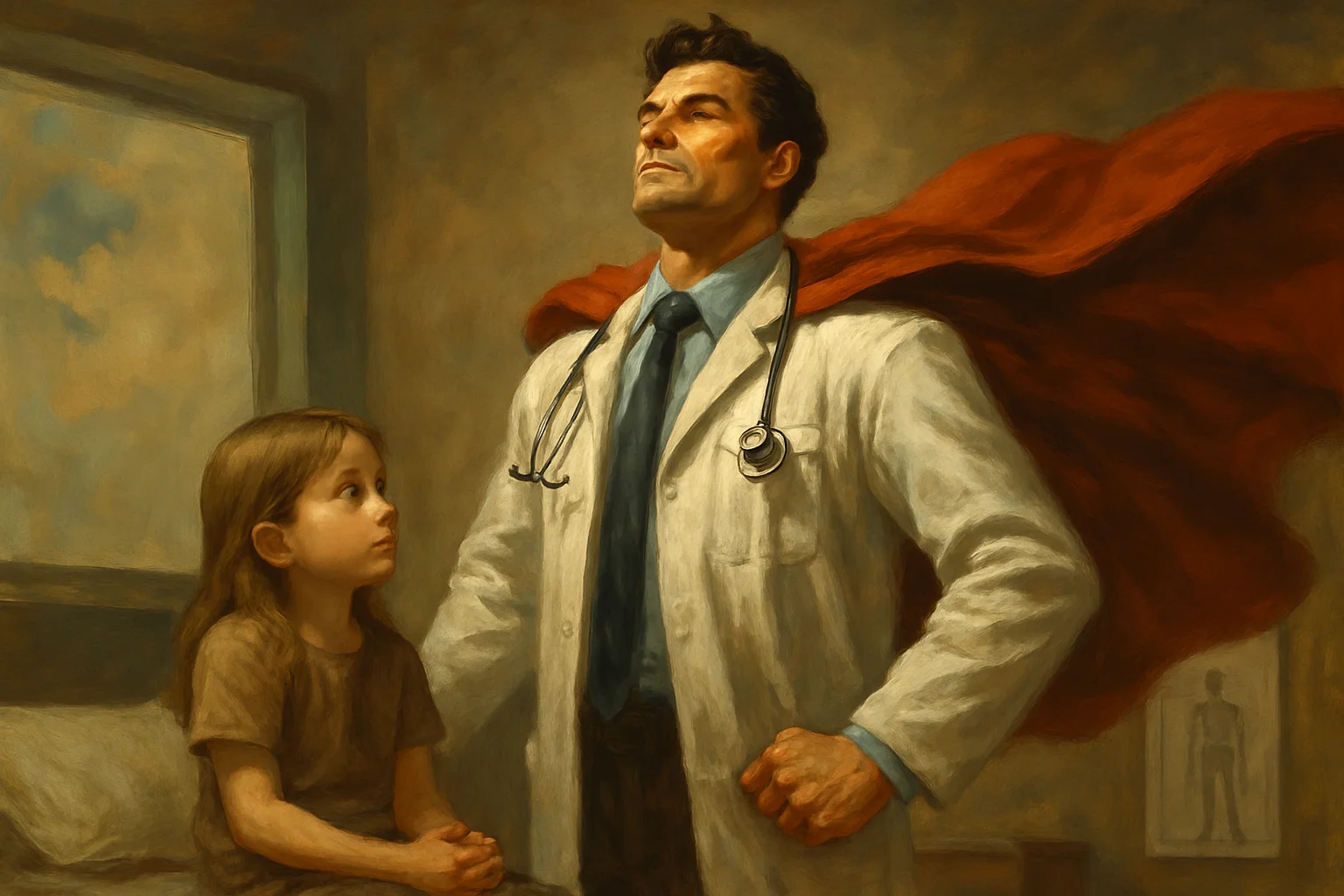
A depth-psychological reading cannot adjudicate the medical questions, but it can ask about the archetypal pattern. When a clinician or advocate presents themselves as a necessary saviour who offers uniquely “life-saving” treatment to vulnerable youth, this can resemble identification with the rescuer archetype. The child’s suffering becomes the stage on which the adult lives out a heroic role. Jung warned that “nobody is saved without being made responsible for himself,” and that the healer who unconsciously plays the redeemer risks sacrificing the patient to their own unconscious needs [13].
In ordinary therapeutic language, this is a problem of projection and transference. The adult may project their shadow, their unlived ideals, or their political commitments into the clinical relationship. The child, eager to please and to secure attachment, identifies with the adult’s story about them. Hillman would call this “literalising the image”: instead of letting the psyche speak in many metaphors, one metaphor is frozen into a concrete script [14]. When treatment proceeds under such conditions, the dynamic can begin to resemble a subtle form of conversion: the child’s complex experience is channelled into one sanctioned narrative, while other narratives are dismissed.
Safeguarding frameworks exist precisely to protect minors from relationships of undue influence, whether in families, religious groups, online communities or clinical settings. They are designed to notice patterns that, in other contexts, we would name grooming: the rapid establishment of trust, the isolation of the young person from alternative viewpoints, the promise of special understanding, the framing of dissent as hateful or unsafe. A Jungian approach would not casually accuse specific individuals. It would insist, however, that where archetypal energies of salvation, martyrdom and sacrifice are in play, the risk of unconscious misuse of power is high, and safeguarding must be correspondingly vigilant.
So what might Jung, von Franz or Hillman say, standing at the threshold of a clinic waiting room where a distressed thirteen-year-old declares themselves “trans”? Jung would likely ask for a long view of the child’s dreams, fantasies and family myths, treating the “wrong body” narrative as a symbol among others, not yet as destiny. He would draw attention to the archetype of the Child itself: a figure of potential, wholeness and future, easily confused with the literal child and easily exploited by collective movements seeking renewal [15].
Von Franz would probably ask how the tension between the child’s biological sex and their felt identity could be borne creatively, rather than resolved too quickly. She often described the work of individuation as a slow process of coming to terms with fate, shadow and limitation, not a project of technological escape from the givens of life [16]. She might recognise in some forms of medical transition a new myth of the puer aeternus: the fantasy of staying forever provisional, never fully inhabiting the mortal, sexed body.
Hillman would probably be the most suspicious of any claim that a single treatment pathway is “life-saving” in a literal sense. For him, the soul speaks in images, and the attempt to guarantee a child’s future happiness by reshaping the body to fit an early narrative risks forgetting the autonomy of the daimon. He might ask: what vocation, what style of love, what form of thinking is trying to emerge through this child’s distress? How can adults serve that mystery without colonising it?
Returning to the Golden Thread, the question becomes: to what, or to whom, is the child being bound? In a symbolic, mythic sense, the deepest thread is between the child and their own Self, the centre of psyche that holds together body, instinct, imagination and spirit. The proper role of parents, teachers, therapists and doctors is to participate in that thread as temporary guardians. They are there to help the child stay in conversation with their own depths, with reality, and with a future they cannot yet envisage.
When the thread is quietly re-routed so that the child is bound instead to an ideology, a clinic, or a saviour figure, the image inverts. What looks like guidance becomes capture. Depth psychology does not give simple policy answers. It does suggest that we honour the phenomenon of the “transgender child” first of all as a symbolic and mythological event in our culture. Only then can we hope to distinguish genuine care from the unconscious playing-out of collective complexes, and to weave safeguarding into something closer to Jung’s enduring Golden Thread.
Endnotes
[1] E. Harding, Conversations with Jung, cited in “Carl Jung on the Golden Thread,” Carl Jung Depth Psychology site, and related commentary on love and individuation.[1]
[2] C. G. Jung, “The Psychology of the Child Archetype” in The Archetypes and the Collective Unconscious, Collected Works, vol. 9.1, and contemporary summaries of Jungian archetypes and the collective unconscious.[2]
[3] “Archetypes and the Collective Unconscious,” transpersonal and Jungian overviews of archetypes such as the Self, Anima/Animus and Androgyne.[3]
[4] James Hillman, The Soul’s Code: In Search of Character and Calling, and secondary summaries of his “acorn theory.”[4]
[5] Marie-Louise von Franz on individuation as “one’s own predestined development,” in interviews and essays summarised in analytical psychology resources.[5]
[6] Marie-Louise von Franz, The Problem of the Puer Aeternus, and later discussions linking the puer motif to modern questions of sexuality and identity.[6]
[7] Jung on love, projection and the “third kind of relationship” as Golden Thread, in relationship-focused commentary on individuation.[7]
[8] NHS England, interim and revised service specifications for children and young people’s gender services, emphasising holistic assessment, co-morbidities and robust safeguarding frameworks.[8]
[9] The Cass Review (Final Report, 2024) and subsequent summaries, highlighting weak evidence for puberty blockers and the need for cautious, evidence-based care.[9]
[10] GenderGP and related interviews in which Dr Helen Webberley and allied commentary describe puberty blockers and gender-affirming care as “life-saving” for distressed youth.[10]
[11] Testimonials and profile material on Dr Helen Webberley’s and GenderGP’s websites, describing the service as “life savers” and emphasising advocacy for trans youth.[11]
[12] NHS England guidance to GPs and commentary noting serious concerns about unregulated providers, including GenderGP, along with legal judgments regarding risks to patient safety and the outcome of Webberley v GMC.[12]
[13] C. G. Jung, selected discussions of the shadow, projection and the dangers of identification with the healer or saviour role, in The Archetypes and the Collective Unconscious and related commentary.[13]
[14] James Hillman, interviews and reviews of The Soul’s Code, on the dangers of literalising soul images and of narrow developmental narratives.[14]
[15] Jung’s essays on the Child archetype and contemporary overviews of Jungian archetypes, emphasising the Child as symbol of potential and wholeness rather than a social role.[15]
[16] Biographical and thematic summaries of Marie-Louise von Franz’s work on fate, limitation and the difficult embodiment of individuation.[16]
Leave a Reply