The Enduring Power of Myth
In today’s media-saturated world, where the next show or film is only a click away, it is remarkable that ancient myths still hold such enduring power. But why do stories about gods, heroes, and the forces of destiny continue to resonate? Why do these narratives draw us in and help us reflect on our own experiences, no matter how far removed we may seem from their ancient origins?
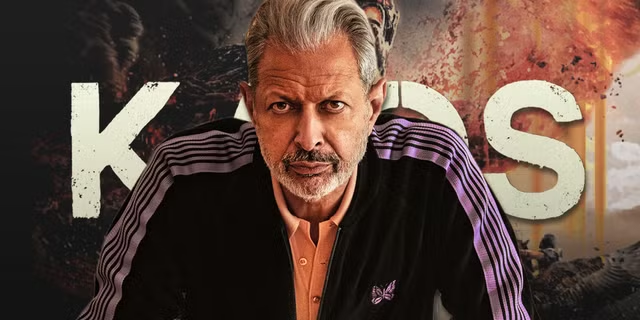
Netflix’s recent series Kaos brought Greek mythology to modern audiences with a dark, humorous twist, blending timeless mythological themes with present-day concerns about power, fate, and identity. Yet despite its potential and dedicated fanbase, Kaos was cancelled after just one season. This post will explore why this show and others like it are important, how audiences react to their sudden endings, and what this tells us about the role of myth in our lives today.
Myths and Their Relevance in Modern Society
Carl Jung and Joseph Campbell were instrumental in showing us that myths are not just stories from ancient times but expressions of universal human experiences. Jung, in particular, believed that myths are rooted in the “collective unconscious,” a deep well of shared archetypes—primordial images and patterns that shape our thoughts, actions, and beliefs. For him, myths are powerful precisely because they tap into these archetypes, reflecting parts of ourselves we may not even be consciously aware of.
Why do these mythological stories still speak to us today? How do they help us make sense of our own experiences, and why is this relevant to modern media?
Through these archetypes, myths reveal deep psychological truths, reflecting everything from our desire for meaning to our fears about power and our place in the world. Campbell’s work on the “hero’s journey” illustrates how these mythic stories guide individuals through transformative experiences, echoing the trials and triumphs that we face in our own lives. It is no wonder, then, that a show like Kaos, which brings these archetypes to life in new ways, draws people in. In many ways, such shows are the modern successors to ancient myths, reaching out through screens rather than fireside gatherings.
The Mythological Experience in Kaos
Kaos brings mythology into the present, reinterpreting ancient narratives to reflect contemporary issues. The show centres on Zeus, the king of the gods, who, upon discovering a wrinkle on his forehead, fears it as the first sign of his downfall. His paranoia spirals, as he tries to control his world, echoing fears of ageing, insecurity, and loss of authority that are universally human.
How does Kaos use myth to comment on these themes, and why do they matter today?
At the same time, Kaos follows mortal characters whose lives become entangled with the gods’ chaotic schemes, highlighting their resilience and struggle for autonomy. The mortal characters embody a quest for identity, a resistance to manipulation, and a journey toward self-realisation—echoing timeless themes within a relatable, human context. By bringing such themes into a contemporary setting, Kaos makes them accessible and relevant, inviting viewers to question their own struggles with identity and power, and to see these as part of a much larger human story.
The Role of Streaming Media in Shaping Modern Myths
Streaming platforms like Netflix have become the new storytellers of our age, where myths are told, adapted, and reimagined for a digital audience. However, while these platforms allow more people than ever to engage with myth-inspired narratives, they also impose certain constraints.
What does the rise and cancellation of myth-based shows like Kaos say about the role of streaming platforms in sustaining these stories? Are streaming services supporting or undermining the cultural value of mythological storytelling?
As Kaos illustrates, streaming platforms are often driven by immediate viewership data rather than a show’s potential to foster long-term impact. If a series doesn’t meet certain metrics, it may be cancelled regardless of its narrative richness or cultural relevance. This short-term approach can limit the life of myth-inspired stories, which traditionally relied on time to build their significance within a community. Kaos, like other mythologically themed series, needed time to cultivate an audience and embed itself in popular culture; instead, it fell victim to a fast-paced content model.
Audience Reaction and the Impact of Kaos’s Cancellation
When Kaos was cancelled, its fans responded with disappointment and anger, seeing this decision as yet another instance of a promising show cut short. Thousands signed petitions and voiced frustration across social media, criticising what they saw as Netflix’s habit of prematurely ending series with dedicated followings.
Why did Kaos inspire such a passionate response? What does this reveal about audiences’ need for meaningful narratives in an age of disposable media?
The strong reaction to the show’s cancellation reveals that viewers seek more than just entertainment—they look for connections, for stories that resonate with their own experiences. Mythological narratives like those in Kaos offer viewers a way to engage with deeper themes, exploring their own questions about destiny, identity, and power through the lens of a modern myth. The outcry over Kaos is more than a call for entertainment continuity; it is a reminder that audiences value stories with substance, narratives that speak to something greater than the immediate gratification of high viewer numbers.
Myth, Media, and the Modern Viewer’s Journey
Mythological storytelling in today’s media holds a profound role in connecting us with timeless elements of the human experience. Shows like Kaos remind us of the power of myth to illuminate complex truths, offer us guidance, and connect us with something beyond ourselves. The cancellation of such shows raises important questions about the sustainability of meaningful narratives in a metrics-driven media landscape.
How can we, as audiences and creators, advocate for the continuation of meaningful, myth-based storytelling in a world increasingly driven by immediate metrics?
Perhaps the answer lies in how we choose to engage with and support these narratives. As viewers, we can seek out and promote shows that offer more than just fleeting entertainment. As creators, there’s an opportunity to push for content that respects these deeper connections and recognises the value of myth as a bridge to personal and collective understanding. Mythological stories are not merely relics of the past; they are tools that can help us navigate our modern world—if only we give them the chance to take root.