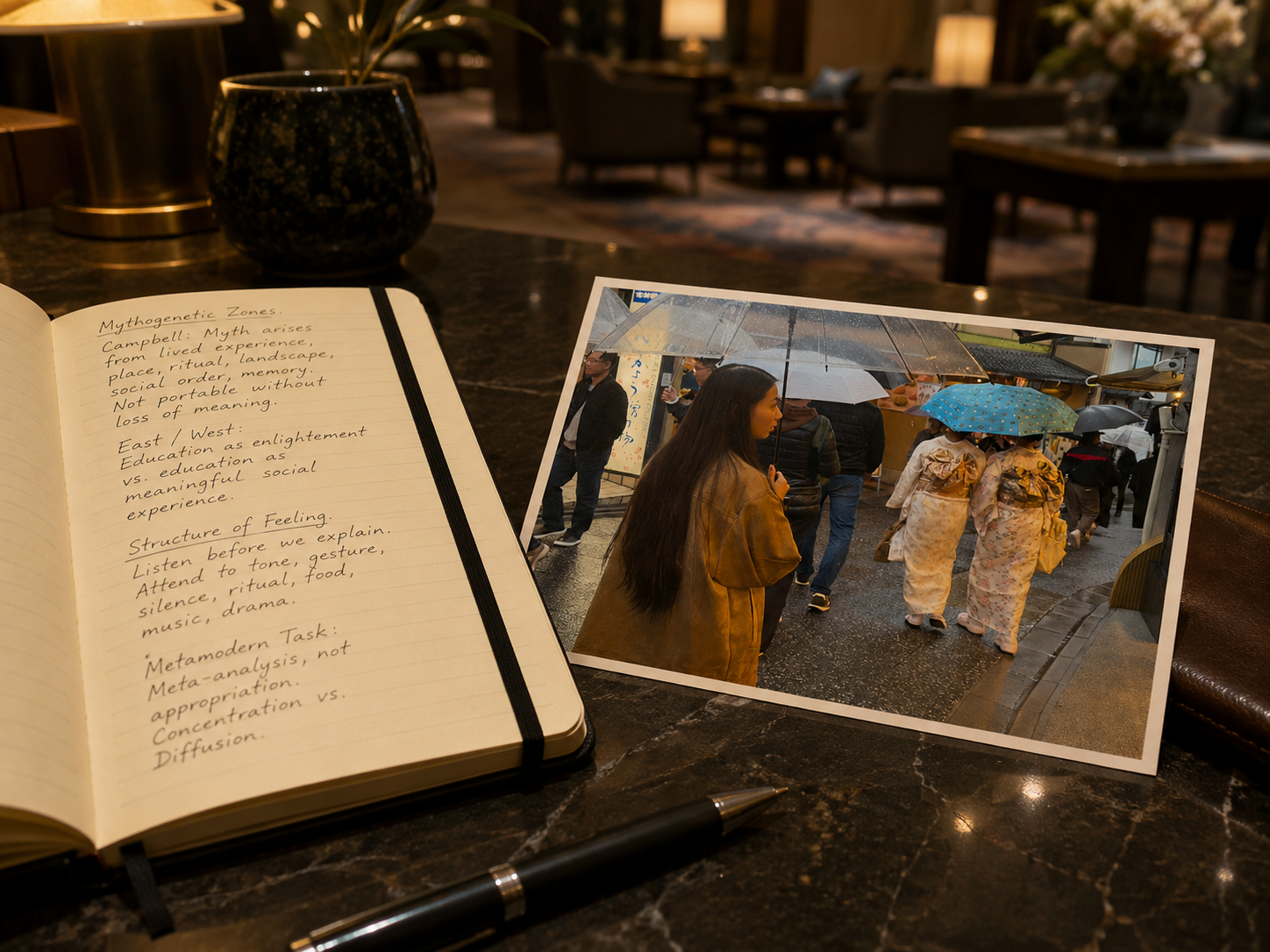
When I visited Japan in November 2025, travelling through Nagoya and Osaka, I did not feel that I was simply moving through another country. I felt that I was moving through another symbolic order. This is not the same as saying that Japan is mysterious, exotic, or unknowable. Those responses are too easy. They turn another culture into an object for Western projection. What I felt instead was more precise and more difficult to describe: a different structure of attention.
The everyday seemed to be organised around another kind of threshold. Food, transport, shops, music, politeness, architecture, small gestures of social care, the dramatic conventions of television, and the compressed emotional grammar of popular culture all seemed to carry meanings that were not fully available to me as an outsider. I could observe them. I could enjoy them. I could respond to them. But I could not claim to inhabit them in the way that someone formed within that culture might.
Since returning, this encounter has not settled into memory. It has become a continuing field of attention. I have found myself submerged in Japanese rock and indie music, listening not as background entertainment, but as an extension of the journey. I have started mixing Japanese bands into podcasts, allowing their textures, vocal tones and rhythms to sit alongside other material. I have also been watching Japanese BL dramas, drawn not simply to their stories, but to their aesthetic handling of longing, restraint, ambiguity, friendship, social pressure, confession and vulnerability.
This is where Joseph Campbell becomes useful, though not because he gives a simple explanation of Japan. Campbell is useful because he warns against simplistic cultural transfer. His idea of the mythogenetic zone gives a way of thinking about the relationship between place, symbol, ritual and lived meaning. A mythogenetic zone is not merely a geographical region. It is the cultural and psychic field from which a mythology arises. It is the zone in which symbols, rites, stories, images and shared emotional patterns acquire their force.
Campbell’s point is not only that different cultures have different myths. His deeper point is that myths arise from specific conditions of life. They are shaped by landscape, ritual, food, kinship, work, danger, cosmology, social hierarchy, memory and bodily practice. They are not free-floating stories that can be lifted intact from one place and dropped into another. A symbol may travel, but its force may not travel with it. A story may be translated, but its original pattern of feeling may remain only partly accessible.
This matters because mythology, for Campbell, is not decorative. It has a function. It opens human beings to mystery. It gives an image of the cosmos. It binds people into a social order. It helps individuals pass through the stages and crises of life. Myth is therefore not simply what a society says about itself. It is one of the ways a society trains attention, channels feeling and organises experience. In a living mythology, the factual world that supplies mythic imagery must be the world actually present to those living within it. Myth cannot simply be exported from one land or time into another without distortion.
This has made me think again about my encounter with Japanese culture. My interest is not only in “Japan” as a topic. It is in the tension between attraction and distance. I am drawn to the music, the dramas, the urban atmospheres, the food rituals, the visual design, the emotional codes. Yet, I am also aware that my response is formed from a Western position. I am not stepping outside my own mythogenetic zone. I am encountering another one through the instruments available to me: listening, watching, travelling, reading, comparing and remixing.
Campbell makes a sharp distinction between Eastern and Western orientations. In Primitive Mythology, he argues that since the Renaissance, the West has tended to understand education as the “inculcation of information about the world in which we live.” By contrast, he argues that in primitive, archaic and Oriental spheres, the aim of education has been less about rational enlightenment in the Western sense, and more about forming communities of shared experience, binding the sentiments of the growing individual to the central concerns of the local group.
This contrast is not absolute, and it should not be treated crudely. The West also has ritual, belonging, church, family, nation, class, school, football, theatre, pub culture and civic ceremony. Japan also has rationality, science, bureaucracy, modernity, technology and critical thought. But Campbell’s distinction is still useful because it points to a difference of emphasis. One model imagines education as the development of a rationally informed individual. The other imagines education as the formation of a socially attuned participant.
This is where Raymond Williams’ idea of a structure of feeling becomes especially helpful. Williams used this phrase to name the lived, affective quality of a culture or period: the not-yet-fully-articulated pattern of meanings, moods, pressures and sensibilities through which people experience their world. It is not ideology in the narrow sense. It is not merely a set of beliefs. It is closer to the felt texture of life before it becomes doctrine.
In Japan, what struck me was precisely this level of culture: the structure of feeling. Not only what people think, but how social life seems to be modulated. The carefulness of food presentation. The choreography of public behaviour. The relation between privacy and social visibility. The aesthetic compression of emotion in drama. The precision of packaging. The politeness rituals around exchange. The tonal range of indie and rock music, which can move between delicacy, melancholy, intensity and release without always fitting Western expectations of emotional display.
When I listen to Japanese rock and indie music now, I am not simply listening to songs. I am listening to a world of social feeling passing through guitars, voices, pauses, production choices and melodic habits. When I watch Japanese BL dramas, I am not only following romantic plots. I am watching a symbolic grammar of hesitation, social risk, coded desire, relational care, shame, loyalty and emotional timing. The appeal is partly aesthetic, but it is also mythological in Campbell’s sense. These forms dramatise how individuals find, resist or negotiate their place within a social field.
This is not the same as saying that Japanese popular culture is “traditional” in any simple way. Much of it is highly modern, commercial, hybrid and globally circulated. But that does not make it symbolically empty. Popular culture is often where contemporary mythology becomes most visible. It is where inherited structures of feeling are remixed with modern anxieties: loneliness, work pressure, gender expectation, romantic uncertainty, technological mediation, urban anonymity and the longing for authentic recognition.
The question, then, is not whether I can “understand Japan.” That would be too large and too presumptuous. The more useful question is: what happens when one mythogenetic zone encounters another?
A Western observer formed by traditions of rational analysis, individual expression, critical distance and self-explanation encounters a cultural field in which social form, ritualised conduct and affective restraint may carry meanings that are not reducible to explanation. The Western impulse is often to interpret, classify, compare and articulate. The Eastern ritual field, as Campbell describes it, may place greater emphasis on participation, attunement, repetition and the formation of shared sentiment.
This does not mean that one is better than the other. It means that they train different capacities. The Western rational model can produce critique, autonomy, scientific inquiry and individual conscience. It can also produce alienation, abstraction and a tendency to mistake explanation for understanding. The Eastern ritual-social model can produce attunement, continuity, discipline and shared belonging. It can also produce conformity, inhibition and difficulty for those who do not fit the expected pattern.
The metamodern task is not to collapse one into the other. It is to develop a meta-analysis of both. That means asking what each mythogenetic zone makes possible, what each suppresses, what each illuminates, and what each cannot easily see in itself.
For me, my growing interest in Japan is therefore not merely cultural consumption. It is becoming a comparative exercise in symbolic attention. The music, dramas, food, cities and aesthetic forms are not isolated interests. They are contact points. They are ways of asking how meaning is generated in different cultural fields, and what happens when those fields meet.
This is also where Campbell’s warning becomes important. Mythic systems can diffuse. They can travel through films, music, tourism, translation, streaming platforms, fashion, food and online fandom. Japanese culture has already been globalised in countless ways. Western audiences consume anime, manga, J-rock, city pop, BL dramas, food culture, design and fashion. But diffusion is not the same as integration. To adopt a surface form is not necessarily to inhabit the mythic ground from which it emerged.
A person can listen to the music without sharing the social atmosphere that shaped its emotional codes. A person can enjoy the drama without understanding the full weight of its silences. A person can admire ritualised politeness without knowing its obligations from within. A person can consume the image while missing the discipline, pressure or historical memory behind it.
This does not make cross-cultural engagement false. It makes it morally and interpretively demanding. The choice is not between appropriation and withdrawal. The better question is how to remain attentive to the difference between appreciation, projection, translation and participation.
Some elements of another mythogenetic zone may be meaningfully integrated. Music is one of the most powerful examples, because it works below the level of explicit concept. It carries rhythm, mood, bodily charge and atmosphere. Food can also cross thresholds, though often unevenly. Dramatic forms can travel, especially when the emotions they carry are recognisable across cultures. But some meanings remain embedded in practices that cannot be detached from upbringing, language, social expectation and ritual memory.
This is why the distinction between concentration and diffusion matters. A concentrated mythos system is thick with local meaning. It is held in place by shared assumptions, embodied habits and inherited forms. A diffused mythos system travels outward, becoming available to strangers, fans, markets and interpreters. In diffusion, symbols gain reach but may lose depth. They become easier to access, but harder to inhabit.
The metamodern response is not nostalgia for purity. Cultures have always borrowed, adapted and transformed. Japan itself is a profound example of cultural adaptation: absorbing, refining, hybridising and reworking influences from China, Korea, Europe and America, while retaining distinctive structures of form and feeling. The question is not whether cultural systems should remain sealed. They never do. The question is what kind of consciousness we bring to the crossing.
Do we treat another culture as content? Do we use it to decorate the self? Do we turn it into a fantasy of escape from our own dissatisfactions? Or do we allow it to question the assumptions through which we ordinarily experience the world?
My own interest in Japanese music and drama feels most valuable when it does the latter. It makes me ask what Western culture has overdeveloped and what it has neglected. It makes me think about the limits of verbal explanation. It makes me more attentive to tone, silence, pacing, gesture and indirect forms of care. It also makes me more aware of my own interpretive habits: the impulse to analyse quickly, to translate feeling into argument, to move from experience to concept before the experience has had time to work.
This is not a rejection of Western rationality. Campbell’s own work depends on comparison, scholarship and conceptual distinction. Williams’ “structure of feeling” is itself an analytical tool. The point is not to abandon analysis, but to re-situate it. Analysis should not stand above experience like a detached judge. It should return us to experience with more tact.
The encounter with Japan, then, becomes a personal version of a larger question. Can distinct mythogenetic zones enter into meaningful relation without being flattened? Can Western rational enlightenment and Eastern social attunement be held in productive tension? Can we learn from another structure of feeling without pretending to own it? Can diffusion become dialogue rather than extraction?
I do not think the answer is simple. Some forms can be shared deeply. Some can be shared only partially. Some will remain opaque, and perhaps should. Not every cultural meaning is available for integration. Some meanings belong to practices, histories and social formations that cannot be acquired through enthusiasm alone. There is dignity in recognising that limit.
But there is also value in standing at the threshold. The traveller, listener, viewer and mixer of sounds can become a kind of interpreter, not by claiming mastery, but by sustaining attention. A podcast mix that includes Japanese indie music alongside other material may not integrate mythogenetic zones in any grand sense. But it can create a small listening space in which different atmospheres touch. A blog post cannot resolve East and West. But it can ask what happens when one structure of feeling begins to resonate against another.
Perhaps that is the more honest form of cultural understanding. Not possession. Not explanation. Not imitation. A careful oscillation between nearness and distance.
Campbell’s mythogenetic zone reminds us that myths are born somewhere, among particular bodies, landscapes, rituals and histories. Williams’ structure of feeling reminds us that culture is lived before it is explained. My experience of Japan has made both ideas more concrete. Nagoya and Osaka were not simply destinations. They became openings into another symbolic order, one that I continue to approach through music, drama, memory and reflective practice.
The task now is not to turn Japan into a theme, but to let the encounter remain active. To listen more carefully. To compare without reducing. To mix without dissolving difference. To ask what can genuinely be shared, what can only be translated imperfectly, and what must remain respectfully beyond integration.
That may be where cultural understanding begins: not in the fantasy that all myths are the same, but in the recognition that each living mythos carries its own conditions of emergence. The work is to meet those conditions with enough humility, curiosity and discipline that the encounter changes the listener, not merely the playlist.
Endnotes
1. Joseph Campbell Foundation, Joseph Campbell’s Four Functions of Myth.
2. Joseph Campbell, The Masks of God: Primitive Mythology, available via Internet Archive.
3. Raymond Williams Society, Structure of Feeling: A Conceptual Tool in the Study of How Ordinary People Live and Struggle.
Leave a Reply