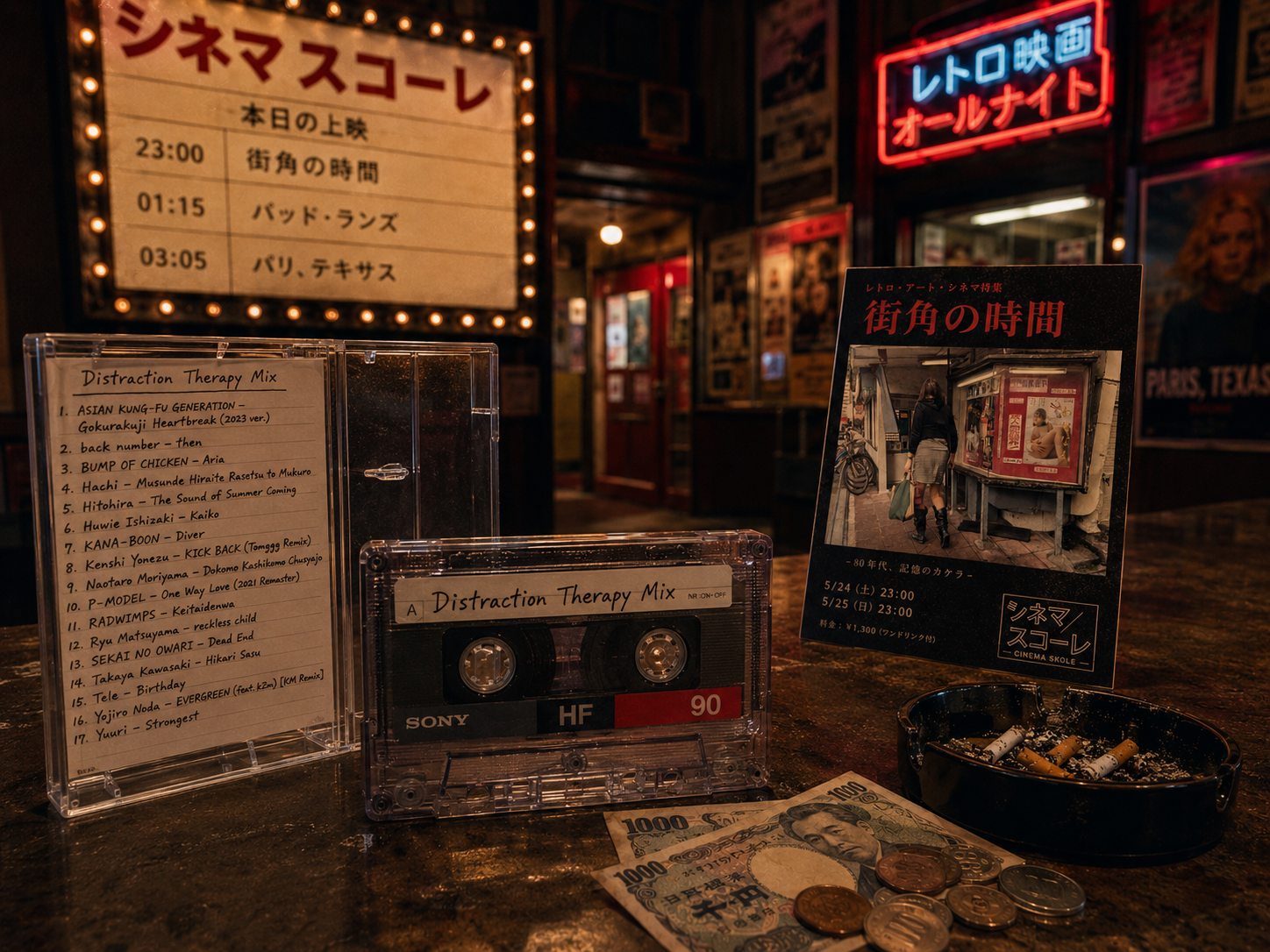
This Distraction Therapy mix moves through Japanese indie, rock, alternative pop and electronic-adjacent music as a sequence of thresholds. It is not a strict genre survey. It is closer to a mixtape of changing states: youth becoming memory, cities becoming emotional landscapes, technology becoming intimacy, and songs becoming places in which the listener can briefly dwell.
Across the mix, there is a repeated feeling of motion. The railway, the phone, the parking lot, the birthday, the remixed single, the anime theme, the remembered summer and the reckless child all imply passage. These are songs of people moving through ordinary spaces while carrying private intensities that do not always fit the public world around them.
It would be too simple to describe this as “Japanese melancholy”, as though a national mood could be reduced to one emotion. What feels more accurate is a sensibility of charged transience. The songs often hold beauty and unease together. They use the familiar surfaces of pop and rock, but the emotional life underneath them is unstable, recursive and reflective. The listener is not being asked only to feel nostalgia. They are being asked to notice the exact point where nostalgia becomes self-recognition.
ASIAN KUNG-FU GENERATION’s “Gokurakuji Heartbreak” opens this space through the coastal geography of Surf Bungaku Kamakura, a project later completed and re-recorded in 2023 as an album structured around the Enoden railway line and its stations. The song carries the feeling of movement through a real place that has already become symbolic. It suggests heartbreak not as theatrical collapse, but as something passed through on a train, a station, a walk, a piece of remembered weather. The 2023 complete version of the album includes re-recordings and additional tracks, extending the original railway concept into a fuller map.
From there, back number’s “then” turns toward the private register of early adulthood and emotional aftermath. Released on the 2009 mini-album Nogashita Sakana, it belongs to the band’s earlier period, before their later national profile. The song’s title is slight, almost evasive, but this slightness is part of its strength. “Then” is not only a time marker. It is a way of naming something that has already slipped away.
BUMP OF CHICKEN’s “Aria” deepens this inward movement. Written and composed by Motoo Fujiwara and released in 2016, it later appeared on Aurora Arc. The song’s emotional centre lies in contact and separation: the attempt to say something, to remember something, to keep the warmth of an encounter after it has passed. It gives the mix one of its clearest expressions of relational memory.
Hachi’s “Musunde Hiraite Rasetsu to Mukuro” interrupts the guitar-led flow with a darker, stranger lineage. As a vocaloid-origin work by Hachi, the earlier artistic identity of Kenshi Yonezu, it connects the mix to online music culture, synthetic voice, folk-horror imagery and the theatrical grotesque. Published in 2009 and associated with Hatsune Miku, it brings in a world of masks, demons, bodies and ritualised play. Within the mix, it acts like a shadow-screen: a reminder that Japanese pop experimentation has often developed through digital folk forms as much as through bands.
Hitohira’s “The Sound of Summer Coming” restores the band format, but with a more shoegaze and post-rock inflection. Hitohira are described by TuneCore Japan as a Tokyo-based four-piece rock band built around alternative sound, Japanese melodic lines, abstract lyrics, twin-lead guitars and shoegaze-influenced roar. The track appears on the 2023 album Tsukuru, whose notes describe songs concerned with the building of personality and life through encounters, scenery and experience. This makes it especially apt for the mix: summer is not simply a season, but an approaching inner climate.
Huwie Ishizaki’s “Kaiko” adds the register of the singer-songwriter. The title, more accurately rendered as “邂逅”, means an encounter or chance meeting. Released as a 2023 single, it appears as a concentrated piece of reflective songwriting, with Ishizaki’s voice carrying the emotional weight of meeting, parting and recognition. The song’s placement in the mix helps move the listener from adolescent memory into a more adult sense of fate and contingency.
KANA-BOON’s “Diver” brings forward momentum. Released in 2015 as the band’s seventh single, it was used as the theme song for Boruto: Naruto the Movie. Its role as an anime film theme matters here, because it connects Japanese rock to mass youth culture, inheritance narratives and the emotional energy of stepping forward from an established world into a new one. In the mixtape, it works as a burst of propulsion after the reflective early sequence.
Kenshi Yonezu’s “KICK BACK (Tomggg Remix)” then pushes that propulsion into a more unstable, remixed space. The remix was released by Sony Music Labels in 2025, with Tomggg credited as remixer and Yonezu and Daiki Tsuneta associated with the original production framework. As the original “KICK BACK” is strongly tied to the high-impact world of Chainsaw Man, the remix carries a jagged, overloaded energy: appetite, absurdity, acceleration and the exhaustion of being pulled through contemporary media intensity.
Naotaro Moriyama’s “Dokomo Kashikomo Chusyajyo” shifts the whole atmosphere into social observation. The title means, approximately, “Parking Lots Everywhere”. Released in 2013 on Jiyū no Genkai, the song is credited to Moriyama and Kaito Okachimachi. Its absurd image of an environment overtaken by parking lots gives the mix an urban-pastoral tension: the everyday built environment becomes comic, alienating and oddly mournful.
P-MODEL’s “One Way Love (2021 Remaster)” brings in an older electronic and new-wave genealogy. The track originates from Landsale, released in 1980, with Susumu Hirasawa credited as composer and lyricist; the remastered version places that early technopop and new-wave sharpness into the present tense. In this mix, P-MODEL functions as a historical disturbance. It reminds the listener that Japanese alternative music did not begin with the indie-rock idioms of the 2000s, but also with synthetic, angular, theatrical forms of pop modernity.
RADWIMPS’ “Keitaidenwa” returns to intimacy, but now mediated by technology. Released in 2010, written and composed by Yojiro Noda, and issued as a single by RADWIMPS, it belongs to a period when the mobile phone had become one of the dominant objects of emotional life. The phone is not just a device. It is a container for waiting, absence, presence and uncertainty. In this sense, the song is one of the mix’s clearest statements about modern connection.
Ryu Matsuyama’s “reckless child” offers a quieter, more spacious reflection. It appears on the 2022 album from here to there, and is written and composed by Ryu Matsuyama. The title suggests a memory of the self before caution, before compromise, before adult calibration. The song holds that younger self with tenderness rather than embarrassment. It is not about returning to childhood. It is about recognising what childhood still carries inside the adult life.
SEKAI NO OWARI’s “Dead End” appears on the 2024 album Nautilus, with Fukase credited as lyricist and vocalist and Nakajin as composer. The title might suggest closure, but within the larger arc of the mix it feels less like finality than a point of reversal. A dead end is also a place where the body turns around. The song becomes a hinge between defeat and renewed movement.
Takaya Kawasaki’s “Hikari Sasu” brings light into the sequence. Released on Magic in 2020, with Kawasaki credited as composer and lyricist, it is a compact singer-songwriter piece whose title suggests light shining through. After the density of the previous tracks, its role is restorative rather than simplistic. It does not cancel the melancholy of the mix. It lets light fall across it.
Tele’s “Birthday” is another contemporary solo voice. Tele is the solo project of Kitaro Taniguchi, who is credited as lyricist, composer and arranger on the track. “Birthday” appears on New Born Ghost, and its images of celebration, exhaustion and change give the song a bitterly self-aware quality. A birthday should mark continuity, but here it feels more like estrangement from the self.
Yojiro Noda’s “EVERGREEN (feat. kZm) [KM Remix]” connects RADWIMPS’ songwriting world to hip-hop and remix culture. RADWIMPS’ official site notes the release of the KM remix, while Apple Music lists the single as a 2024 hip-hop/rap release. The title “evergreen” suggests endurance, but the remix form complicates that endurance: what lasts does not remain unchanged. It survives by being reworked.
Yuuri’s “Strongest” closes the track sequence with a direct statement of force. Sony Music identifies “最&強” as a Yuuri release, while the auto-generated Sony Music Labels listing credits CHIMERAZ with composition, lyrics, arrangement and production and gives the release date as 20th April 2025. In the mix, it reads as an ending that refuses delicacy. After so much memory, mediation and uncertainty, the song reaches for strength, not as domination, but as the desire to withstand the conditions through which the listener has been travelling.
As a Distraction Therapy podcast, this mix can be heard as an emotional map of passage. It begins with stations, remembered roads and earlier selves. It moves through phones, screens, anime intensity, vocaloid shadows, parking lots and remixed futures. It ends with light, birthday, evergreen endurance and strength. The sensibility is not one of escape from ordinary life. It is closer to the transformation of ordinary life into an inner landscape.
The Japanese experience suggested here is therefore not a fixed identity, but an aesthetic field: trains and towns, pop and folklore, youth media and adult solitude, precision and emotional overflow, memory and technological presence. The mix feels like walking through a city after rain, with songs appearing in shop windows, headphones, station platforms and half-remembered conversations. It asks the listener to remain attentive to what is passing because what is passing may be the very thing that makes experience luminous.
Leave a Reply