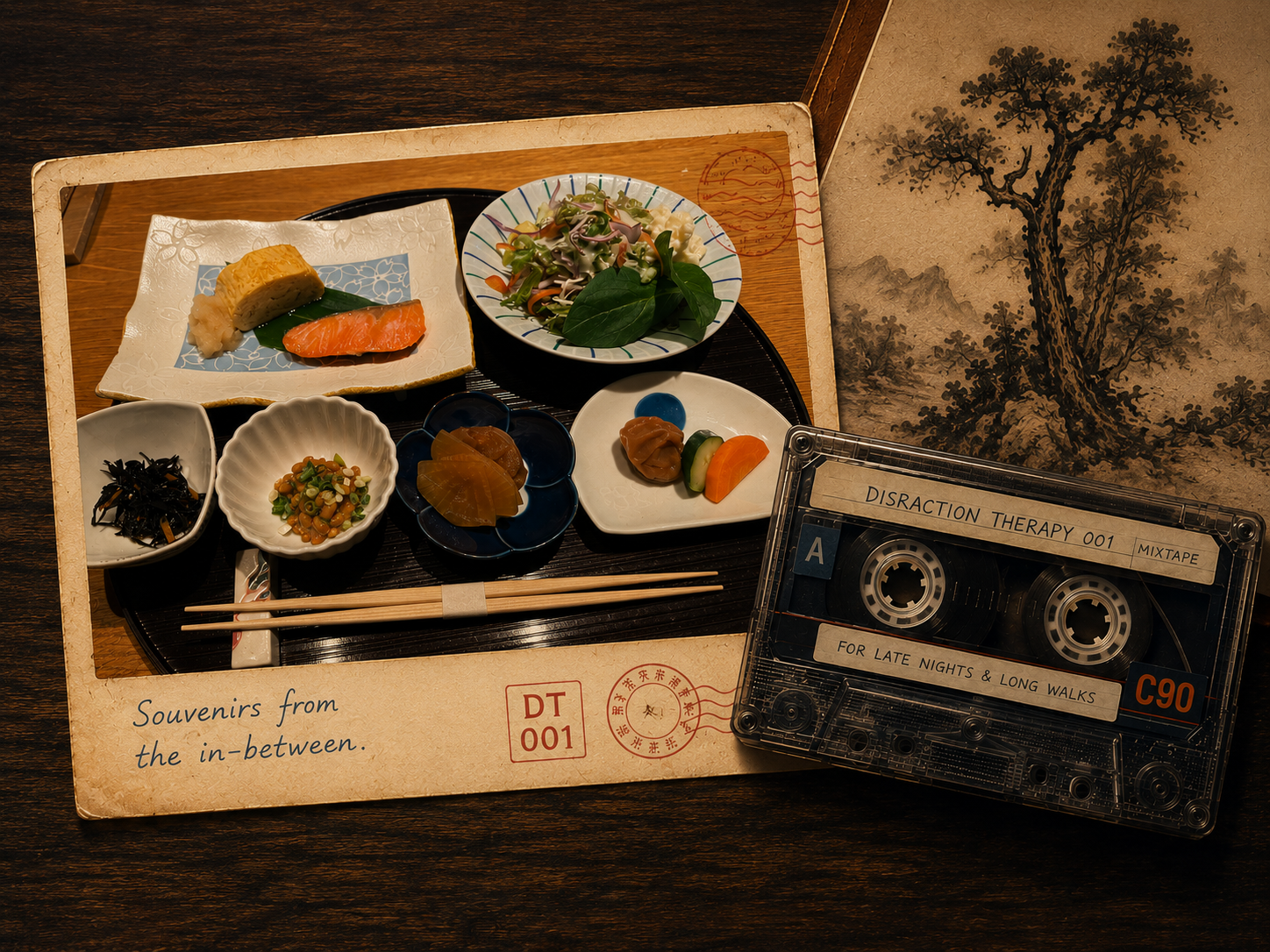
This music mix episode of Distraction Therapy unfolds less as a sequence of songs than as a slow passage through altered emotional weather. The tracks gather around a shared atmosphere of distance, memory, fragility, and suspended movement, creating a listening experience shaped by quiet transitions rather than dramatic declarations. The emotional register remains subdued throughout, but beneath that restraint is a continual oscillation between intimacy and estrangement, warmth and dislocation, melancholy and renewal.
Much of the mix seems to inhabit twilight spaces. Rain shelters, railway platforms, empty roads, fading neon, sleeping cities, forgotten coastlines, and drifting interiors are implied throughout the sequence, even when never directly named. The music evokes a world experienced indirectly, through reflection, recollection, or emotional afterimage. Voices often sound distant or partially submerged within the arrangements, as though emerging from memory itself rather than from the immediate present.
There is also a persistent sense of emotional incompletion. These tracks rarely resolve tension in a conventional way. Instead, they linger within uncertainty, allowing emotional ambiguity to remain open and unresolved. Harumi Fuuki’s delicate orchestration, Kenshi Yonezu’s fractured introspection, and the cinematic melancholy of RADWIMPS establish an atmosphere where feeling exists prior to explanation. Emotions drift across the surface of the music like changing light, rather than becoming fixed statements.
Thematically, the mix moves through experiences of separation and return. There are traces of absence everywhere: lost conversations, imagined futures, fading relationships, and places revisited only through recollection. Yet, the atmosphere is not despairing. The emotional tone is one of endurance through uncertainty. Even the more sorrowful passages retain a sense of openness and permeability, as though memory itself remains alive and unfinished.
This quality becomes more pronounced as the sequence shifts toward the electronic and experimental works of P-MODEL, sakanaction, and Susumu Hirasawa. Here the emotional landscape becomes stranger and more abstract. Mechanical rhythms and synthetic textures do not erase human feeling, but instead refract it through technological surfaces. Identity begins to feel fluid and unstable. The listener moves from reflective nostalgia into something more dreamlike and liminal, where inner life and mediated reality begin to overlap.
Hirasawa’s presence is especially important within this atmosphere. His work often occupies a threshold between the organic and the artificial, between ritual and machinery, transcendence and collapse. In the context of this mix, his music acts almost like a portal into a deeper psychic landscape, where emotional states are experienced spatially rather than narratively. The effect is hypnotic rather than analytical.
Alongside these more experimental moments are recurring gestures of tenderness and stillness. Yoshitaka Fujimoto’s ambient abstraction dissolves fixed emotional boundaries, allowing atmosphere itself to become the primary expressive medium. Silence, reverberation, and sonic distance become emotionally communicative.
The inclusion of Tim Love Lee subtly alters the geography of the mix. The atmosphere expands outward into movement, transit, and horizon. Airports, departures, coastlines, and temporary shelters seem to emerge at the edges of perception. The listener is no longer enclosed entirely within interior emotional reflection, but begins drifting through larger spaces shaped by travel, impermanence, and transitory encounters.
Across the full sequence, Japanese contemporary music reveals a particular sensitivity toward emotional atmosphere and temporal fragility. The tracks often resist direct emotional exposition in favour of implication, spatial awareness, and tonal subtlety. Nature, weather, memory, architecture, and technology are not treated as separate categories, but become intertwined emotional environments through which the listener passes.
The reflective journey of the mix is therefore not linear. It does not move from sadness toward happiness, nor from darkness toward resolution. Instead, it traces a series of emotional thresholds. The listener drifts between states of recognition and estrangement, closeness and distance, solitude and quiet consolation. What emerges is a contemplative emotional ecology shaped by impermanence and attention.
This mix ultimately creates the sensation of inhabiting a half-remembered world. The music feels suspended between analogue memory and digital dream, between private reflection and collective cultural atmosphere. It invites listeners not to escape contemporary life, but to move more slowly within it, noticing the fragile emotional textures that usually pass unheard beneath the noise of ordinary experience.
The track listing for this episode of Distraction Therapy presents a reflective and atmospheric selection of Japanese contemporary music, soundtrack composition, ambient electronics, and crossover experimental pop. The sequence moves between emotional introspection, urban melancholy, dreamlike instrumental textures, and cinematic atmosphere.
Harumi Fuuki – “Namida to Block”
Harumi Fuuki is a Japanese composer known for emotionally rich orchestral and cinematic works across television, film, and animation. Her music often combines classical composition with subtle electronic and contemporary textures. “Namida to Block” appears on the *Hirayasumi* original soundtrack and carries a restrained emotional tone, using gentle harmonic progression and sparse melodic phrasing to evoke reflection and quiet emotional recovery. Critics and profile material often describe Fuuki’s work as cinematic, humane, and psychologically attentive. ([HARUMI FUULI])
Kenshi Yonezu – “Shouhon”
Kenshi Yonezu emerged from the Vocaloid and internet music scene before becoming one of Japan’s most influential contemporary songwriters. “Shouhon” comes from his early album *diorama* and reflects the transitional period where he moved from digitally mediated experimental pop toward more emotionally direct songwriting. The song has been noted for its lyrical ambiguity and atmosphere of urban alienation and longing. Yonezu’s work is frequently discussed as combining literary introspection with alternative pop structures. ([Kenshi Yonezu])
LEGO BIG MORL – “Saishukai wa Tohmei”
LEGO BIG MORL are associated with emotionally expansive Japanese alternative rock, often balancing post-rock textures with melodic indie songwriting. “Saishukai wa Tohmei” (“The Final Episode is Transparent”) carries a sense of fading memory and unresolved emotional distance. Live versions are especially valued by listeners for their spacious arrangements and gradual crescendos. Their work often attracts comparisons with cinematic alternative rock bands such as Asian Kung-Fu Generation and early RADWIMPS. ([youtube.com)
Mirai Kodai Gakudan – “Eden No Yurikago (Instrumental)”
Mirai Kodai Gakudan (“Future Ancient Orchestra”) work within the Japanese fantasy and anime soundtrack tradition, blending orchestral arrangements with progressive rock and symphonic electronics. “Eden No Yurikago” (“Cradle of Eden”) evokes suspended or dreamlike emotional states through layered instrumentation and melodic romanticism. Their work often appeals to listeners interested in speculative or mythic atmospheres.
OFFICIAL HIGE DANDISM – “Midori no Amayoke”
Known colloquially as “Higedan,” OFFICIAL HIGE DANDISM combine jazz harmony, pop melody, soul, and indie rock. “Midori no Amayoke” (“Green Rain Shelter”) has a softer and more pastoral atmosphere than many of their more commercially recognised tracks. Their music is frequently praised for sophisticated chord structures and emotionally expressive vocal delivery, often balancing optimism with melancholy.
P-MODEL – “Ihojin (2021 Remaster)”
P-MODEL were pioneers of Japanese technopop and experimental electronic music, led by Susumu Hirasawa. “Ihojin” (“Stranger” or “Foreigner”) reflects the band’s mechanised rhythmic structures, angular synthesisers, and themes of estrangement and altered identity. The remaster restores clarity to the dense electronic textures while preserving the cold futurist aesthetic associated with late seventies and eighties Japanese avant-garde synth music.
RADWIMPS – “Kanata Haluka”
RADWIMPS are known internationally for their collaborations with filmmaker Makoto Shinkai. “Kanata Haluka” was used in *Suzume* and carries themes of separation, distance, memory, and emotional persistence. Reviews frequently note the song’s gradual emotional build and expansive arrangement. The group’s songwriting often moves fluidly between intimate confession and large-scale cinematic expression.
RADWIMPS – “Kuchikamizake Trip”
This instrumental and atmospheric piece references the ritual sake motif from Your Name. It combines ambient electronics, traditional Japanese sonic references, and drifting harmonic movement. The track is frequently discussed as part of RADWIMPS’ ability to create emotional continuity and spatial atmosphere within narrative cinema.
sakanaction – “Yes No (AOKI takamasa Remix)”
sakanaction occupy a distinctive position between indie rock, dance music, and experimental pop. AOKI takamasa’s remix transforms the original track into a more abstract electronic meditation, emphasising repetition, texture, and spatial rhythm. The remix has been noted for reducing the emotional directness of the original in favour of hypnotic electronic fragmentation and nocturnal ambience.
SEKAI NO OWARI – “Nemurihime”
SEKAI NO OWARI combine fantasy imagery, theatrical production, and emotionally accessible pop songwriting. “Nemurihime” (“Sleeping Princess”) is often interpreted as a dreamlike meditation on emotional isolation and vulnerability. Their work frequently balances innocence with melancholy, using elaborate sonic environments and childlike symbolism.
Shigeo Sekito – “A Whiter Shade of Pale”
Shigeo Sekito became internationally rediscovered through interest in Japanese lounge and “environmental” music. His electone organ interpretations are valued for their uncanny mixture of nostalgia, detachment, and dreamlike serenity. His version of “A Whiter Shade of Pale” transforms the Procol Harum original into something more fragile and suspended, aligning with contemporary interest in ambient exotica and retro-futurist listening culture.
Spitz – “Heavy Mellow”
Spitz are one of Japan’s defining melodic rock bands, known for understated emotional songwriting and warm guitar arrangements. “Heavy Mellow” combines gentle psychedelia with reflective pop lyricism. Their music is often associated with nostalgia, emotional subtlety, and a distinctly Japanese form of understated romanticism.
Susumu Hirasawa – “Skelton Coast Kouen (Live At Shibuya Koukaido 1990)”
Susumu Hirasawa’s solo and P-MODEL-related work combines progressive electronics, philosophical themes, cybernetic imagery, and ritualistic repetition. Live performances from this period are often described as hypnotic and visionary. The piece carries a mechanical but strangely spiritual atmosphere, characteristic of Hirasawa’s exploration of technology, memory, and transcendence.
Tamiya Terashima – “Light and Shadow”
Terashima is best known for anime and cinematic soundtrack composition, especially in emotionally reflective or contemplative settings. “Light and Shadow” uses restrained orchestration and tonal contrast to suggest ambiguity, memory, and emotional transition. His work is often valued for its understated narrative sensitivity.
Tim Love Lee – “Exit 747”
Tim Love Lee is associated with downtempo, Balearic, and eclectic electronic production. “Exit 747” evokes travel, drift, and transitional movement, combining dub textures with lounge and ambient influences. His productions are frequently described as cinematic and transportive, situated between club culture and introspective listening.
Tim Love Lee – “Twilight Reservation”
This track continues Love Lee’s fascination with travel imagery and suspended emotional states. The title itself suggests liminality and impermanence. The composition combines soft breakbeats, ambient layering, and melodic repetition to create an atmosphere of reflective motion.
Yoshitaka Fujimoto – “The Unseen Life of the Gun-Kyou”
Yoshitaka Fujimoto works within Japanese ambient and electroacoustic traditions, often integrating environmental sound, minimalism, and abstract sonic narrative. This piece is elusive and meditative, suggesting hidden structures or invisible emotional landscapes. His work is often discussed alongside Japanese environmental music and post-industrial ambient experimentation.
Collectively, the playlist establishes a coherent “structure of feeling” rooted in emotional suspension, urban solitude, dream imagery, memory, and metamodern oscillation between sincerity and fragmentation. The transitions between cinematic
soundtrack work, alternative Japanese rock, ambient electronics, and retro-futurist textures create a listening experience that feels simultaneously intimate, reflective, and geographically expansive.
Leave a Reply