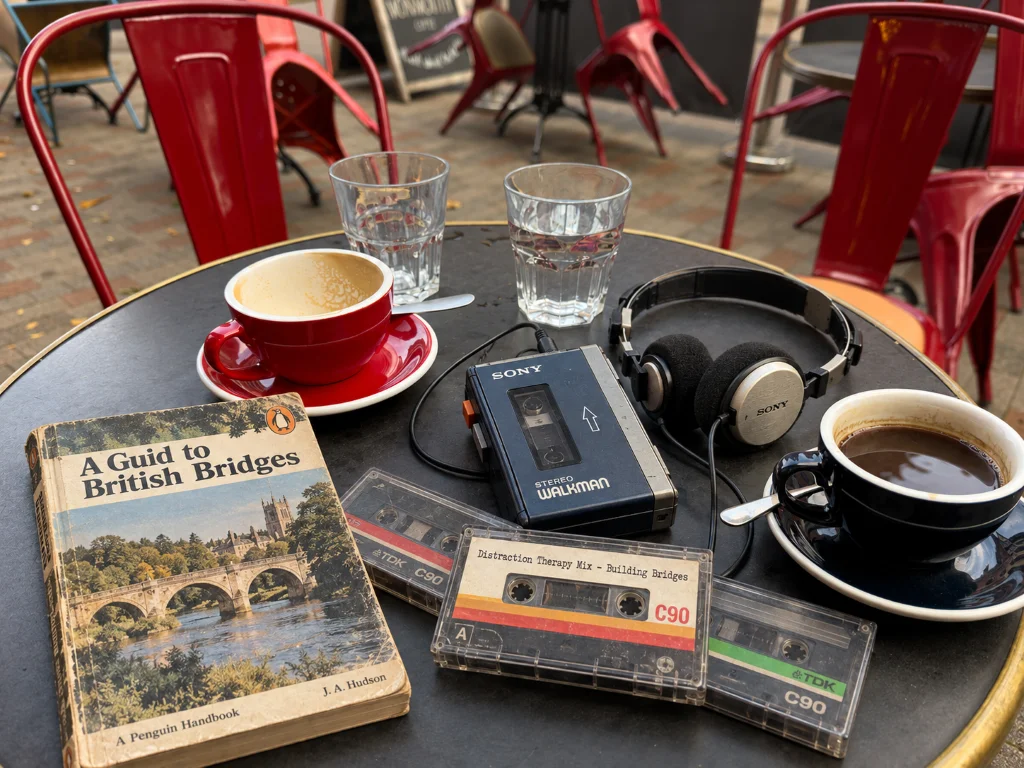
There is something deceptively simple about a bridge. It joins one place to another. It allows movement across a space that would otherwise interrupt the journey. But a bridge does not abolish the distance beneath it. The river remains a river. The railway remains a railway. The valley stays open. Perhaps that is why the bridge is a useful image for thinking about how we live alongside other people.
This edition of Distraction Therapy begins with the idea that connection does not necessarily mean agreement. We can meet without becoming the same. We can share a rhythm, a room or a journey while continuing to carry different memories, assumptions and ways of understanding the world. The bridge makes that possible because it is neither destination nor origin. It is a place of movement between them.
Finding A Shared Rhythm
Imagine a footbridge somewhere on the edge of a large city. Below it, water catches fragments of buildings, clouds and passing light. People cross in both directions. Someone cycles past. Somewhere nearby there is traffic, conversation, perhaps music coming through an open window.
For a few moments, people whose lives may have little else in common occupy the same structure. Much of the music in this episode operates in a similar space. Rock, electronic music, indie pop, dance music and more hauntological textures move alongside one another without being required to resolve into a single style. What holds them together is movement.
Rhythm has a peculiar social quality. We do not have to know what somebody else is thinking in order to move alongside them. We do not need a complete account of their history. Something can be shared before it has been explained. That does not mean that differences disappear.
Sometimes a familiar phrase lands differently from the way we intended. An invitation can be misunderstood. A conversation that appeared straightforward becomes difficult. The temptation is often to imagine that better communication will remove these uncertainties. Yet perhaps a more useful form of connection begins by accepting that complete understanding may never be possible.
A bridge does not remove the gap. It creates a way of crossing it.
Leaving Room For Difference
There is a particular promise contained in collective music. Someone establishes a rhythm. Someone else finds a place within it. A sound enters, disappears and returns. What seemed to belong to one person becomes part of something larger. The finished recording can disguise how contingent this process is.
Behind it are innumerable small decisions. Someone leaves space rather than filling it. A rough sound is retained because it changes the atmosphere. An unexpected contribution alters the direction of the whole piece. These are small negotiations about how different things might coexist.
They are also useful ways of thinking about public and social life. Any shared space depends upon somebody deciding that there is room for another person to enter it. The invitation matters, but so do the practical conditions that make participation possible.
A dance floor can promise freedom, but real rooms have doors. They have prices, expectations and exclusions. A public space only becomes genuinely shared when people pay attention to who is able to enter it and who is not. Even so, there are moments when moving together changes the way strangers perceive one another.
The unknown person nearby becomes somebody whose timing we recognise. For a moment, difference is not a problem requiring a solution. It becomes part of the texture of the room.
Cities, Memory And Incomplete Signals
The bridge also offers another possibility. It can connect different times. Sounds do this constantly. A fragment of music can return us to a journey, a room or a period of our lives almost instantaneously. Sometimes the memory is precise. More often it is incomplete. A texture feels familiar without telling us why. This incompleteness can be productive.
We begin supplying what is missing: the weather, the architecture, the journey home, the feeling of standing somewhere that no longer exists in quite the same way. The experience becomes partly the recording and partly the imagination we bring to it. There is always a danger that this becomes nostalgia: the desire to turn an uncertain past into a place where things were supposedly more coherent.
But memory can serve another purpose. Instead of asking how we might return to the past, we can ask what unfinished possibilities might still be carried forward. Which friendships deserve another conversation? Which experiments could take another form? Which spaces of encounter could be rebuilt differently?
The point is not to reconstruct what has disappeared. It is to recognise that some possibilities remain open.
Crossing Into The Unfamiliar
Travelling through an unfamiliar city offers a similar experience. At first we see surfaces. Roads, buildings, stations, shops and signs appear without their histories attached. Then somebody tells us something. A small detail changes the way a street looks. A place we might have ignored begins to matter. The city starts answering back.
This requires a particular kind of attention. Instead of immediately deciding what a place means, we remain with it for a while. We listen. We adjust our assumptions. We allow what we encounter to alter our first impression. Perhaps building bridges begins here.
Not with the ambition to eliminate difference, but with sufficient curiosity to cross towards it. The same movement can take place internally. One part of us wants security. Another wants movement. One seeks certainty while another remains attracted to possibility. They do not necessarily have to defeat one another. The bridge can exist between them too.
A Rhythm Across The Divide
This episode of Distraction Therapy follows that movement through eleven tracks spanning British, French, Norwegian and wider European musical contexts. The sequence moves between indie rock, electronic music, dance culture, psychedelic pop and more spectral electronic textures. It is less an argument about Europe than an attempt to inhabit some of the spaces where different histories, influences and musical traditions have encountered one another.
The question running underneath it is simple. What kind of bridge allows us to meet without requiring us to leave our difficult feelings behind?
Perhaps the answer is not another grand declaration about unity. Perhaps it begins with smaller acts. A conversation returned to. A room kept open. A stranger noticed. An invitation made real.
And somewhere beneath all of this, a rhythm that gives different people somewhere to move.
Tracklisting
Phoenix — Lisztomania
La Femme — Où va le monde
The Go! Team — Ladyflash (2006)
The Chemical Brothers — Star Guitar (Edit)
Stereolab — Ping Pong (Single Version)
The Beloved — The Sun Rising (Deeply Satisfying)
Röyksopp — What Else Is There? (Radio Edit)
Pye Corner Audio — The Black Mill Video Tape
Public Service Broadcasting — People, Let’s Dance (feat. EERA)
Todd Terje — Inspector Norse (Justin Van Der Volgen Remix)
New Order — Temptation (2019 Remaster)
Leave a Reply