What happens when the way we feel no longer fits the life we are expected to lead?
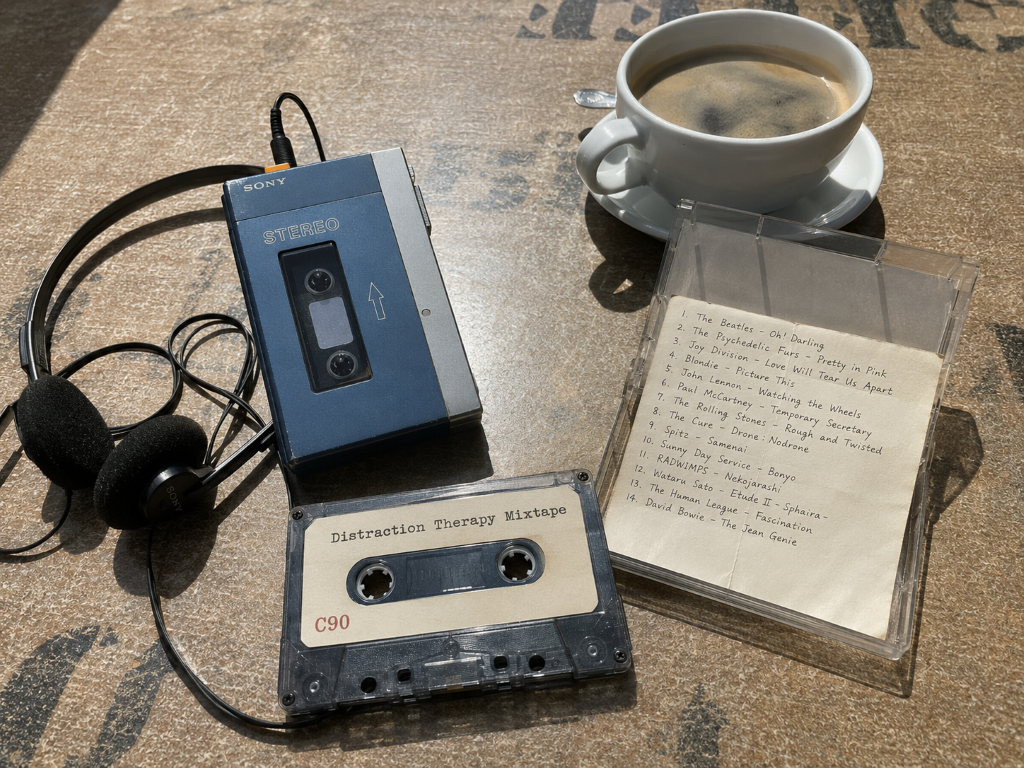
This edition of Distraction Therapy moves through songs shaped by longing, pressure, memory and change. It begins with voices reaching towards other people and gradually enters a less certain space, where intimacy becomes image, work becomes performance and attention slips away from the place in which it has been instructed to remain.
The music crosses decades, languages and forms. Raw guitars meet programmed rhythms. Familiar pop surfaces open onto anxiety and estrangement. Recent recordings sit beside songs whose emotional arguments have survived several changes in fashion and technology. The result is not a history lesson or a set of fixed interpretations. It is a journey through the ways people plead, watch, withdraw, remember and return.
Longing, Possession and the Fear of Separation
The opening sequence places desire under pressure. The Beatles’ Oh! Darling makes love sound like an argument against abandonment. The performance is powerful because the plea is sincere, but sincerity does not make the feeling simple. To need another person may be tender. It may also become an attempt to hold them in place.
That tension continues through The Psychedelic Furs’ Pretty in Pink, Joy Division’s Love Will Tear Us Apart and Blondie’s Picture This. Each song approaches intimacy through a different emotional temperature, yet all are concerned with the unstable distance between a person and the image made of them. A lover can become a role. A memory can become a photograph. Fascination can bring people closer while also preventing them from seeing one another clearly.
These songs carry the social assumptions of their periods, including recognisable positions such as the lover, the beautiful outsider and the person expected to wait. Those positions have not disappeared. They have been updated. The photograph has become the profile. The audience has become a permanent background presence. The pressure to perform has followed us into private life.
Can emotional truth survive inside a role that has become too narrow? Can a song remain meaningful when we no longer accept every assumption through which its feeling was first expressed?
Work, Visibility and the Right to Step Away
John Lennon’s Watching the Wheels changes the direction of the programme. Here, withdrawal is not necessarily failure. Refusing the expected race may be an attempt to recover an inner measure of time. Other people may interpret stillness as disengagement because activity has become confused with meaning.
Paul McCartney’s Temporary Secretary offers a sharper and stranger reflection of organised life. Its sequenced pulse sounds playful, awkward and faintly compulsive, as if an office system has developed a personality of its own. Human beings are sorted through titles and functions, while the machine keeps moving with an energy that is both comic and unsettling.
These recordings ask what participation means when work, visibility and personal identity have begun to overlap. Must a person remain available in order to count as present? What becomes audible when somebody refuses another person’s definition of usefulness?
Rough Roads and Watched Skies
The Rolling Stones’ Rough and Twisted brings the physical force of electric blues into the present. Released in 2026, the track carries the pleasure of movement without pretending that the road is smooth.1 Its roughness is not merely nostalgic. It reminds us that rhythm can hold uncertainty without resolving it.
The Cure’s live recording of Drone:Nodrone, drawn from the Troxy performance of Songs of a Lost World, turns unease into a more unstable field of sound.2 The title itself branches in several directions. A drone may be a machine overhead, a sustained musical tone, or the sensation of being watched. It may also be the mind continuing to hum after certainty has disappeared.
Technology changes, but the underlying unease remains familiar. Machines promise connection, efficiency and control. Music reveals their other qualities: repetition, anxiety, comedy and estrangement. Perhaps the unsettling sound is not an interruption of ordinary life. Perhaps it is ordinary life, heard without its reassuring explanations.
Listening Beyond Immediate Understanding
The Japanese sequence shifts the programme’s centre of gravity. Spitz, Sunny Day Service and RADWIMPS introduce another relation between melody, language and emotional atmosphere. When every word is not immediately available, language becomes sound before it becomes explanation. Breath, pacing, texture and repetition move forward. Interpretation becomes less secure.
That uncertainty can be useful. Translation is necessary, but it is never neutral. A title may carry several meanings at once, while a simple English equivalent can close down associations that remain active in the original. Listening without complete possession of the words can become an exercise in restraint. We do not have to understand everything immediately in order to be affected by it.
Spitz’s Samenai, Sunny Day Service’s Bonyo and RADWIMPS’ Nekojarashi create a passage in which brightness and inwardness coexist. The familiar distinction between cheerful and melancholy music becomes less useful. A melody can move lightly while carrying a shadow. A reflective song can still contain warmth. Feeling does not need to settle into a single category.
A Clearing in the Programme
Wataru Sato’s Etude II -Sphaira- opens a temporary clearing. Built around Rhodes piano and electric guitar, its ambient movement follows the circular suggestion of a title meaning “sphere”.3 There is no character to judge, no story to complete and no argument to win. Attention can loosen without disappearing.
This stillness does not cancel the tensions that came before it. It gives them somewhere to settle. In a culture that often treats silence as an empty space awaiting content, the piece suggests another possibility. What if stillness is not the absence of experience, but the condition in which experience can begin to take another shape?
Fascination and the Return of Movement
The Human League’s extended version of (Keep Feeling) Fascination brings colour and collective movement back into the mix. Fascination is no longer only the solitary act of looking at another person. It becomes rhythm, repetition and shared energy. Yet the title contains its own instruction: keep feeling. Even pleasure must apparently be maintained.
David Bowie’s The Jean Genie closes the programme with a character who is still posing, desiring and inventing himself. The performance does not offer a settled identity. It thrives on movement between image and impulse, theatricality and physical rhythm. After the inward spaces of the preceding music, the return of swagger feels less like a final answer than a renewed willingness to enter the world with its contradictions intact.
Distraction as Another Form of Attention
Distraction is often described as a failure of concentration. The mind wanders, the signal breaks and the plan is interrupted. This programme suggests that distraction may also be a form of intelligence. It can reveal that the official subject is no longer the real subject.
A bright chorus may carry loneliness beneath its surface. A mechanical rhythm may expose the emotional life of schedules and prescribed roles. An unfamiliar language may slow the desire to classify. A sustained tone may create enough space for a feeling to be noticed before it is explained away.
The movement of the mix is therefore not from difficulty to resolution. It passes from pleading to distance, from distance to observation, and from observation to disorientation. It then approaches a more open form of attention, one that can enjoy a recording while noticing the assumptions it carries, or recognise emotional truth without turning biography into destiny.
What has interrupted your attention while listening? Was it a memory, a rhythm, an unfamiliar word or a sudden feeling that would not remain in the background? Perhaps distraction is not the opposite of attention. Perhaps it is what happens when attention refuses to stay where it has been put.
Track Listing
The Beatles – Oh! Darling (2019 Mix)
The Psychedelic Furs – Pretty in Pink (Remastered)
Joy Division – Love Will Tear Us Apart
Blondie – Picture This
John Lennon – Watching the Wheels (2010 Remix)
Paul McCartney – Temporary Secretary
The Rolling Stones – Rough and Twisted
The Cure – Drone:Nodrone (Live Troxy London MMXXIV)
Spitz – Samenai
Sunny Day Service – Bonyo
RADWIMPS – Nekojarashi
Wataru Sato – Etude II -Sphaira-
The Human League – (Keep Feeling) Fascination (Extended Version)
David Bowie – The Jean Genie
Notes
1. “Rough and Twisted” appears on The Rolling Stones’ 2026 album Foreign Tongues. See Pitchfork, “The Rolling Stones Unveil New Album Foreign Tongues”.
2. See The Cure, Songs of a Live World: Troxy Live MMXXIV.
3. See FRIENDSHIP., Wataru Sato artist and release information.
Leave a Reply