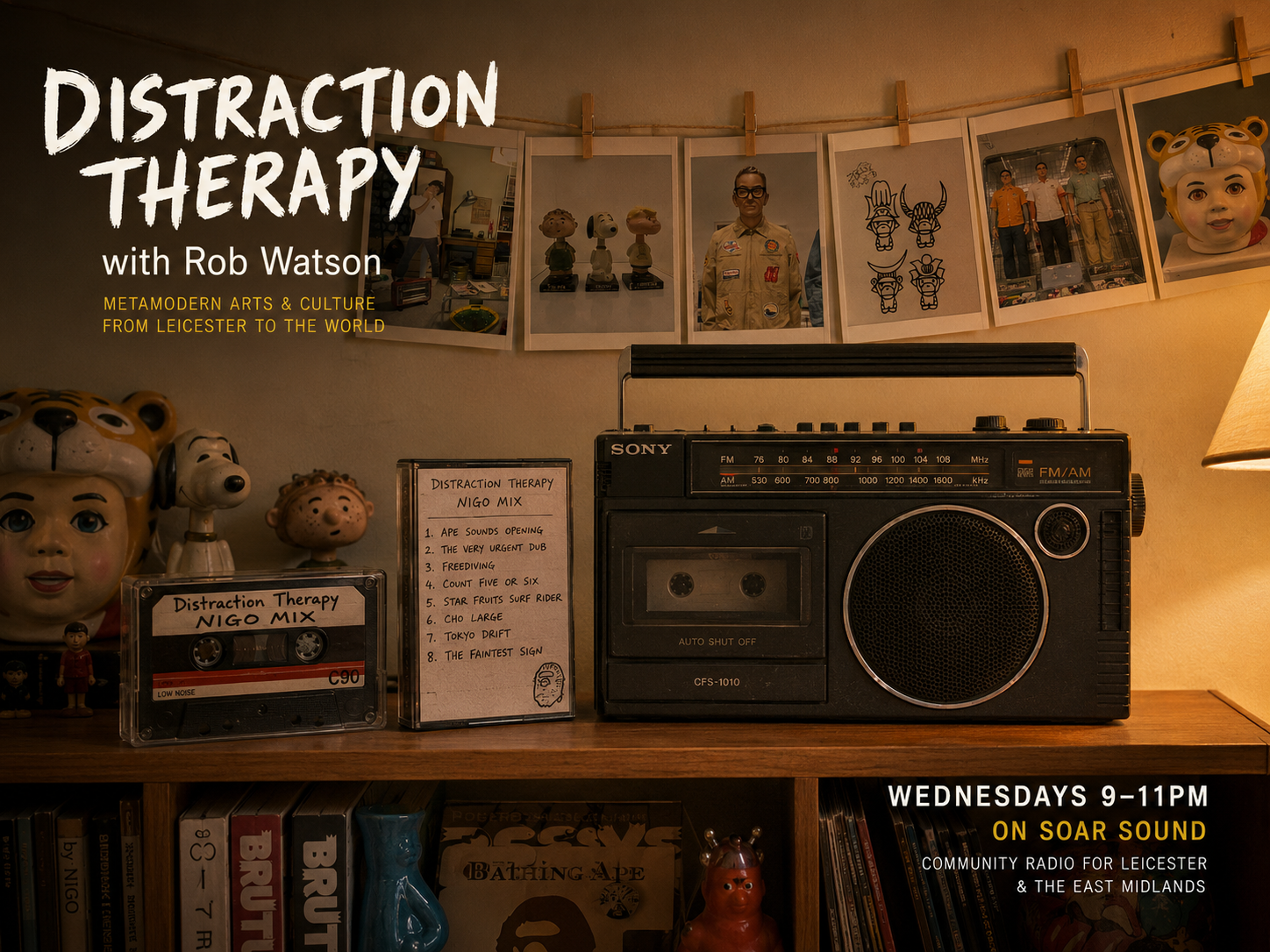
Distraction Therapy with Rob Watson now goes out on Soar Sound, community radio from Leicester and across the East Midlands, on Wednesdays from nine to eleven o’clock in the evening. The programme brings together music, field recordings, reflective notes, and metamodern arts and culture, with each edition shaped as much by mood and atmosphere as by information.
This episode draws from a research day in London on Saturday 30th May, centred on a visit to the Design Museum for NIGO: From Japan with Love. The exhibition explores the work and cultural world of Tomoaki Nagao, better known as NIGO, whose practice moves across fashion, music, streetwear, collecting, design, ceramics and Japanese craft. It is a useful subject for Distraction Therapy because NIGO’s work is not easily contained within a single form. It operates more like a mixtape, an archive, a shop, a studio, a memory system, and a way of arranging cultural fragments into a living atmosphere.
The mix includes background sounds and field notes recorded during the journey. These sounds are not decorative. They are part of the structure of the programme. The train, the museum, the street, the pauses between places, and the small sounds of movement through London all help to hold the music in place. They give the mix a lived setting, so that the tracks are heard not as isolated selections, but as part of a day spent looking, listening, walking, photographing and thinking.
NIGO is often described through the language of streetwear: A Bathing Ape, Human Made, Kenzo, collaborations, limited editions, graphics, camouflage, sneakers and shop culture. That is all important, but it is only part of the picture. What becomes clearer through the exhibition is his role as a cultural editor. He gathers and arranges. He places hip-hop beside vintage Americana, Japanese craft beside global street culture, toys beside ceramics, records beside clothing, and the energy of Harajuku beside the slower attention of collecting.
The music chosen for this mix follows that same movement. It begins with NIGO’s own Ape Sounds, a record that belongs to the late nineteen-nineties and early two-thousands world of dub, trip-hop, hip-hop, sampling and record-collector culture. Tracks such as Ape Sounds Opening, The Very Urgent Dub and Freediving give the programme a sense of texture and arrangement. They sound like objects placed in a room: bass, echo, fragments, rhythms and traces of other genres brought together without needing to resolve into a single style.
From there, the mix moves toward Cornelius and the wider Shibuya-kei sensibility. Count Five or Six and Star Fruits Surf Rider capture a kind of graphic pop intelligence: playful, exact, referential and restless. This is music that feels designed without becoming cold. It has the quality of collage, where different cultural signals are cut, polished and reassembled. In that sense, it sits very naturally alongside NIGO’s visual world, where clothes, labels, toys, records and interiors all become part of the same system of feeling.
The Teriyaki Boyz tracks bring the programme into the BAPE-era hip-hop network. Cho L A R G E, featuring Pharrell Williams, and Tokyo Drift connect NIGO’s Japanese street culture to a more global image of movement, style, speed and cinematic identity. These tracks are more obvious, more direct, and more recognisable, but they are useful because they show how NIGO’s world travelled. It did not remain enclosed within Tokyo or within fashion. It became audible, visible and mobile.
Hiroshi Fujiwara sits behind this story as a quieter but essential presence. His connection to Harajuku, DJ culture, streetwear, editing, collaboration and cultural transmission helps explain the environment from which NIGO emerged. Including Fujiwara in the programme gives the mix a reflective undertone. It points to the way cultural scenes are made not only by individual designers or musicians, but by networks of people who pass signals between records, clothes, magazines, clubs, shops and friendships.
What matters in this episode is not only the factual connection between NIGO and the tracks selected. It is the shared sensibility they carry. The mix is about cultural memory as something that can be worn, heard, handled and reactivated. A jacket, a cassette, a logo, a ceramic bowl, a record sleeve or a bassline can all become a vessel for feeling. They do not simply refer to a period or a scene. They hold a mood, a time, a way of moving through the world.
This is where the mix connects with the wider idea of Distraction Therapy. To be distracted, in this sense, is not to be careless or inattentive. It is to allow attention to loosen from the purely functional. It is to notice atmosphere, texture, resonance and association. A journey to an exhibition becomes more than travel. It becomes a sequence of impressions: field recordings, photographs, notes, objects, songs, transitions, and the reflective state that opens between them.
The Design Museum exhibition places NIGO’s work within a broad field of influence: street style, music, vintage collecting, traditional Japanese craft, nineteen-eighties Tokyo, hip-hop, architecture, interior design and more than seven hundred objects from his personal archive.1 The podcast mix responds to that breadth by treating the music as a route through those influences rather than as a simple soundtrack. It is not a documentary in the formal sense. It is closer to a sound notebook.
The track selection for this podcast version includes NIGO’s Ape Sounds Opening, The Very Urgent Dub and Freediving; Cornelius with Count Five or Six and Star Fruits Surf Rider; Teriyaki Boyz with Cho L A R G E and Tokyo Drift; and Hiroshi Fujiwara’s The Faintest Sign as a possible reflective closing point. Together, these tracks trace a path through Harajuku, Shibuya-kei, Japanese hip-hop, global streetwear, design culture and the emotional life of collected things.
This edition of Distraction Therapy is therefore a journey mix, but not only in the sense of travel. It is a journey through cultural association. It moves from Leicester to London, from the train to the museum, from field notes to records, from the visual world of NIGO to the sonic world that surrounds it. The result is a half-hour reflection on how music and objects can organise memory, and how a day spent paying attention can become a small archive of feeling.
Track Listing
NIGO – Ape Sounds Opening
NIGO – The Very Urgent Dub
NIGO – Freediving
Cornelius – Count Five or Six
Cornelius – Star Fruits Surf Rider
Teriyaki Boyz – Cho L A R G E featuring Pharrell Williams
Teriyaki Boyz – Tokyo Drift
Hiroshi Fujiwara – The Faintest Sign
Endnotes
1. Design Museum, “NIGO: From Japan with Love”, accessed 31st May 2026.
Leave a Reply