
What role does parody play in easing social tensions and integrating differences? Can British humour—rooted in working-class irreverence—still act as a cultural safety valve in an age of “kind comedy” and virtue-signalling? How does Jung’s Trickster archetype illuminate the deeper function of satire in times of moral rigidity?
“O, thou hast damnable iteration and art indeed able
to corrupt a saint. Thou hast done much harm upon…” (Falstaff, Henry IV part 1).
Humour is often dismissed as mere entertainment, a distraction from life’s weightier concerns. Yet Carl Jung saw something profoundly different: the playful, irreverent voice of the Trickster archetype, a force that unsettles rigid certainties, exposes hidden truths, and punctures the swollen ego. Where moral piety and virtue-signalling dominate, the Trickster slips in with laughter and absurdity, creating space for honesty and integration. In this sense, parody and satire are not trivial—they are cultural safety valves, mechanisms through which the unconscious vents its pressure without catastrophic rupture.
The British have long understood this instinctively. Our comic traditions—from bawdy music hall routines and seaside postcards to Monty Python’s surrealism—testify to a national genius for laughing at authority, sanctimony, and the follies of human pretension. Shakespeare recognised this centuries ago in Falstaff, who stands as an eternal reminder that piety is always ripe for ridicule. In the Anglo-Saxon psyche, where moral earnestness can shade into hypocrisy, the corrective is not confrontation by force but confrontation through parody. “If you can’t beat them, parody them” might as well be our collective motto.
 One contemporary example of the Trickster spirit thriving online is the parody account @damekatydenise_, which lampoons the excesses and contradictions of gender identity discourse. By adopting an outrageously inflated persona—a “TransBiPanLesbian of colour” with absurd credentials like “PhD in Cat Psychiatry & Rodent Gender Studies”—it mirrors the performative self-branding often seen in activist spaces. Through exaggerated hashtags (#TransAnimals, #ChairPoverty) and surreal claims (“1 in 3 cats are trans”), the account exposes the fragility and theatricality of identity politics while avoiding direct hostility. Its satire functions as cultural therapy: revealing the collective shadow of ideological rigidity and inviting laughter as a more humane alternative to polarisation. In this sense, Dame Katy Denise belongs to a lineage stretching from Dick Emery’s grotesques to Viz magazine’s caricatures, updating British irreverence for the digital stage.
The Psychological Function of Parody
 Jung understood that psychic wholeness is not achieved by denying or erasing opposites, but by holding them in tension until a new synthesis emerges—a process he called the transcendent function. Social life mirrors this struggle. In a world riven by divisions of class, gender, ideology, and morality, there is a temptation to force consensus through politeness or “kindness.” But individuation—whether personal or cultural—does not proceed by avoidance. It proceeds by conflict, contradiction, and the awkward recognition that shadow material exists in every camp.
Parody allows these tensions to manifest symbolically. It externalises what cannot be spoken in earnest, making difference bearable through laughter. The bawdy joke on a music hall stage or the grotesque caricature in a Viz strip does what sermons and think-pieces cannot: it reveals the unspoken, shakes the collective persona, and invites a flash of humility. Without such symbolic outlets, psychic energy risks stagnating into repression or erupting into rage.
Working-Class Sensibility and the Edge of Humour
 British humour is deeply rooted in working-class sensibility, forged in communities where hardship demanded resilience and laughter was a form of survival. The humour of the pub, the factory floor, or the back-street club was not designed to be “kind.” It was earthy, cutting, often cruel—but it carried a democratic impulse. Authority figures—bosses, priests, politicians—were deflated with a wink and a punchline. This irreverence was never about erasing difference; it was about coping with it, sharing it, and, in some way, mastering it together.
Contrast this with much contemporary comedy, shaped by what is often termed a “woke” ethic of kindness. Here, offence is treated as a sin, and humour is policed for its potential to wound. While well-intentioned, this risks neutering the Trickster and foreclosing the messy dialogues that laughter once enabled. Jung warned that attempts to impose harmony without acknowledging the shadow breed inflation and resentment. In other words: when humour becomes too polite, the shadow finds another stage—often in the extremes of political rage or online vitriol.
The British Lineage of Parody as Social Integration
Our cultural archive overflows with examples of parody as psychic release:
- Music Hall and Marie Lloyd: A chorus of innuendo masking critiques of prudery and gender roles.
- Seaside Postcards: Donald McGill’s saucy cartoons offered permission for desire in a culture bent on denial.
- The Carry On Films: Camp and innuendo turned post-war anxieties about sexuality and authority into farce.
- Monty Python: Surrealist deconstruction of British bureaucracy and moral posturing, culminating in the glorious absurdity of “The Ministry of Silly Walks.”
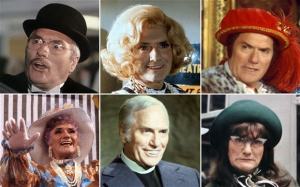
- Dick Emery: With characters like Mandy and the toothy vicar, Emery’s sketches lampooned both permissiveness and propriety in an age of social flux.
- The League of Gentlemen: A darker turn, revealing the shadow of parochial Britain—its xenophobia, repression, and quiet cruelties—through grotesque humour.
- Viz Magazine: A working-class howl against middle-class respectability, inflating stereotypes to monstrous proportions.
- Modern Digital Parody: Spoof social media accounts like @damekatydenise_ keep the tradition alive, satirising identity inflation and virtue theatre.
What unites these forms is their capacity to confront difference without annihilating it, to transform moral tension into shared laughter rather than tribal warfare.
Parody as Social Individuation
To laugh at what we secretly fear or resent is not to deny its seriousness, but to disarm its tyranny. Jung would say that the psyche cannot integrate what it cannot symbolise. Parody provides the symbols—wild, grotesque, exaggerated—that allow us to approach the unbearable without being crushed by it. In this sense, humour performs a sacred function: it mediates between opposites, turning rigidity into play, division into dialogue, despair into delight.
But let us be clear: this is not easy work. It requires the courage to endure discomfort, to tolerate ambiguity, to face the possibility that we ourselves are the butt of the joke. The Trickster does not flatter; he exposes. Yet in that exposure lies the possibility of humility—and, beyond it, the fragile beginnings of wholeness.
So the next time you encounter a parody account or a piece of satire that unsettles as much as it amuses, resist the urge to cancel or condemn. Ask instead: What shadow is being shown to me here? And what part of me is laughing because it recognises the truth?
Because if Jung—and Falstaff—teach us anything, it’s this: when virtue grows pompous and division grows sharp, the saving grace may not be solemn dialogue but the irrepressible, anarchic voice that says, with a wink and a grin:
If you can’t beat them, parody them.
Leave a Reply