
What happens when symbolic suffering is treated as a medical emergency? How does Carl Jung’s depth psychology help us understand the dangers of literalising fantasies through surgery and chemical intervention? This reflective set of notes explores the archetypal tensions between Hermes (interpretation and transformation) and Hades (finality and control), examining how modern medicine risks becoming a technocratic expression of unresolved psychic content. Drawing on mythology, Jungian analysis, and cultural texts like Frankenstein and His Dark Materials, it asks whether our obsession with fixing the body has eclipsed our capacity to understand the soul. What is lost when we bypass symbolic meaning in favour of irreversible medical action—and can a hermeneutic approach offer a more integrated path toward wholeness?
In every culture, the healer occupies a liminal space—a figure poised between suffering and its resolution, between mortality and renewal. Medicine is as old as myth itself, and, like myth, it deals with thresholds: the threshold between illness and health, despair and hope, life and death. Yet in the modern world, the healer has been drawn into a Promethean drama, armed with technologies that make literal what once lived only in dream and symbol. Irreversible surgical and chemical interventions—performed ostensibly to alleviate suffering—are not simply technical acts; they are the expression of a deeper psychic movement: the collapse of the symbolic into the material.
Carl Jung would recognise this as the one-sidedness of a culture dominated by Thinking and Sensation functions, where the demand for certainty and operational control overrides the interpretive, meaning-making dimension of the psyche. What was once held as image or metaphor—the longing for transformation, rebirth, or the reconciliation of opposites—becomes reified in flesh and bone. The doctor, in this drama, asserts two truths at once: the conscious assertion of benevolence, and the unconscious assertion of power.
The Dual Assertion of the Healer
On the surface stands the benign persona of medicine: the healer as servant of life, committed to alleviating pain, restoring harmony, and upholding autonomy. This is the Hippocratic archetype, clothed in the virtues of science, reason, and humanitarian ethics. Yet, as Jung warned, the brighter the conscious ideal, the darker its shadow. Beneath the healer’s white coat may lurk an unconscious identification with the demiurge, the god-maker, the one who can not only mend but remake the human form according to will or ideology. Here, healing becomes a species of domination: the assertion that suffering is intolerable, ambiguity is pathological, and wholeness can be engineered.
This is not the individual doctor’s pathology alone—it is the expression of a collective psychic inflation. Modern medicine, in its technological triumph, risks enacting what Jung called a reductive fallacy: confusing the symbol with its object. Where the unconscious offers transformation through meaning, the literalising impulse substitutes transformation of tissue. The fantasy of metamorphosis, so central to myth and dream, becomes a prescription for hormones, a scalpel’s cut, a permanent chemical dependency.
“The symbol is the best possible expression for something unknown. To reduce it to something known is to empty it of its living meaning.” (CW 6, Psychological Types)
Hermes and Hades: Two Archetypal Logics
To grasp the polarity at work here, we turn to myth. If the hermeneutical approach—the interpretive, meaning-oriented attitude—belongs to Hermes, the messenger and psychopomp, then the literalising approach belongs to Hades, lord of the underworld.
Hermes mediates between worlds, carrying messages from gods to mortals, facilitating dialogue between consciousness and unconsciousness. His is the spirit of interpretation, of open-endedness, of keeping meaning alive. When the psyche presents a fantasy of transformation—whether in dreams or waking life—the Hermetic attitude asks: What is this image saying? What undiscovered part of the Self does it call forth?
Hades, by contrast, closes doors. His domain is finality, the sealing of thresholds. Once a soul crosses his river, it does not return unchanged. In psychological terms, Hades represents the fixation of possibilities into irreversible form. When the healer becomes an agent of Hades, ambiguity dies; the symbol is annihilated in favour of its material surrogate.
“We are still far from understanding that the psyche and the body are not separate entities, but one and the same life.” (CW 8, Structure & Dynamics of the Psyche)
This unity is what the literalising impulse ignores: that suffering is not merely biological malfunction but a psychic event that demands interpretation, not erasure.
Mythological Warnings and Modern Echoes
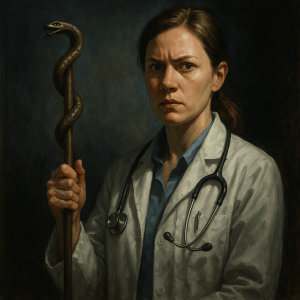 The Greeks intuited this tension in the figure of Asclepius, the god of healing. When Asclepius learned to raise the dead, Zeus struck him down—not as punishment for kindness, but for hubris. To transgress the boundary between life and death was to destabilise the cosmic order. The Netflix series Kaos depicts the struggle mortals have in living with the caprice of the gods. Similarly, Prometheus paid dearly for stealing fire: a gift that empowered humanity but bound its giver to eternal torment. These myths speak to an archetypal truth: every technical victory carries a metaphysical cost.
In modernity, these themes re-emerge not in temples but in laboratories and operating theatres. Mary Shelley’s Frankenstein remains the foundational myth of scientific overreach, its creature the embodiment of what the rational ego refuses to imagine: the shadow side of its own omnipotence. The monster is not merely a horror; it is the symbol betrayed, a dream rendered grotesque by literalisation.
Philip Pullman’s His Dark Materials dramatises the same logic in the Magisterium’s war on Dust. By severing children from their dæmons—those living symbols of soul—the Magisterium seeks purity through violence, mistaking mystery for pathology. What Pullman casts as theological authoritarianism, we might see reflected in the technocratic certainties of our own time.
Other cultural texts echo this tension. In Brave New World, chemical serenity replaces the tragic depth of existence; in Cronenberg’s cinema (The Fly, Videodrome), the body becomes the screen on which psychic distortions play out. Cyberpunk narratives—Deus Ex, Ghost in the Shell—envision futures where identity is engineered, individuality outsourced to code and circuitry. Even in the shimmering pop aesthetics of artists like Björk or Grimes, we find the ambivalence of transhumanist fantasy: liberation or annihilation, evolution or exile from the soul.
The Hermeneutical Alternative: Suffering as Symbol
Against this backdrop, the hermeneutical stance appears almost subversive. It does not deny suffering, but it refuses to treat suffering as meaningless. For Jung, neurosis, fantasy, even bodily symptom are not mechanical faults—they are messages in symbolic form. To interpret them is to restore dialogue between conscious and unconscious, to discover what the symptom demands rather than annihilate it.
“The neurotic state is an uncompleted process which should be lived out in the form of a higher and more comprehensive attitude.” (CW 7, Two Essays on Analytical Psychology)
This approach demands patience, humility, and a tolerance for ambiguity—all virtues alien to a culture obsessed with efficiency and certainty. The hermeneutical healer acts in the spirit of Hermes: as mediator, not master; as guide, not god. They understand that transformation cannot be imposed from without, but must emerge from within, through the slow alchemy of insight and integration.
Between Fire and Shadow
The question, then, is not whether medicine should heal—of course it must—but whether it can do so without enacting the tyrannical shadow of its own archetype. For every Asclepius, there is a Zeus; for every Prometheus, a vulture on the cliff. The myths endure because they speak to a truth we still resist: that to literalise the symbol is to rob it of its soul, and that what is repressed in the realm of meaning returns in the realm of matter—often with monstrous force.
We stand, culturally, between Hermes and Hades. Will we choose interpretation or fixation, dialogue or domination? Jung’s answer was clear: the psyche thrives on symbols, not solutions; on meaning, not mechanism. To forget this is to condemn ourselves to a world of Frankensteins—creatures born not from malice, but from the terror of mystery and the hunger for control.
“Where wisdom reigns there is no conflict between thinking and feeling.” (CW 9, The Archetypes and the Collective Unconscious).
Leave a Reply