There’s a hollowness I keep encountering—not in isolated pockets of society, but as a spreading atmosphere. Something fundamental has shifted in the texture of social life in the UK. It’s not just a decline in civic institutions, or the corrosion of trust. It feels deeper: a psychic depletion. As if the spirit that once animated communal life has been drained, leaving behind only form without content, presence without reciprocity.
Over time, I’ve come to think of this in symbolic terms—as a parasitic presence embedded in the collective unconscious. Not as a metaphor for specific individuals or groups, but as a pattern of behaviour that has become quietly normalised. A way of surviving that draws from others without giving back, that takes rather than co-creates, that conceals itself in legitimacy while hollowing out meaning.
This isn’t about moral judgement. It’s about the ecology of social and psychological life, and what happens when the mutual flows of value, trust, and responsibility are replaced by systems of extraction.
In part, this has been catalysed by the displacement of people—physically, culturally, symbolically. The era of mass and industrial-scale migration has had a profound effect on the UK. The debate is often polarised between slogans of welcome and slogans of resistance. But what is less frequently addressed is the effect on the symbolic centres of meaning—the shared reference points that make a place feel coherent, familiar, regenerative.
When communities are uprooted or restructured too quickly, the threads that bind memory to place, ritual to routine, responsibility to belonging, are frayed. What emerges is a fragile social matrix, increasingly populated not by citizens but by hosts and guests—uncertain of their roles, unaligned in their values, and unequally tethered to the space they share.
Into this vacuum creeps the parasitic mindset.
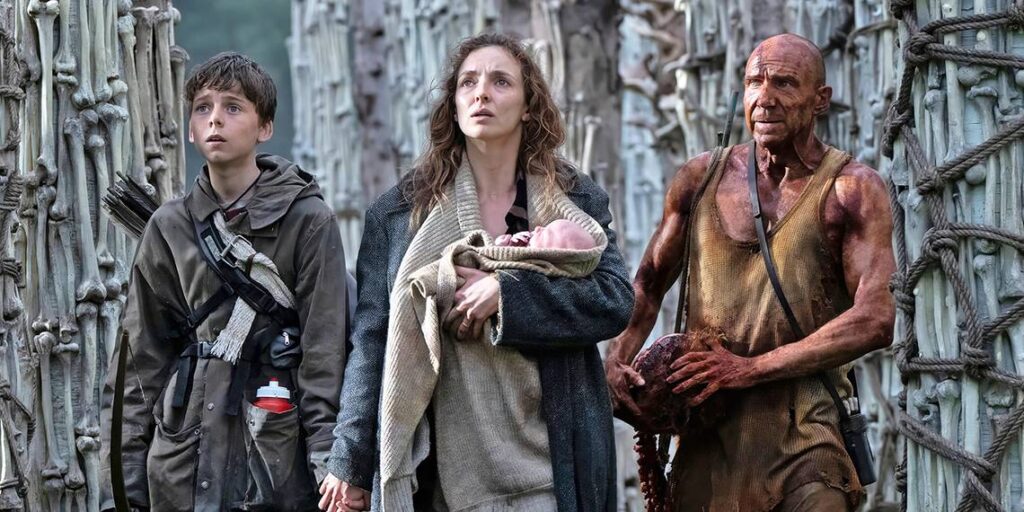
The newly released 28 Years Later—the long-awaited sequel to 28 Days Later—lands in UK cinemas in 2025 with an uncanny resonance. Its premise builds on the eerie question posed by the original: what if life in the UK stopped in 2002? What if the forward march of modern society was frozen in place, while nature was left to take its own course? In this imagined aftermath, it is not just the infrastructure of civilisation that has collapsed, but its psychic scaffolding as well.
The zombies depicted across both films are not the shambling undead of traditional horror—they are pure embodiments of parasitic rage, stripped of selfhood and driven by blind consumption. In symbolic terms, they externalise a pathology that has taken hold in our own world: the extractive, unreflective drive that depletes rather than regenerates.
But what stands out even more in 28 Years Later is the contrast: the scattered survivors are not only fleeing infection, they are slowly being drawn toward a more elemental, mythological way of being. Their struggle is not just physical—it is spiritual. It calls them back to something older than modernity: to the land, to silence, to fire, to archetypal patterns of care, kinship, and ritual.
To watch this film in the UK of 2025 is to confront its quiet insight into our condition. Social trust is fraying. Cultural experience is fragmented. The torrent of globalised information overwhelms local meaning. In the midst of this, we are seeing what Joseph Campbell called the breakdown of the mythogenetic function—the capacity of a culture to generate living symbols that orient, guide, and bind it together.
What 28 Years Later offers is more than dystopia. It is a mirror. It reflects our own cultural exhaustion, our parasitic dependencies, and our loss of symbolic grounding. But within it is also a faint echo of invitation: to remember what sustains life beyond survival. To recover the threads of meaning that connect us to nature, to each other, and to something sacred and enduring beneath the ruins.
The parasitic shows up in institutions that once served the public good but now operate as marketplaces. It shows up in cultural actors who mirror authenticity while exploiting attention. It shows up in the everyday reliance on others’ emotional, economic, or cultural labour—without acknowledgement, without contribution, without consequence.
This extractive model of social gain has left our institutions brittle. What once could hold meaning, could foster growth and offer shelter for future generations, now struggles to even justify its own existence. We are losing our capacity to regenerate—and no sustainable future can be built on a hollow core.
It’s tempting, in moments like these, to reach for easy answers and quick fixes. To blame others. To pathologise the outsider. To frame society’s decline as a malfunction—an outdated operating system needing an upgrade, or a corrupt file needing deletion.
But society is not a machine. It is a living, interdependent body—and the parasitic pattern is now deeply woven into its cells. This is not about cleansing an external threat. It is about confronting something that has taken root within us. The tendency to consume without care. To survive without service. To take comfort without contribution.
Undoing this will take time. It will not be achieved by another initiative, another commission, another tech solution. It will require re-learning how to live with one another—how to recognise mutual responsibility, how to hold boundaries and remain open, how to restore meaning not through efficiency, but through presence.
And it will require the courage to turn inward, and to ask:
- Where have I become a host to what depletes me?
- Where have I taken more than I’ve given?
- And where might something more reciprocal, more enduring, begin again?
Because regeneration—of culture, community, even of the self—doesn’t begin with reforming systems. It begins with clearing out what no longer belongs and nourishing what might slowly, tentatively, grow in its place.
Leave a Reply