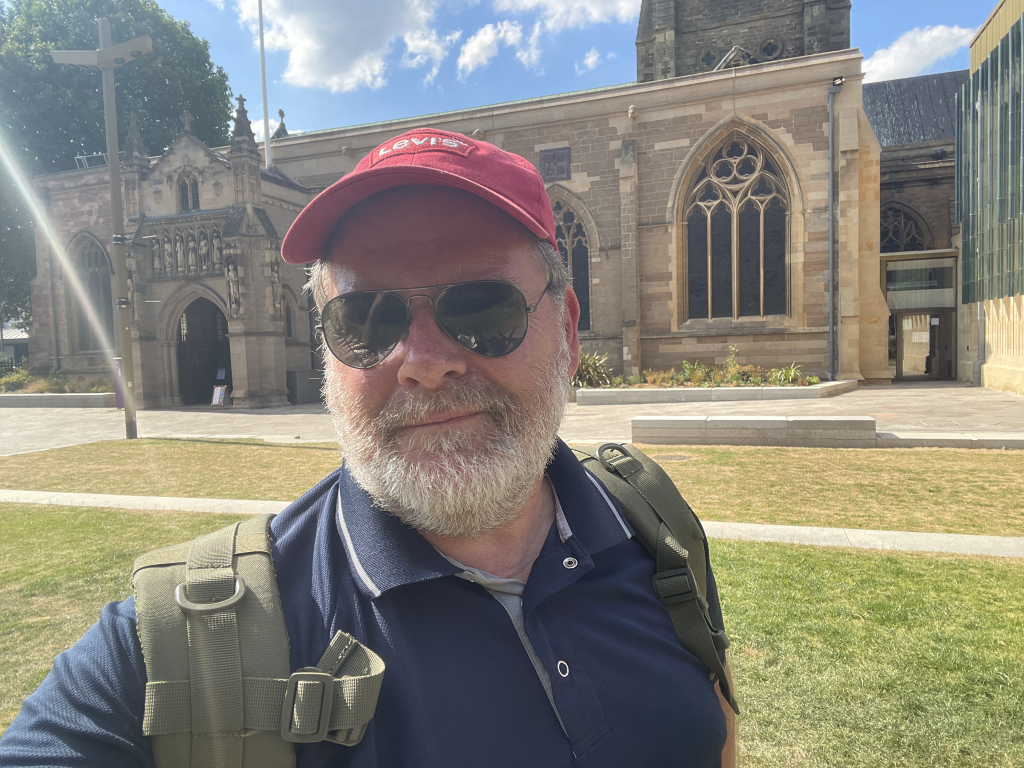
As I recorded today’s Distraction Therapy podcast, I found myself once again at Leicester Cathedral, shaded from the intense summer heat, contemplating the disorientation and richness of reading Nietzsche’s Thus Spoke Zarathustra. This is the second entry in my summer-long project of reflective inquiry, combining a scholarly and therapeutic approach to Nietzsche’s text and Carl Jung’s psychological commentary. What emerged in today’s recording was a meditation on style, voice, memory, and the layered symbolism that binds philosophy to psychology.
Nietzsche’s writing presents a challenge not only in content but in form. His aphoristic, prophetic tone resists the linearity that modern readers often expect. Reading Zarathustra on the page had felt like wading through an arid landscape, but listening to the audiobook—particularly the Penguin edition, performed with care and tone—allowed the text to come alive. Nietzsche’s intention, it seems, was never to write a didactic treatise but to perform a philosophical drama, rich in allegory and mythic provocation. Engaging with it this way confirmed something I’ve sensed: this text is not meant to be “understood” in a rational sense, but metabolised, lived with, and returned to repeatedly.
Jung’s dream analysis seminars have become an essential companion. His conversational style, drawn from seminar notes in the 1920s, helps ease some of the philosophical density by re-situating key concepts into a symbolic framework. One of Jung’s most helpful assertions is that the unconscious, by definition, cannot be directly known. It reveals itself only indirectly—through images, dreams, myths, and symbols. Like the eddies on the surface of a lake, what we glimpse are disturbances, patterns, hints. This model, when brought into dialogue with Nietzsche’s vision of a world stripped of metaphysical order, frames Zarathustra as an exploration of what remains when the old symbolic gods have died.
One of the key threads I pursued in today’s reflection is the contrast between Nietzsche’s and Kant’s models of morality. Whereas Kant grounds ethics in reason and universalisable maxims, Nietzsche turns away from transcendental logic and insists on the rawness of lived experience. Yet this creates a deep tension—if there is no moral absolute, if God is dead, how do we orient ourselves? Jung’s answer might be through symbols, through inner feeling rather than abstract emotion, through the rhythms of the psyche that form our patterns of individuation.
This brought me to consider the Eternal Return, Nietzsche’s difficult idea that everything recurs infinitely, and that we must learn to affirm life as though we were destined to live it again and again. At first glance this feels like a nihilistic burden, but approached symbolically, it opens a different dimension. If time is not linear but spiral, if learning is not accumulation but recurrence with depth, then individuation is not about becoming someone new—it is about recognising and integrating what has always been circling within.
In this episode I also reflected on the film 28 Years Later, a cinematic sequel that unexpectedly echoed many of the symbolic and psychological themes of Zarathustra. The film’s apocalyptic setting, its mythic characters, and its confrontation with memory, horror, and redemption, offered a parallel mythos. What struck me was its use of sound—especially a scene set beneath a cosmos-lit sky accompanied by Wagner’s Das Rheingold—as a way of embedding the symbolic into a visceral, bodily experience. This kind of mythological storytelling reaffirms what Jung believed: that transformation is never only intellectual. It is emotional, imaginal, and often accompanied by archetypal encounters that disrupt as much as they reveal.
Today’s episode is a meditation on fragments, cycles, voices, and echoes. It is a step further into this summer’s descent, an ongoing effort to walk with Nietzsche and Jung not as authorities to be obeyed, but as companions to be questioned and internalised. If you’re interested in symbolic exploration, in metamodern meaning-making, or in the slow process of reflective individuation, I invite you to listen and reflect along.
As always, stay with the questions.
Leave a Reply