
In the spirit of metamodern inquiry and integration—where the aesthetic impulse is guided by a mythic sensibility, and the fire of critique is held within the hearth of care—irony and sincerity no longer stand opposed, but dance together as stewards of complexity, tending to meaning with humility, reverence, and creative renewal.
We are called to examine the complex cultural and ethical terrain surrounding the increasing use of puberty blockers. Originally intended for rare medical conditions, these interventions are now offered to a broader group of people under the framework of gender affirmation. This shift merits thoughtful attention, especially given the uncertain long-term impacts on psychological and physiological development.
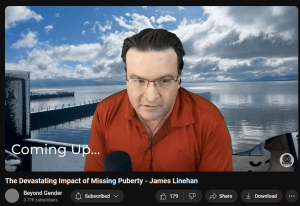 James Linehan’s testimony on the Beyond Gender podcast invites a pause for reflection. Diagnosed with hypogonadism, James did not experience a natural puberty. His account highlights the essential role of adolescence as a transformative phase in which hormonal shifts initiate emotional, cognitive, and relational growth. Puberty, in his experience, was not simply about physical change; it was a deeply integrative process that activated previously dormant aspects of his psyche.
This transformative journey has been archetypally represented across cultures. In masculine narratives, we see the Hero’s Journey: the adolescent leaves the comfort of the known to face trials and return changed. In feminine frameworks, such as The Virgin’s Promise, the path involves nurturing a sense of wholeness, reclaiming internal meaning, and harmonizing the personal with the communal. Both narratives point to adolescence as a symbolic rite of passage necessary for the emergence of adult identity.
Carl Jung’s psychological model reminds us that the human psyche is composed of both masculine (animus) and feminine (anima) components. These archetypal forces strive toward integration through embodied experience. Jung expressed concern about premature interference in natural development, especially when achieved through artificial or chemical means. Such manipulation, he warned, can interrupt the psychoid processes by which the unconscious and the physical body co-evolve.
In a time marked by a loss of shared symbolic frameworks, the metamodern condition is characterized by oscillation: between hope and doubt, sincerity and irony, structure and fragmentation. Many adolescents are now coming of age in a world saturated with media, where identities are shaped less by enduring narratives than by shifting iconotypes and digital memes. The traditional rites of passage that once offered grounding and meaning have not been adequately replaced. In this vacuum, medical interventions risk becoming substitutes for deeper symbolic and developmental work.
Rather than framing puberty as a problem to be managed, we might instead see it as an essential initiation into the fullness of being. To indefinitely delay or override this process may have consequences that extend beyond the physical. It may affect the psyche’s capacity to engage with complexity, form relationships, and cultivate resilience.
The Beyond Gender podcast is a thoughtful contribution to this discussion. It does not offer simplistic answers, but seeks to foster genuine dialogue. It is a resource for those navigating these issues with openness, curiosity, and care. By prioritizing healing and understanding over ideological allegiance, it models the kind of conversation that is so urgently needed.
In considering the ethics of puberty blockers, we must ask not only what is possible, but what is wise. Adolescence is not merely a stage to be passed through; it is a vital threshold where the seeds of adult identity are sown. Let us approach it with the depth and discernment it deserves.
Leave a Reply