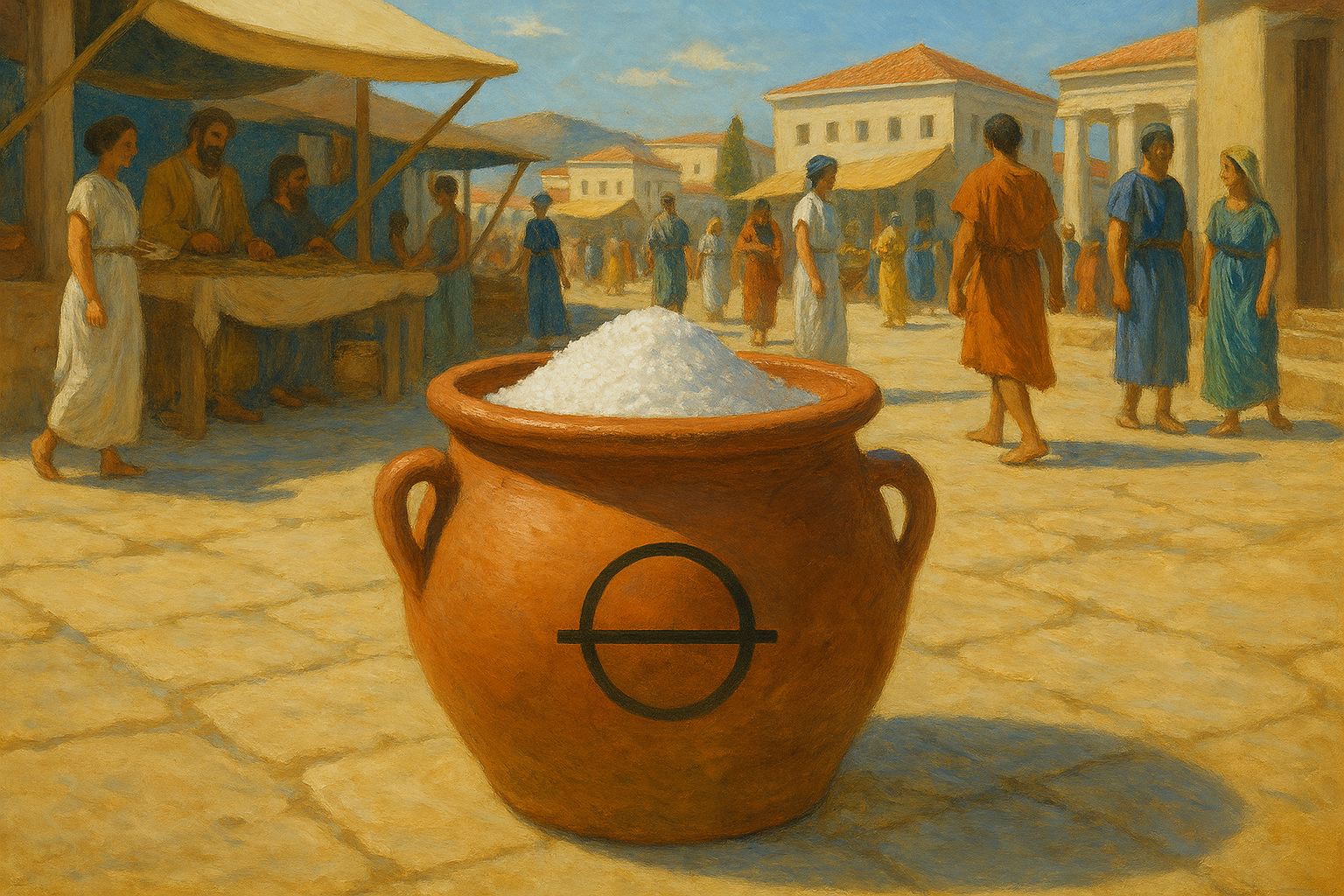
I’ve been continuing to reflect on the image of the open pot in the marketplace. That vessel—humble, unadorned, standing unattended in the shifting light—keeps resurfacing in my imagination. It represents a kind of presence: not a clamouring, attention-seeking visibility, but a quiet, open availability. It offers itself without demand. It waits without urgency.
Lately, I’ve begun to wonder what such a pot might be for. What does it contain? What might it offer?
Perhaps, I’ve come to think, it holds salt.
In Michael Meade’s Living Myth podcast (Episode 428), he speaks of salt not just as a dietary necessity, but as a substance steeped in myth and meaning. Salt is a preserver, a purifier, and a source of endurance. In many cultures, it has been regarded as the essence that bridges the celestial and the earthly—the mineral embodiment of truth and vitality. In the symbolic traditions of alchemy, salt was considered the prima materia, the foundational material from which transformation begins.
In practical terms, salt was once a rare and precious resource. It sustained communities, preserved food, and enabled trade. In that context, the pot in the market might have once held salt not just as a seasoning, but as a shared necessity—essential, even sacred. To be entrusted with the salt pot would be to carry a role of deep communal responsibility, not glamorous, but vital.
In our modern world, salt has been cast in a different light. Within the industrial food system, where it is used as a blunt instrument to mask blandness and prolong shelf life, salt has become demonised—stripped of its symbolic value and seen merely as a dietary threat. We are told to limit it, avoid it, control it. But what is often left out of this narrative is that salt, in its pure form and rightful place, enhances flavour and awakens potential. It transforms the simple into the savoury. It draws out what is already there.
This, too, feels deeply symbolic.
Many of us, especially those with a predisposition towards intuitive care—what some might label the INFJ psyche—carry an internalised pressure to please others, to offer ourselves as useful, as agreeable, as needed. We risk becoming pots open to the marketplace without boundaries or function. But if the pot is given a purpose—if it is known to hold something of value—then it becomes not just a vessel, but a point of orientation for the community.
To hold the salt is to hold something ancient and essential. It is not to be everything for everyone. It is not to pour oneself out aimlessly. It is, instead, to offer what enhances, what preserves, what gives depth and character. The salt pot is not heroic. It does not need to be. Its value lies in its enduring presence, its rootedness, and its quiet service to something greater.
This reframing offers a way of thinking about personal vocation and community participation. We do not need to be spectacular. We do not need to perform. What matters is whether we are contributing something sustaining—something that draws out the best in others, even if it is only a pinch at a time.
There is wisdom in the ordinary. There is alchemy in simplicity. There is meaning in being worth one’s salt.
So I return again to that image: the open pot in the market, this time known and valued not for what it might become, but for what it already holds. It does not cry out for recognition. But those who know, know. And those who need, find themselves drawn near.
Leave a Reply