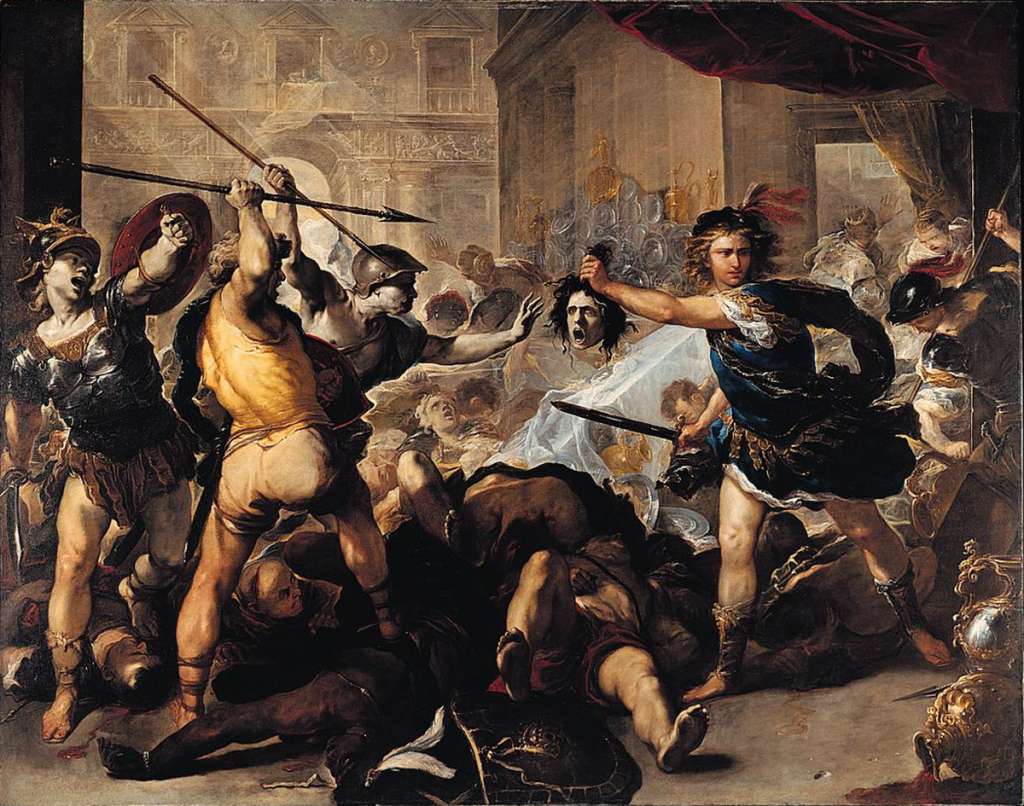
There are moments in public life when political disputes seem to draw upon a deeper reservoir of images and symbols than the immediate arguments might suggest. The contemporary controversy surrounding gender identity is one such case. Alongside debates about law, medicine, language, rights, and social recognition, there has emerged a symbolic landscape populated by powerful images, myths, and archetypes. Among the most striking of these is the recurring image of decapitation.
Historically, the severed head has occupied a significant place in mythology, religion, art, and political culture. It appears in ancient stories, medieval legends, Renaissance paintings, revolutionary iconography, and modern protest movements. Whenever it appears, it rarely signifies mere physical violence. More often it represents the removal of authority, the silencing of a voice, the destruction of a worldview, or the overthrow of an established order.
One of the most famous examples is the story of Perseus and Medusa. In Greek mythology, Medusa’s gaze turns observers to stone. Perseus defeats her not through direct confrontation, but through reflection, using a polished shield to avoid looking directly at her. The severed head retains its power even after death and becomes an object of protection and terror. Across centuries, artists have interpreted this story in different ways. Medusa has appeared as a monster, a victim, a warning, and more recently as a symbol of feminine rage and resistance.
Elsewhere, the motif appears in the biblical story of Judith and Holofernes, where decapitation becomes an act of liberation from tyranny. In the story of Salome and John the Baptist, the severed head symbolises the destruction of prophetic speech. During the French Revolution, the guillotine transformed decapitation into a political ritual intended to demonstrate the replacement of one social order by another.
In all these cases, the head carries a symbolic meaning beyond the physical body. The head represents consciousness, identity, vision, speech, and authority. To remove the head is therefore to remove a particular mode of understanding the world.
Carl Jung was deeply interested in such symbols because he believed they revealed underlying psychological processes. In his extensive seminars on Nietzsche’s Thus Spoke Zarathustra, Jung repeatedly returned to the relationship between consciousness and embodiment. He admired Nietzsche’s extraordinary psychological insight but believed that Nietzsche had become increasingly identified with the realm of consciousness, spirit, and visionary thought.
For Jung, this posed a danger. Consciousness detached from the body becomes inflated. It begins to imagine itself autonomous, independent of instinct, limitation, and nature. Yet, the body, Jung argued, is not merely a biological machine. It is the living expression of the unconscious, carrying inherited patterns, instincts, emotions, and forms of wisdom that cannot be reduced to rational thought.
Nietzsche himself recognised this tension. Zarathustra declares that there is more wisdom in the body than in the deepest philosophy. Yet, Jung wondered whether Nietzsche fully integrated this insight into his own life. He believed that Nietzsche’s tragedy lay not in thinking too much, but in becoming too identified with a heroic vision of consciousness that struggled to remain grounded in ordinary human existence.
This observation raises an interesting question when considering contemporary debates around identity. Is the conflict partly rooted in different understandings of the relationship between consciousness and embodiment?
Many contemporary discussions are framed through concepts of self-identification, personal meaning, and subjective experience. Others emphasise biological embodiment, material reality, and physical sex. Both perspectives often appear to operate as competing absolutes. One privileges consciousness. The other privileges the body.
From a Jungian perspective, such polarisation may itself be the problem.
Jung consistently warned against one-sidedness. Human beings are neither pure spirit nor pure matter. We are not merely consciousness, nor merely biology. Psychological health emerges through the ongoing relationship between the two. The task is not to choose one over the other, but to understand how they interact, shape one another, and sometimes come into conflict.
This suggests another way of interpreting the symbolism of decapitation. Rather than representing the triumph of one side over another, it can be understood as an image of separation itself. The head becomes detached from the body. Thought becomes detached from instinct. Identity becomes detached from embodiment. Spirit becomes detached from nature.
Perhaps this is why the image continues to exert such power. It expresses a fear that something essential has been divided.
The challenge facing contemporary society may therefore be less about determining whether consciousness or embodiment should prevail. The deeper challenge may be understanding how both belong together.
Psychology offers an important lesson here. Human beings flourish neither through complete surrender to instinct nor through complete surrender to abstract ideals. The task of maturity is to sustain a dialogue between what we think, what we feel, what we imagine, and what we physically are.
In that sense, the severed head remains a warning. It reminds us that whenever consciousness attempts to exist without the body, or whenever the body is understood without consciousness, something vital is lost. The aim is not victory of one over the other, but a more complete understanding of the relationship between them.
In an age increasingly defined by questions of identity, perhaps the most useful question is not which side is correct, but how a richer and more integrated understanding of human experience might emerge. Such a vision would recognise both the reality of embodiment and the reality of subjective experience, without reducing either to the other.
That was, in many ways, Jung’s central concern. Not the triumph of spirit over matter, nor matter over spirit, but the difficult and lifelong work of bringing them into relationship.
Leave a Reply