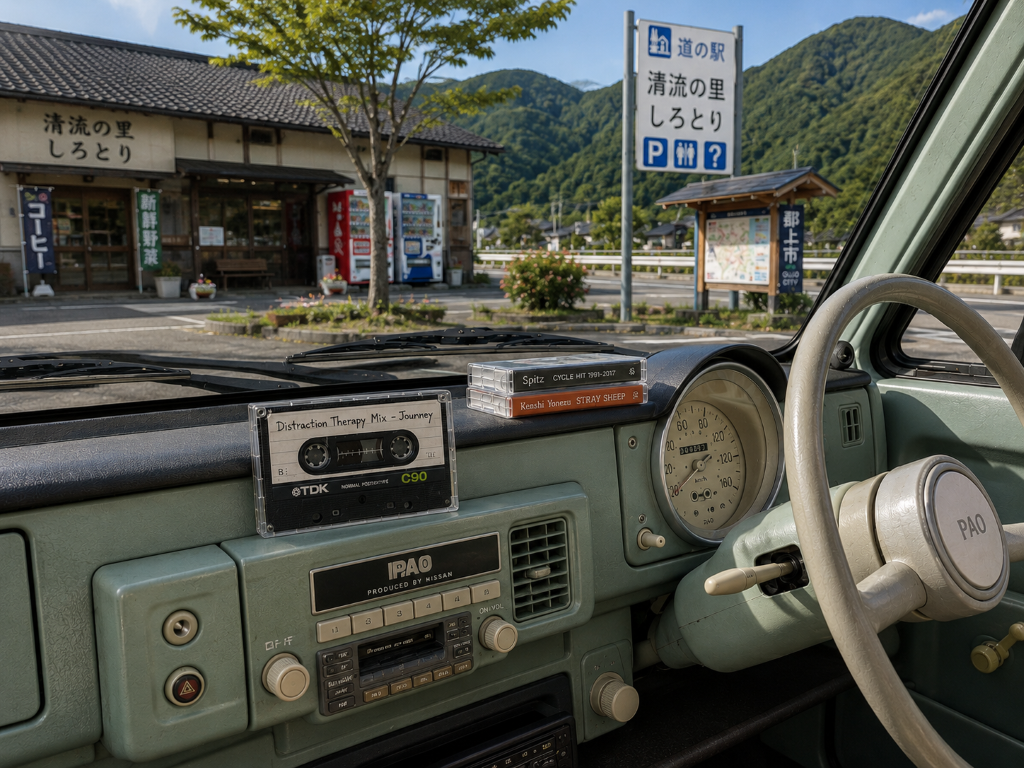
Some music is made for arrival. Some music is made for departure. Some music is made for the hour between places, when the train has pulled away, the city is loosening behind the window, and the mind has not yet committed itself to memory, fantasy, anticipation or sleep.
This Distraction Therapy mix belongs to that in-between condition. It is music for the moment when a journey begins to form a backdrop around itself. The route may be ordinary: a walk through a shopping arcade, a bus ride at dusk, a station platform, a hotel room, a notebook opened in a café, the mild disorientation of waking somewhere unfamiliar. But the soundtrack changes the grain of it. It makes the ordinary feel receptive.
A good mixtape does not simply accompany movement. It shapes the way movement is perceived. It bends the mood of streets, trees, bridges, vending machines, train announcements, ticket barriers, rain on glass, evening light and faces seen once and never again. It helps the journey become more than logistics. It turns travel into a condition of attention.
What Does a Journey Remember?
We often remember journeys inaccurately. The sequence of events fades. The timetable becomes vague. The exact restaurant, platform or street corner disappears into blur. What remains is affect. A temperature. A colour. A feeling of openness or unease. The body remembers the slant of light more clearly than the name of the road.
This is where music becomes powerful. A song can become the clasp that holds a journey together. It may not preserve the factual order of events, but it can preserve the emotional structure. Years later, a few bars can restore not only a place, but a whole mode of being: the person one was, the air one moved through, the strange confidence or vulnerability of that day.
The mix works with that possibility. Its sequence moves through tenderness, animation, brightness, melancholy, speed, recovery, social strangeness and dream. It does not offer one stable mood. It offers variation. That variation matters because journeys are rarely emotionally consistent.
How Does a Mixtape Become a Backdrop?
A backdrop is not passive. It does not merely sit behind the action. It changes the action by giving it depth. A painted sky in a theatre, a neon-lit shopfront, a grey platform canopy, a mountain seen between tower blocks: each gives the foreground a different kind of meaning.
A mixtape does the same thing with sound. BUMP OF CHICKEN’s “Aria” can give a moment lift and movement. Fujii Kaze’s “Hachikō” can suggest loyalty, waiting, and the tenderness of being attached to a place or presence. KANA-BOON’s “Diver” can turn movement into plunge, descent and release. Kenshi Yonezu’s “Spinning Globe” can make the journey feel planetary rather than private.
These songs do not have to explain themselves to work. They create tonal fields. They lend a certain shape to perception. The listener does not need to decode the track in order to be altered by it.
The best journey music allows the world to remain itself while becoming slightly charged. It does not overwrite the scene. It illuminates it from the side.
What is the Structure Of Feeling in a Journey?
Raymond Williams used the phrase “structure of feeling” to name something difficult but recognisable: the lived, shared, emergent mood of a time before it can be fully explained. A journey often has its own smaller structure of feeling. It is not an opinion. It is not a plan. It is the felt atmosphere through which the traveller moves.
This mix seems built for that atmosphere. HY’s “Sangatsu No Kagerou” brings the shimmer of March heat-haze, the sense that a season is shifting before anything has been settled. RADWIMPS’ “Nekojarashi” gives the sequence a softer texture, something playful and intimate, like noticing a small movement by the roadside. sakanaction’s “Me Ga Aku Aiiro” opens into a more expansive blue, a colour of perception rather than just a title.
These tracks do not all point in the same emotional direction. That is why they can hold a journey. Travel is made from contradiction. One can be excited and tired, hopeful and uncertain, solitary and porous, distracted and intensely present. A mixtape that smooths those contradictions away becomes background wallpaper. A mixtape that keeps them alive becomes a companion.
Can Distraction Become a Form Of Attention?
Distraction is often treated as failure. We are told to focus, organise, optimise and complete. But aesthetic distraction can work differently. It can release the mind from its narrow task-state and let it become available to association, memory, image and mood.
That is the promise of Distraction Therapy. Not distraction as avoidance, but distraction as loosening. Not a retreat from reality, but a change in how reality is approached. The distracted state of aesthetic appreciation is not empty. It is alive with sideways perception. It lets the mind notice details that purpose-driven attention would miss.
A shop sign glimpsed from a bus. A cat on a bar sign. A station name that sounds like a dream. A stranger waiting under a flyover. A figure at a crossing. A song arriving at exactly the moment the light changes. These things do not ask to become important. The mixtape gives them permission.
The mix carries a contemporary Japanese sensibility without reducing itself to a tourist image of Japan. It moves between band music, singer-songwriter intimacy, anime and film association, commercial pop, city feeling, digitally mediated melancholy and small acts of emotional endurance.
OFFICIAL HIGE DANDISM’s “Midori No Amayoke” suggests shelter and colour. SEKAI NO OWARI’s “Love Song” and “Hakuchū No Yume” pull the sequence towards romance, daydream and theatrical feeling. Spitz’s “Heavy Mellow” carries the contradiction in its own title: heaviness made soft, softness made durable. Tele’s “Yakou Bus” closes the imagined route with the night bus, perhaps the most literal journey image in the mix, and also one of the most emotionally suggestive.
The zeitgeist here is not reducible to fashion or trend. It is a lived mood of movement through mediated life. It is the feeling of wanting sincerity without naivety, beauty without sentimentality, technology without spiritual flattening, travel without consumption, and memory without nostalgia becoming too easy.
Perhaps it will be heard on a train. Perhaps in a hotel room before sleep. Perhaps while walking through a neighbourhood that feels both ordinary and unreal. Perhaps it will accompany a journey that has not yet declared its meaning.
That is often when music matters most. Not when everything is already clear, but when the emotional significance of the journey is still forming. A mixtape can become a provisional atmosphere. It can hold open a space for expectation.
Soon, there will be journeys. Some may be planned. Some may happen because the day has become too enclosed and the mind needs a wider frame. Some may be physical journeys through streets, stations, galleries, cafés and unfamiliar districts. Others may be inward journeys, taken through memory, writing, listening and reverie.
This mix is offered in anticipation of those movements. It does not claim to define them. It waits beside them.
What Remains After The Journey?
The details may go. The names may blur. The sequence may become unreliable. But the music may remain as a hinge. It may reopen a mood that would otherwise be lost.
That is the deeper purpose of a mixtape. It gathers music before memory knows what it will need. It prepares a shape for experience. It gives future recollection something to fasten itself to.
When this Distraction Therapy mix accompanies a journey, it may become more than a playlist. It may become the hidden architecture of the day. It may turn a walk, a bus ride, a train window, a shop counter, a notebook page or a late-night room into something that can be felt again later.
And perhaps that is enough. To make a journey more available to feeling. To let the world arrive with a little more resonance. To give the distracted mind a path through beauty, drift and recognition.
The journey has not yet happened. The memory has not yet formed. The mix is ready.
Endnotes
- The Mixtape Museum defines a mixtape as a compilation of songs from different sources arranged in a specific order: The Mixtape Museum.
- Research on music-evoked autobiographical memories examines how music can trigger memories of past events, often through emotion and involuntary recall: Exploring The Nature Of Music-Evoked Autobiographical Memories.
- Raymond Williams’s concept of “structure of feeling” is discussed as a way of understanding emergent lived experience and artistic value: Raymond Williams’s “Structure Of Feeling” And The Problem Of Democratic Values.
- The uploaded Distraction Therapy Mix Tracklist 002 provides the working sequence for this reflection.
Leave a Reply