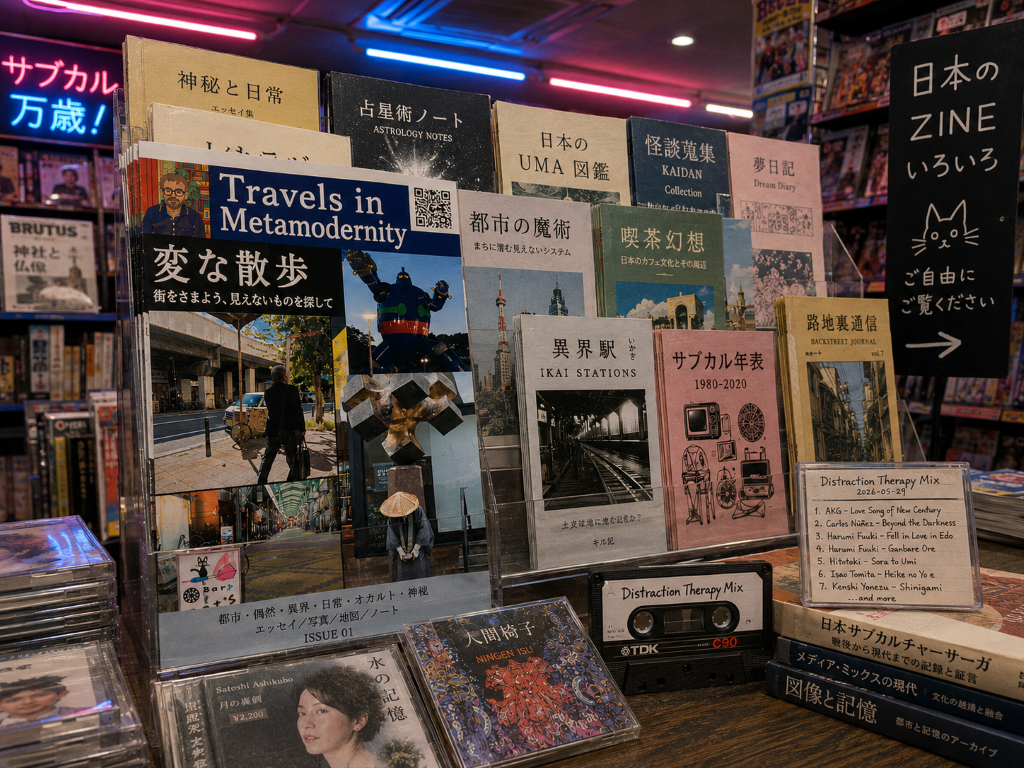
This Distraction Therapy mix does not behave like a simple track list. It begins as a love song for a new century and ends in an augmented-reality rendezvous in pyjamas. Between those two points it passes through Ghibli landscape, Edo memory, sky, sea, courtly ruin, rakugo death, community fantasy, human blooming, data minimalism, city pop architecture, food, posthuman electronics and fragile present-tense beauty.
That is a lot for one mix to carry. But perhaps that is the point. Distraction Therapy is not about avoiding the world. It is about changing the way the world is held in attention.
What Kind Of Love Song Belongs To A New Century?
Asian Kung-Fu Generation’s “Shinseiki No Love Song”, or “Love Song Of The New Century”, opens the mix with a question hidden inside its title. What does love sound like when the century has already become strange? What happens when affection has to pass through screens, cities, crises, routines and all the background noise of contemporary life? This is not the love song of a sealed private world. It is a love song with traffic outside the window. It carries the feeling that emotion has to be sung against the grain of its own time. So the mix begins not with escape, but with a wager: that feeling can still be made audible inside a restless historical moment.
Where Do We Go When The Map Turns Mythic?
Carlos Núñez’s “Beyond The Darkness: Anthem From Earthsea” opens a door into another kind of landscape. The title already gives us the movement: beyond darkness, towards earth, sea, trial and return. The music carries the atmosphere of Studio Ghibli’s Tales From Earthsea, but it also feels older than film. It feels like a path across a hill where the weather has moral force. What are we really looking for when we turn to mythic music? Comfort? Scale? A world in which inner trouble can appear as terrain? The track suggests that darkness is not merely an obstacle. It is a country one has to pass through.
Can A City Remember How To Dream?
Harumi Fuuki’s “Fell In Love With You In Edo”, from Miss Hokusai, gives the mix its first historical shimmer. Edo appears not as museum scenery, but as an emotional climate. Art, family, craft, streets, rooms and glances all become part of the same atmosphere. What if the past is not behind us, but beside us? What if a woodblock print, a film soundtrack, or a half-remembered city can give us a temporary home for feelings we do not yet know how to name? In this part of the mix, memory is not documentary. It is theatrical, textured and alive.
How Do We Keep Going Without Becoming Dramatic About It?
Fuuki’s “Ganbare Ore”, from Hirayasumi, changes the scale. The title suggests something like “come on, me” or “keep going, me”. It is the sound of self-encouragement without grandiosity. What does resilience sound like when it is not heroic? What if the most important emotional labour is not transformation, but getting up, making tea, sending the message, doing the washing up, stepping outside, trying again? This is one of the mix’s quiet truths. The ordinary life is not small. It is where the myth has to be lived.
What Is Between Sky And Sea?
Hitotoki’s “Sora To Umi”, or “Sky And Sea”, creates a clearing. The title places the listener between two immensities. Above, there is openness. Below, depth. Between them, there is the fragile human position: breathing, listening, looking out. Is this a landscape track, or a state of mind? Is the sea outside, or is it the body? Is the sky freedom, distance, or the silence after too many thoughts? The mix does not answer. It simply opens the window.
What Does An Ending Remember?
Isao Tomita and the Tokyo Symphony Orchestra’s “Shuukyoku Heike No Yo E”, from Symphonic Tale Of Genji, moves the mix into the sound of historical ending. The reference to the Heike world carries the weight of impermanence, courtly memory and the fading of power. Why are endings so beautiful in music? Is it because music lets loss have shape? Or because it gives collapse a form that can be endured? Here, the mix looks back across a world that has already vanished. But it does not become nostalgic. It listens for the echo that remains after grandeur has gone.
Can Death Be Funny?
Kenshi Yonezu’s “Shinigami” turns the room lights down and pulls a face in the shadows. Drawing on the rakugo death-god motif, it brings theatricality, humour, menace and performance into the sequence. What happens when death arrives not as solemn abstraction, but as a figure in a story? What if the frightening thing becomes slightly comic because it has entered the stage? This is where the mix stops being merely beautiful. It becomes stranger, sharper and more entertaining. Death gets a role. The listener gets a seat. The joke may or may not be on us.
What If Community Is Also A Fantasy?
koushingnu’s “Community Fantasy”, or “共同体幻想”, asks one of the most difficult questions in the mix. What is community when it nourishes us? What is community when it presses too hard? Where is the line between belonging and absorption? The phrase “community fantasy” is useful because it does not reject community. It complicates it. It asks how much of collective life is shared care, and how much is theatre, projection, pressure, etiquette, performance or wishful thinking. In a Distraction Therapy setting, this question matters. A mixtape can offer company without demanding identity. It can place us near other people without making us disappear into them.
Can A Human Bloom Without Becoming A Symbol?
RADWIMPS’ “O&O”, from Human Bloom, returns the mix to song form after the social unease of “Community Fantasy”. The album title does a lot of work here. Human blooming suggests growth, but not mechanical improvement. It suggests emergence, exposure and vulnerability. What if relation is not fusion? What if connection means remaining separate enough to be real to one another? The track sits in the mix like a question about intimacy after society. Not the crowd. Not the fantasy of belonging. Just one human presence trying to reach another.
What Happens When Music Becomes A Machine For Listening?
Then Ryoji Ikeda enters and removes the soft furnishings. “0000000010”, “CHECK”, “CACOEPY” and “CIRCUIT” alter the conditions of the mix. Melody recedes. Voice disappears. Narrative is cut away. What remains is pulse, tone, signal, diagnostic tick, mathematical pressure and the cold pleasure of precision. Is this still emotional music? Yes, but not in the usual sense. It does not tell us what to feel. It makes us notice that we are perceiving. It turns listening into a room with hard white walls. And after the lushness of soundtrack, song and memory, that room is useful. It clears the senses. It removes decorative feeling. It asks: what is attention before it becomes interpretation?
Can A City Be Edited Like A Song?
sakanaction’s “Montage” brings back rhythm, movement and urban texture. A montage is never just a collection. It is an argument made by cuts. Images are placed next to one another until a third thing appears between them. Is that how city life works? A shop window, a train platform, a phone screen, a night walk, a half-finished conversation, a song heard through someone else’s headphones? “Music” then turns the question towards vocation. What does it mean to make music professionally, deliberately, repeatedly? When does feeling become craft? When does craft become another way of surviving? In this part of the mix, creativity stops being a vague mood. It becomes labour with rhythm.
What Are We Really Hungry For?
SEKAI NO OWARI’s “Food”, from Eye, resolves the previously incomplete listing. The track pulls the mix into a bodily register. Food is appetite, texture, ritual, dependence, pleasure, disgust, comfort and consumption. What do we take into ourselves? What do we digest? What consumes us while we imagine we are consuming it? Placed after sakanaction’s “Music”, “Food” is almost comic in its directness. After vocation comes appetite. After the crafted song comes the mouth. The human being is not only a listener, worker, lover or dreamer. The human being is also hungry.
Do We Want To Be More Than Human, Or Just Less Tired?
Yellow Magic Orchestra’s “Be A Superman (Human Animal Mix)” pushes the mix into posthuman comedy and electronic glamour. The title is absurd in the best way. Superman. Human animal. Remix. Machine body. Dance floor intelligence. What does technological transformation promise us? Power? Efficiency? Play? Escape from the animal body? Or a more elaborate way of discovering that the animal body is still there? YMO make the question stylish. That is part of the danger and the pleasure. The future has a beat. The machine has a grin.
Can Beauty Stay In The Present?
Yoshitaka Fujimoto’s “Beautiful Now”, from Tomorrow, I’ll Be Someone’s Girlfriend, brings vulnerability back after the electronic charge of YMO. The title is delicate because of that word “now”. Beautiful now. Not forever. Not guaranteed. Not secured. What makes the present beautiful if it is already passing? Is beauty something we recognise, stage, borrow, perform, photograph, sell, remember or lose? The track returns the mix to fragility. After the machine and the superman, there is still a person trying to survive the moment they are in.
Where Do Pyjamas Belong In Augmented Reality?
The closing correction matters. The final track should be listed as 川田十夢 / Tomu Kawada, “Pajama Rendez-Vous”, from AUGMENTED RARELITY. The supplied artist field was corrupted, but the corrected credit gives the ending its proper charge. What kind of rendezvous happens in pyjamas? Is it private, public, intimate, absurd, digital, dreamy, lonely or theatrical? By the time the mix arrives here, the listener has moved through love, myth, Edo, everyday endurance, sky, sea, Genji, death, community, human blooming, data, city rhythm, appetite, posthuman play and present-tense beauty. The pyjamas are not a joke. Or rather, they are a joke with depth. They are the costume of domestic vulnerability worn at the edge of an augmented world.
The mix ends where inner life and mediated life meet. Not in a grand revelation, but in a small strange scene: dressed for sleep, awake inside the interface.
So What Has This Mixtape Been Doing To Us?
Perhaps it has not been telling a story at all. Perhaps it has been asking the listener to try on different ways of being.
What does it feel like to love in a new century? To pass beyond darkness? To fall in love in Edo? To keep going quietly? To stand between sky and sea? To listen to an ending? To laugh with death? To question community? To bloom as a human without becoming swallowed by the group? To let sound become signal? To edit the city into rhythm? To admit hunger? To become a human animal inside an electronic future? To find beauty now? To meet someone, or some version of yourself, in augmented pyjamas?
This is why the mix works as Distraction Therapy. It is not simply a selection of tracks. It is a set of listening prompts. It invites attention to become more mobile, more playful and more reflective. It gives the mind a series of rooms to move through, each with a different light.
At its best, a mixtape does not explain itself. It rearranges the listener. This one begins with a love song and ends with a dream interface. Somewhere between them, ordinary consciousness loosens its collar.
Running Order
Asian Kung-Fu Generation, “Shinseiki No Love Song” / “Love Song Of The New Century”
Carlos Núñez, “Beyond The Darkness: Anthem From Earthsea”
Harumi Fuuki, “Fell In Love With You In Edo”
Harumi Fuuki, “Ganbare Ore”
Hitotoki, “Sora To Umi” / “空と海”
Isao Tomita & Tokyo Symphony Orchestra, “Shuukyoku Heike No Yo E”
Kenshi Yonezu, “Shinigami”
koushingnu, “Community Fantasy” / “共同体幻想”
RADWIMPS, “O&O”
Ryoji Ikeda, “0000000010”
Ryoji Ikeda, “CHECK”
Ryoji Ikeda, “CACOEPY”
Ryoji Ikeda, “CIRCUIT”
sakanaction, “Montage”
sakanaction, “Music”
SEKAI NO OWARI, “Food”
Yellow Magic Orchestra, “Be A Superman (Human Animal Mix)”
Yoshitaka Fujimoto, “Beautiful Now”
川田十夢 / Tomu Kawada, “Pajama Rendez-Vous”
Endnotes
- SEKAI NO OWARI, Eye, including “Food”: album and track listing reference.
- Ryoji Ikeda, 0ºC, Touch release note: Touch archive listing for 0ºC.
- RADWIMPS, Human Bloom, including “O&O”: official RADWIMPS album listing.
- 川田十夢 / Tomu Kawada, “Pajama Rendez-Vous”, from AUGMENTED RARELITY: YouTube metadata listing.
[1]: https://jpop.fandom.com/wiki/Eye_%28SEKAI_NO_OWARI%29?utm_source=chatgpt.com “Eye | Jpop Wiki | Fandom”
Leave a Reply