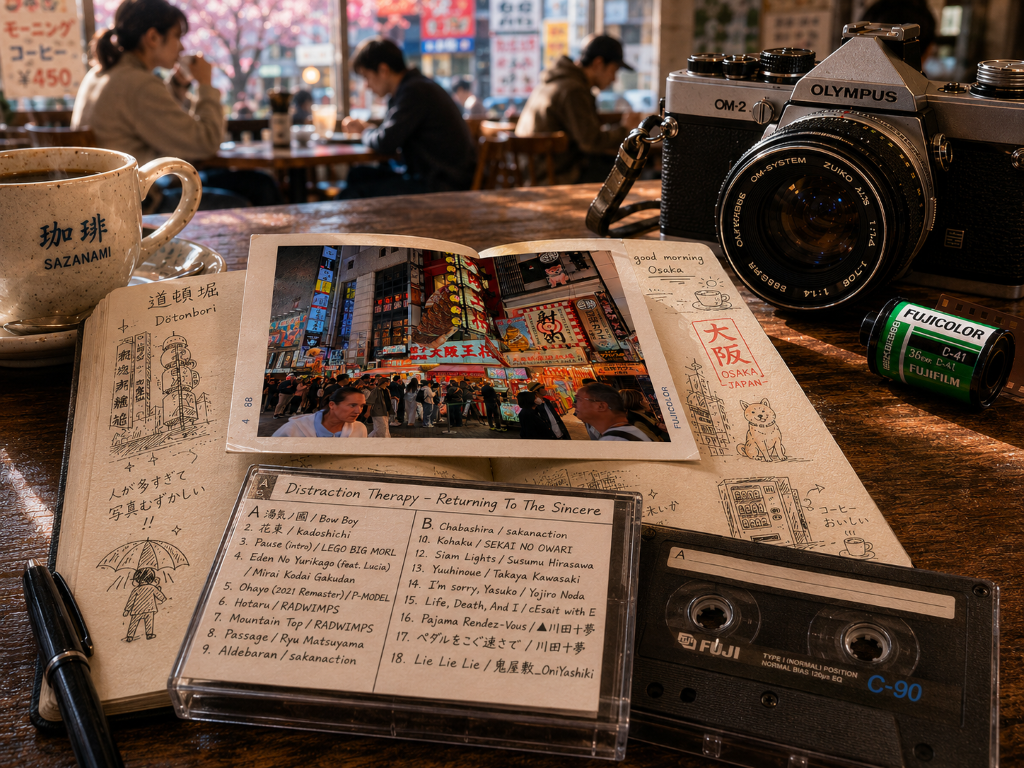
This edition of Distraction Therapy gathers music that seems to hover at the point where private feeling becomes audible, but before it has hardened into statement. The mix begins in vapour and flowers, moves through lullaby, morning, firefly, mountain, passage, star, tea, amber, artificial light, sunset, apology, life and death, augmented reality, motion and deception. This is not a random mood board. It has the shape of a journey through images of fragile light, suspended memory and uncertain renewal. The track-listing gives us a sequence that feels less like a playlist than a passage through altered states of attention.1
The phrase “structure of feeling” is useful here because the mix is not united by genre alone. Raymond Williams used the phrase to name a lived cultural atmosphere that has not yet fully settled into formal language. It is the felt pattern of a moment before it becomes doctrine, slogan or style. This mix has that quality. Its songs do not all say the same thing, and the artists do not come from one narrowly defined scene, but the tracks share a recognisable emotional grammar. They are concerned with the sincere after irony, tenderness after detachment, and lyric feeling after the long postmodern habit of quotation, fragmentation and defensive cleverness.2
This does not mean that the music is naïve. The return to sincerity heard here is not a simple recovery of unbroken belief. It is closer to the metamodern movement described by Timotheus Vermeulen and Robin van den Akker as an oscillation between modern enthusiasm and postmodern irony, between hope and melancholy, knowingness and vulnerability. Luke Turner’s later formulation of metamodernism as a movement between irony and sincerity is also relevant, not because the mix illustrates a theory, but because the songs seem to inhabit precisely that unstable threshold. They know that innocence cannot simply be restored, but they keep reaching for forms of feeling that irony alone cannot sustain.3
The opening movement establishes a soft threshold. Bow Boy’s “湯気ノ國” suggests vapour, warmth and partial disappearance. kadoshichi’s “花束” turns towards the bouquet as an image of offering, memory and ceremony. LEGO BIG MORL’s “Pause (intro)” does what its title promises: it interrupts ordinary momentum. The first section of the mix is therefore not an argument. It is a clearing. It asks the listener to step away from the declarative noise of the present and enter a field of images that are intimate, transient and lightly ritualised.
Mirai Kodai Gakudan’s “Eden No Yurikago”, featuring Lucia, deepens that opening into myth. The group describes its own work as “ancient music from a thousand years in the future”, crossing classical, folk, rock, pop, jazz, world music and electronic dance music. That self-description is revealing. It refuses the clean division between archaic and futuristic. Its sound-world is imagined as both ruin and prophecy, lullaby and digital artefact. In this mix, Eden is not treated as a fixed religious image, but as a cradle of longing: a place remembered, invented and mourned at once.4
P-MODEL’s “Ohayo (2021 Remaster)” then shifts the listener into synthetic morning. The track’s greeting is cheerful on the surface, but it is not innocent. Coming from the post-punk and new-wave world associated with Susumu Hirasawa, it carries the charge of mechanical wakefulness: the start of the day as system, signal and performance. This is one of the places where the mix distinguishes itself from sentimental nostalgia. It does not simply oppose machine culture to human feeling. Instead, it listens for feeling inside mediated, electronic and artificial forms.
The two RADWIMPS tracks give the mix one of its emotional centres. The band’s official biography notes its formation in 2001 and major-label debut in 2005, but what matters here is not career chronology so much as the group’s facility with direct emotional address. “Hotaru” places the listener near a small and mortal light. “Mountain Top” moves from this fragility towards ascent, endurance and the difficult labour of belief. Together they stage a movement from flicker to horizon. The firefly is not triumphant, and the mountain is not easily conquered, but both images resist collapse into cynicism.5
Ryu Matsuyama’s “Passage” gives this emotional ascent a quieter bridge. Matsuyama’s official profile describes Ryu as an Italy-born and Italy-raised vocalist and pianist who moved to Japan and began activity under the name Ryu Matsuyama in 2012; the current line-up centres on Ryu and drummer Jackson. This biographical context matters because “passage” can be heard not only as a musical transition, but as a condition of cultural and emotional crossing. The track sits in the mix like a corridor between inner and outer worlds.6
Sakanaction’s “Aldebaran” and “Chabashira” refine the mix’s language of signs. A star and a tea stalk are very different images, but both ask the listener to notice small indicators of orientation. Aldebaran belongs to the night sky, distant and astronomical. Chabashira belongs to the domestic table, intimate and accidental. One points upward; the other appears in a cup. Together they suggest a structure of feeling in which meaning is no longer guaranteed by grand systems, but can still appear through attention, pattern and omen. Sincerity here is not grand confession. It is the willingness to notice.
SEKAI NO OWARI’s “Kohaku” continues this movement into preservation. The official site lists the group’s members as Nakajin, Fukase, Saori and DJ LOVE, and the song appears as part of the group’s 2025 double A-side single “琥珀/図鑑”. Amber is an exact image for this mix: light solidified around what might otherwise disappear. It holds time, memory and loss without pretending that they can be restored unchanged. The track therefore becomes one of the clearest expressions of the mix’s return to the sincere: not a demand to believe everything again, but a refusal to let tenderness be dissolved by irony.7
Susumu Hirasawa’s “Siam Lights” then opens another register. Hirasawa’s official profile places him in a long continuum that includes P-MODEL and his later solo work. In the mix, his presence functions almost architecturally. “Siam Lights” is luminous, synthetic and ceremonial. It brings an otherworldly geography into the programme, but it does not use exoticism as decoration. Rather, the track intensifies the sense that electronic music can carry ritual feeling. It does not abandon artifice. It spiritualises it.8
Takaya Kawasaki’s “夕陽の上” and Yojiro Noda’s “I’m sorry, Yasuko” then bring the mix down from cosmic and synthetic light into the human weight of apology, regret and late-day reflection. Sunset and apology are both temporal forms. They arrive after the event. They cannot undo what has happened. Their sincerity lies in belatedness. This is important for the overall emotional structure of the mix, because the return to sincerity is not presented as youthful innocence. It is adult, wounded and retrospective. It is the sincerity that becomes possible after one has already failed, misunderstood, lost or withheld too much.
The closing movement is stranger and more contemporary. “Life, Death, And I” states the existential frame directly, though public information about the track remains limited and should be treated cautiously until verified from the source platform. 川田十夢’s “Pajama Rendez-Vous” and “ペダルをこぐ速さで” introduce a playful augmented everydayness. Kawada describes “Pajama Rendez-Vous” as emerging from the experience of spending several days in the city in pyjamas, which made ordinary urban life feel like augmented reality. This is a significant turn. The mix does not end by rejecting the artificial world. It finds odd sincerity in mediated life, in altered self-presentation, in the comic dignity of moving through the city in sleepwear.9
鬼屋敷_OniYashiki’s “Lie Lie Lie” gives the ending its unresolved edge. After flowers, stars, amber, sunset and apology, the final word is not truth but lie. That does not cancel the sincerity of the mix. It tests it. A return to sincerity after postmodern ironisation cannot be easy, because language itself has been made suspect. The final track leaves us with repetition, accusation and instability. It asks whether sincerity can survive in an environment where performance, evasion and mediated identity are now ordinary parts of cultural life.
This is why the mix works as Distraction Therapy. It does not use music as escape from feeling. It uses distraction as a sideways route back into feeling. The listener is moved through atmospheres rather than instructed through themes. Vapour, bouquet, lullaby, morning, firefly, mountain, passage, star, tea stalk, amber, light, sunset, apology, life, death, pyjamas, pedals and lies become a set of symbolic stations. Each one is modest on its own. Together they form an emotional map of the present.
The structure of feeling that unifies the mix is therefore a guarded sincerity. It is sincere, but not naïve. It is romantic, but not grandiose. It is technologically mediated, but not emotionally empty. It knows the lessons of postmodern irony, but it refuses to live there permanently. These artists and performers intimate a desire to mean again, to address one another again, to let small lights matter again. The mix does not claim that the world has become whole. It suggests that wholeness may still be approached through fragments, if the fragments are held with care.
Endnotes
1. The running order and track selection are taken from the uploaded “Distraction Therapy Mix Track List 001 2026-05-26”.
2. Raymond Williams’ concept of “structure of feeling” is summarised as a way of naming the lived quality of a period before it is fully articulated in formal ideology or ordinary explanatory language.
3. Vermeulen and van den Akker describe metamodernism as oscillating between modern enthusiasm and postmodern irony, while Turner’s Metamodernist Manifesto defines it as moving between and beyond irony and sincerity, naïvety and knowingness, optimism and doubt.
4. Mirai Kodai Orchestra describes its work as “ancient music from a thousand years in the future”, crossing multiple genres under an “Epic Pop” frame.
5. RADWIMPS’ official biography states that the band formed in 2001 and made its major-label debut in 2005.
6. Ryu Matsuyama’s official profile describes Ryu as an Italy-born and Italy-raised vocalist and pianist who moved to Japan and began activity under the name Ryu Matsuyama in 2012, with Jackson joining on drums in 2014.
7. SEKAI NO OWARI’s official site lists Nakajin, Fukase, Saori and DJ LOVE as members, and lists “琥珀/図鑑” among the group’s 2025 releases.
8. Susumu Hirasawa’s official site gives the broader artist context connecting his solo work and P-MODEL history.
9. Tom Kawada’s own description of “Pajama Rendez-Vous” links the song and video to spending several days in the city in pyjamas, making ordinary urban life feel like augmented reality.
Leave a Reply