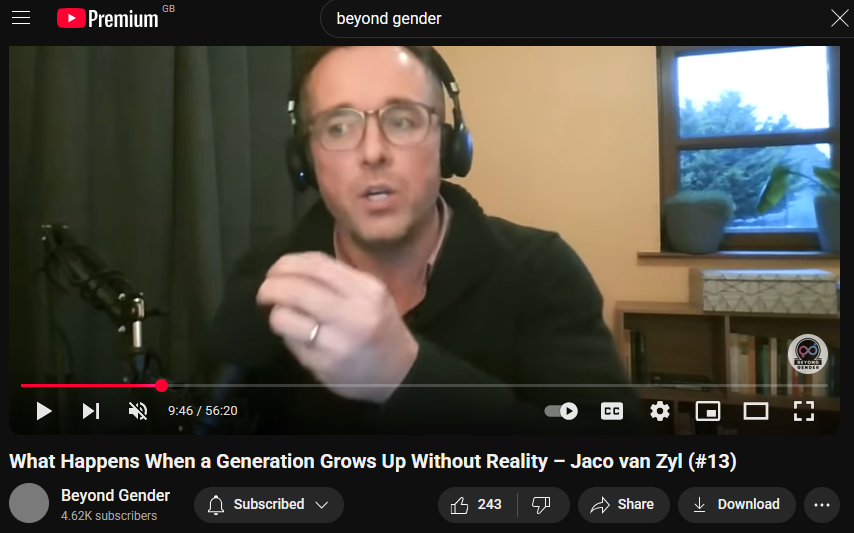
The conversation with Jaco van Zyl on the Beyond Gender podcast marks a significant shift in the cultural discourse surrounding trans-identification, moving away from surface-level affirmation or political contestation and into the realm of depth psychology. As a social observer attentive to the symbolic currents of popular culture, it is both welcome and overdue to see psychological frameworks—especially those grounded in the unconscious—brought into the discussion. Van Zyl’s contribution, however, remains firmly rooted in a Freudian tradition, one that foregrounds the Oedipal structure, castration anxiety, and the superego’s imposition of societal duty.
In Van Zyl’s framing, trans-identification is interpreted through the lens of developmental failure or distortion: the infantile fusion with the mother is not properly disrupted by the “cut” of the father, leading to a refusal of limitation, frustration, or symbolic loss. This results, in his view, in an “anti-Oedipal” cultural condition where gratification supersedes maturity, and identity is untethered from the stabilising influence of symbolic boundaries. He traces this condition through contemporary ideological movements—particularly queer theory and gender deconstruction—which he regards as symptoms of a broader cultural refusal to engage with reality-based limitations.
This analysis is provocative, but from a Jungian standpoint, it risks becoming reductive. Freud’s emphasis on power, prohibition, and repression offers valuable insights into the structuring of the psyche, but Jung cautioned against reducing the entire psychological landscape to oedipal conflicts or death drives. He saw these as important, but partial, aspects of a deeper and more dynamic psyche, one animated not just by lack and struggle, but by a striving toward wholeness and integration. In Jung’s terms, the psyche is a teleological system: it aims at individuation—the realisation of the self as a totality that integrates both conscious and unconscious elements.
From this Jungian perspective, trans-identification may be interpreted not merely as a failure to resolve oedipal dynamics, but as an expression of a much broader psychic process—a symbolic expression of the collective unconscious, emerging in new and, at times, disoriented forms. The phenomenon of trans-identity, particularly as it proliferates in symbolic, cultural, and mythic registers, can be seen as a modern enactment of the archetype of transformation, of shapeshifting, of transcending fixed categories. The problem may not be that society has rejected the paternal function, but that it has lost the capacity to symbolise it effectively. Likewise, the symbolic resonance of the anima and animus—the inner feminine and masculine—has been flattened by cultural scripts that deny their psychological complexity.
Rather than condemning this symbolic turbulence as regressive, a Jungian response would seek to listen more carefully to what is being expressed. What myths are being re-enacted through the rise in trans-identification? What neglected parts of the psyche are demanding recognition? What symbolic material has been forced underground and is now resurfacing in fragmented, politicised, or literalised form?
Where van Zyl sees a collapse of structure, a Jungian reading might see a cultural psyche undergoing a crisis of symbolic renewal. But this renewal cannot be achieved through political assertion or technocratic affirmation alone. It requires a deeper, more courageous engagement with the unconscious—personal and collective. We are witnessing a symbolic drama that is not merely about gender, but about the contemporary psyche’s attempt to reimagine what it means to be human in a time of profound disorientation.
In this light, the Beyond Gender podcast marks a step forward—not because it offers a complete account, but because it opens the door to a more psychologically honest conversation. If we are to understand trans-identification not only as a social or medical phenomenon, but as a symbolic enactment of psychic and cultural shifts, then we must widen the frame. Jungian thought offers precisely the tools to do so—inviting us to descend beneath the manifest content of identity into the archetypal forces at play, where meaning is made not by negating structure, but by integrating its opposites into a dynamic, living whole.
Leave a Reply