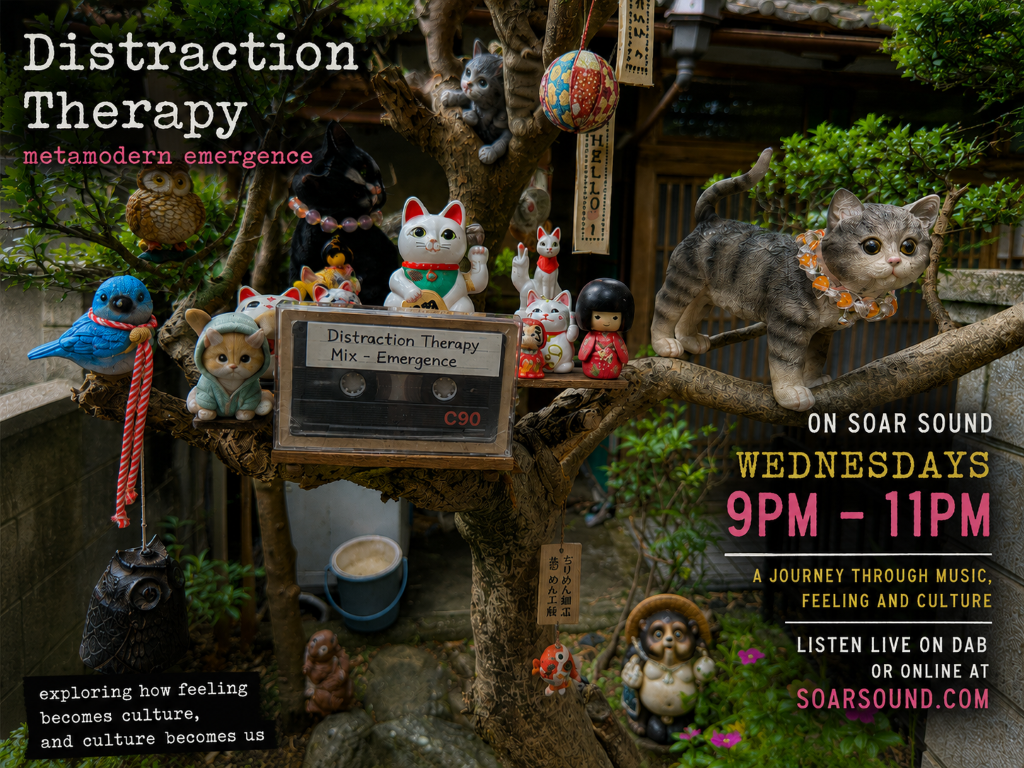
This edition of Distraction Therapy is arranged around the idea of cultural emergence. That phrase can sound abstract, but the experience itself is familiar. A feeling begins somewhere private, perhaps in a phrase, a rhythm, a memory, or a voice. Then it is rehearsed, performed, recorded, shared, broadcast, heard again, and carried into other lives. What began as an inward state becomes part of the world.
This is one of the quiet powers of music. It doesn’t simply express emotion. It gives emotion a form that can travel. A song can hold what might otherwise remain unspoken. A performance can make a private sensation public without reducing it to explanation. A mix can place different states of feeling alongside one another, allowing them to resonate, contradict, answer, and unsettle each other.
The sequence in this hour begins with movement. There is a sense of walking, of setting out, of entering the present moment without yet knowing what shape the journey will take. That opening feeling matters because culture does not emerge from nowhere. It begins in embodied life. It begins in the step, the breath, the repeated action, the attempt to stay attentive to what is happening now.
From there, the mix turns towards the work of emotional repair. Love, forgiveness, distance, and reconciliation are not treated as soft abstractions. They are presented as forces that have to be enacted. Feeling has to be carried into relation. It has to be tested by another person, by time, by place, by the limits of expression. In this sense, music becomes more than a container for emotion. It becomes a rehearsal for social life.
That is where performance becomes central. A performance is not just the delivery of a finished musical object. It is an event of relation. Someone sings, plays, produces, listens, remembers, responds, and carries the experience away. The meaning is not held only in the track itself. It is produced through the encounter between performer, medium, listener, and moment.
This is especially clear in contemporary music culture, where performance often moves through layers of mediation. We hear music through recordings, streams, radio broadcasts, headphones, phones, online concerts, files, memories, and fragments of visual identity. These channels are not neutral. They shape how feeling arrives. A live recording carries the trace of a room. A streamed performance carries the ache of distance. A mobile phone becomes a symbol of closeness and interruption. The technology does not simply transmit emotion. It becomes part of the emotional atmosphere.
The middle of the hour opens this out into a wider cultural field. The mix begins to suggest how scenes form. A scene is not only a sound. It is a pattern of association. It includes rehearsal rooms, venues, friendships, regions, record labels, fan practices, fashion, artwork, broadcast habits, local histories, and borrowed influences. No single element explains the whole. Culture appears through their interaction.
This is why the idea of emergence is useful. A song is not reducible to melody, rhythm, production, lyric, or voice. A musical culture is not reducible to genre, nation, market, or identity. The living force comes from relationship. It comes from the way separate elements begin to make sense together. The feeling that emerges is greater than any one part, but it does not erase those parts. It allows them to resonate.
The mix also moves between scales. It can feel intimate one moment and expansive the next. A small domestic image can carry the force of an omen. A phone can become an emotional landscape. A stage can become a memory. A single voice can point towards a generation. A playful closing question can return the whole sequence to the body, to school, to shared games, to the possibility that culture might begin again in something as simple as throwing and catching.
That movement between the ordinary and the symbolic is important. Cultural emergence does not always announce itself through grand gestures. It often appears through small acts of attention. A listener notices a phrase. A performer repeats a gesture. A group gathers around a shared sound. A memory attaches itself to a melody. Over time, these small acts form a world.
This is also why a mix matters differently from a playlist. A playlist can be a set of selections. A mix can become a passage. It can guide attention across a changing emotional field. It can allow sincerity and doubt to sit beside one another. It can move through melancholy without becoming resigned. It can reach towards uplift without pretending that everything is resolved. It can hold playfulness, tenderness, distance, and hope in the same listening space.
There is a metamodern quality in this movement. The hour does not settle into a single mood. It oscillates. It moves between intimacy and spectacle, the private and the collective, digital mediation and embodied presence, fragile hope and unresolved longing. It knows that feeling is unstable, but it does not dismiss feeling as naive. It allows sincerity to return, but with a more reflective awareness of how difficult sincerity can be.
In this sense, the mix is not trying to give information about a music scene from the outside. It is trying to inhabit a structure of feeling from within. It listens for how affect is formed, carried, and transformed. It asks how music can make an emotional world available without needing to explain that world fully.
For the podcast listener, this means the hour can be approached as a journey through states rather than as a set of separate tracks. The first state is movement. Then comes presence. Then repair. Then mediated performance. Then the strange intimacy of technology. Then the everyday work of bands and scenes. Then signs, images, spectacle, endings, creatures, and play.
What holds these movements together is the idea that creative expression is not only self-expression. It is world-making. A feeling becomes cultural when it finds a form that others can enter. Performance is one of the ways this happens. It gives feeling a body. It places emotion into time. It allows others to gather around something that cannot be fully paraphrased.
Perhaps this is why music remains so necessary. It allows us to share feeling without making it too simple. It lets us recognise states of mind that may not yet have settled into language. It carries fragments of place, history, technology, memory, and desire into a form that can be heard.
This edition of Distraction Therapy is therefore a mix about emergence, but also an example of it. Its meaning does not sit in one track, one artist, one scene, or one explanation. It forms through the passage. It appears in the movement between sounds. It is carried by performance into the world, and then carried further by the listener.
Broadcast: 17th June 2026
Track Listing
This mix explores cultural emergence: the process by which private feeling becomes shared experience through performance, recording, memory, and listening. Moving between intimacy and spectacle, technology and embodiment, melancholy and hope, the sequence traces how music carries emotion into the world and transforms it into something collective.
- Ryu Matsuyama – Footsteps
- Naotaro Moriyama – Ima ga Jinsei: Hishouhen
(今が人生 ~飛翔編~) - HY – Aishiatte Yurushiatte
(愛し合って許し合って) - Official Hige Dandism – Vintage (Online Live 2020: Arena Travelers) [Live]
- RADWIMPS – Keitaidenwa (Cat Version)
(携帯電話) - LEGO BIG MORL – a day in the live
- Asian Kung-Fu Generation – Love Song of New Century
(Shinseiki no Love Song / 新世紀のラブソング) - sakanaction – Chabashira
(茶柱) - SEKAI NO OWARI – Stargazer / Starlight Parade
(from Du Gara Di Du) - SHE’S – Happy Ending
- Spitz – Shirokuma
(シロクマ) - 川田十夢 (Tomu Kawada) – キャッチボールを必修科目にしてみませんか?
(Would You Consider Making Catchball a Compulsory Subject?)
Endnotes
[1] Christopher Small’s concept of “musicking” is useful here because it treats music as a relational activity involving performers, listeners, spaces, and social meanings, rather than only as a finished object.
[2] Raymond Williams’s idea of a “structure of feeling” is relevant to this mix because it helps describe forms of cultural emotion that are lived and sensed before they are fully named or formalised.
[3] The metamodern frame is used here to describe an oscillation between sincerity and doubt, melancholy and hope, private feeling and collective meaning.
Leave a Reply